1. What is fiber optic ferrule end checking and why is it important?
Measuring the integrity of fiber optic network installations is paramount to enabling the rapid transfer of communications data used by numerous industrial sectors, such as industrial automation, data centers, smart buildings, and many others. Fiber optic data communications demand that networks operate with minimal downtime and maximum efficiency. However, the increasing diversity of fiber optic applications has underscored the need for adaptable and user-friendly testing solutions.
Among the most important checks that system installers and integrators can perform is the ferrule end check, which involves verifying the cross-section of a fiber optic network connected to another fiber optic component. The design of fiber optic connectors and adapter ports varies depending on the application.
2. What instruments are available for testing the end of a fiber optic ferrule, and what are their functions?
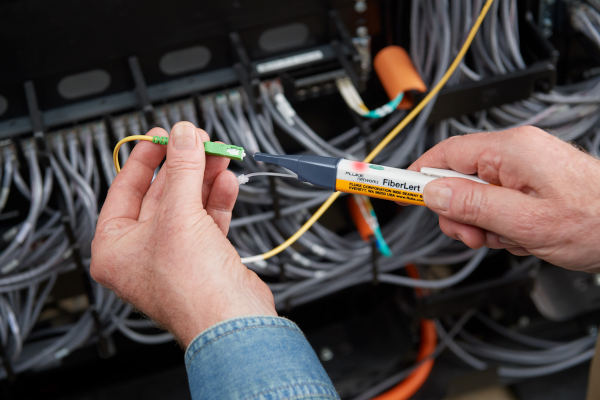
Technicians can find it difficult to work with fiber optics, especially with fibers that don't transmit well or not at all—also known as dark fibers. The Fluke Networks FiberLERT is the world's first active fiber detector that allows for basic fiber optic testing to easily identify polarity problems and faulty transceivers. This award-winning, pocket-sized instrument detects the invisible wavelengths in the near-infrared range (850nm–1625nm) commonly used in fiber optic communications.
 The FiberLERT is an ideal solution for common, yet traditionally challenging, troubleshooting applications that require rapid identification of problems in cables and ports. This device aims to save users time and protect their eyes from damage. It achieves this by preventing the invisible light generated when fiber optic transceivers convert an electrical signal into an optical signal from being accidentally directed toward the human eye. Essentially, the device eliminates the uncertainty involved in checking whether a signal is present or not.
Designed for ease of use, the FiberLERT generates an optional audible alarm and illuminates an LED when placed in front of a port or cable with an active optical fiber. The FiberLERT's LightBeat feature causes the LED to flash to indicate that the instrument is powered on and has sufficient battery power. Simply put, the instrument emits a sound or illuminates when it detects an active link.
The biggest obstacle to fiber optic maintenance is dirt and impurities; even the smallest speck of dust can cause errors or the complete failure of a fiber optic connection. Another essential tool for engineers is inspection and cleaning equipment.
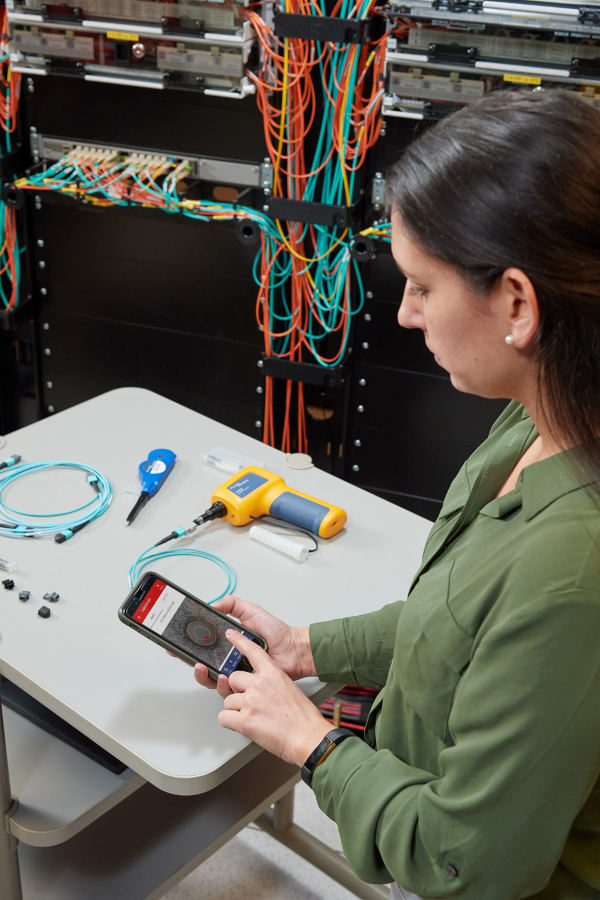
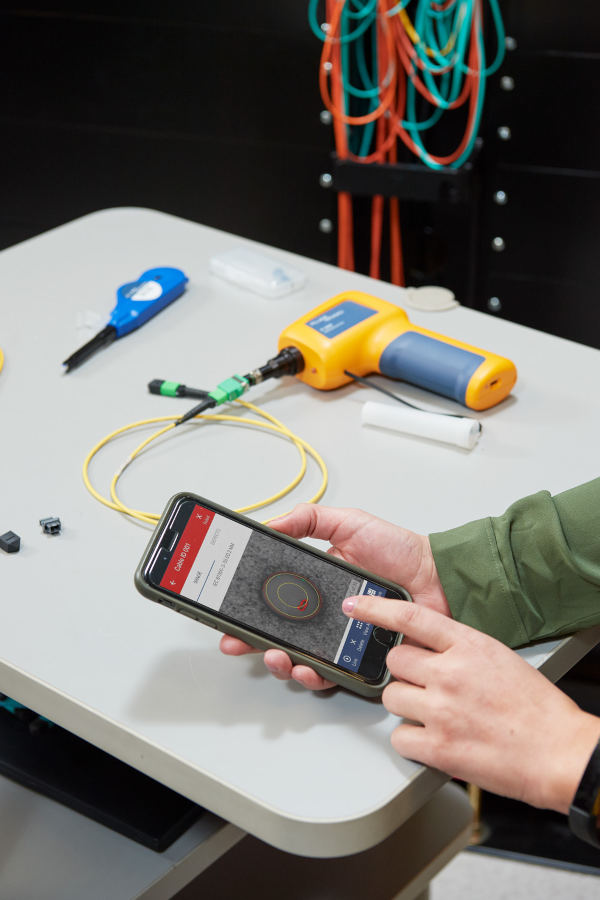
The Fluke Networks FiberInspector Ultra FI-3000 camera is designed for the simple and efficient testing of trunks, cassettes, and multi-fiber cables using MPO connectors. The multi-camera design provides users with real-time viewing and the ability to switch between trunk testing and ferrule end-to-end inspection via the touchscreen. Within seconds of pressing a button, users will see the pass/fail result, indicating compliance with the IEC 61300-3-35 standard. In addition, the autofocus feature speeds up the cable and port testing process. All test results can be saved to a mobile phone and shared with other team members via email. Comprehensive project reports can be stored using Fluke Networks' LinkWare™ software.
The robust FiberInspector Ultra FI-3000 camera is compact and easy to use. Key features include seamless integration with the Versiv™ cabling certification system and support for individual UPC or APC connectors, as well as single or double rows of 8, 12, or 16 connectors. For MPO connectors, up to 32 fibers can be installed in a single cable, and the FI-3000 allows the user to inspect them all simultaneously.
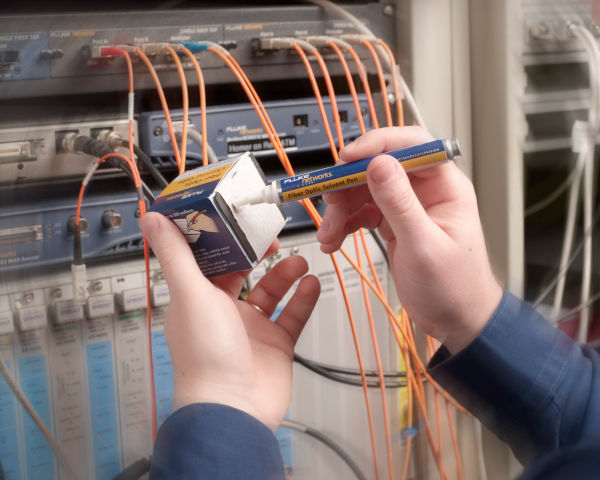
To support these products, Fluke Networks offers a range of lint-free fiber optic cleaning kits that remove contaminants from any fiber optic cable network. Available options include quick dry cleaning solutions, a cleaning stick/card, and a solvent-based pen for wet cleaning connectors and ferrule ends inside ports. The solvents are more effective than the traditional isopropyl alcohol method used to dissolve contaminants commonly found on fiber optic cables.
3. What is the fastest way for network technicians to locate faults and check for continuity or polarity issues when troubleshooting fiber optic cables?
Speed is paramount when trying to locate a problem in a network. This process can be difficult and time-consuming when working with a complex fiber network. Whether technicians are installing new fiber optic links or troubleshooting an existing network, a very useful tool is a cable continuity tester.
The rugged, laser-based Fluke Networks VisiFault Visual Fault Locator enables users to pinpoint cable breaks and damaged connectors, faulty connectors, and excessive bends in optical fibers, both inside and near equipment racks. A continuous or flashing visible light allows for rapid identification of activity and faults. The battery-powered VFL supports small-size 2.5mm and 1.25mm connectors, speeds up the end-to-end fiber optic testing process, and can be used in the field for up to 80 hours.
 The definitive system for troubleshooting fiber optic systems involves using an optical time-domain reflectometer (OTDR). These portable optoelectronic instruments can thoroughly test an entire fiber optic link to determine its condition and performance level. OTDRs are unique in that they test components installed along the cable, such as connection points, bends, and splices, to assess the cable's capacity from end to end. Essentially, the device sends a pulse of light toward one end of the cable and receives a reflected signal at the same port on the OTDR. Some of the light transmitted through the cable will be scattered, while some will be reflected back to the OTDR, indicating losses and distances to connectors or faults. This is measured by recording the time it takes for the signal to return.
Using some OTDRs can be complicated, but Fluke Networks has introduced the OptiFiber Pro family of OTDRs intended for both novice and expert users, and specifically designed for network engineers and installers working in enterprise and outdoor environments.
Thanks to its multiple wavelengths (850nm, 1300nm, 1310nm, 1490nm, 1550nm, and 1625nm), the OptiFiber Pro is ideal for LAN, data center, PON, and FTTx applications. Featuring an automatic configuration function to instantly detect fiber optic characteristics and adjust measurement parameters, the instrument also offers an "Expert Manual" mode that allows users to make simple adjustments to the automatic configuration for more detailed testing. A built-in location system automatically identifies problems in fiber optic cabling, whether they are connectors, splices, bends, or splitters. The OptiFiber Pro is easy to use thanks to its gesture-based interface and SmartLoop OTDR technology, which can test two fibers simultaneously, eliminating the need for the user to travel to the other end of the connection to perform tests. The OptiFiber Pro is fully integrated with the LinkWare™ Live cloud service.
4. What trends will drive change in network testing over the next 2-5 years?
The number of fiber optic networks installed worldwide is growing rapidly, and with it, the need for specialized testing personnel. However, the development of powerful yet easy-to-use network testing equipment will provide the solution, not only to meet the requirements but also to ensure fast and efficient testing of this critical infrastructure. Automation and full integration not only streamline the fiber optic testing process but also ensure that the stored data is accurate and shared in real time. This is essential in markets that rely on fiber optics.
At Fluke Networks, we have developed fiber optic testing solutions that provide significant cost savings for customers compared to other products on the market. They also save time by enabling fault detection without requiring users to resort to complex configurations or sophisticated methods for interpreting the collected measurement data. Any technician or engineer working with fiber optic cabling infrastructure now has access to powerful and versatile instruments that provide unprecedented levels of confidence in reliability and accuracy.
Thanks to point-and-click inspection equipment, engineers no longer have to perform outdated, time-consuming manual checks or rely on unscientific guesswork. The ability to accurately, quickly, and cost-effectively identify and locate problems with minimal contamination or damage represents a revolutionary shift in the world of fiber optic network testing.
 5. What is the Spanish market like for Fluke Networks fiber optic testing products? Has it been affected by the pandemic?
Fluke Networks is a leader in developing certification, troubleshooting, and installation tools for the network cabling industry, and our performance in the Spanish market remains excellent. We support our customers through a local sales team and dedicated technical staff, including application engineers and support personnel, along with a robust distribution network. We focus on innovation and collaborate closely with our customers to create new, robust, and user-friendly testing solutions that meet market demand.
Like many other sectors, the fiber optic testing market felt the effects of the pandemic, but our support teams worldwide are working together to mitigate these impacts. Our customers in Spain will continue to benefit from our dedication and innovation, our increased local presence, and our strong distribution network to ensure product supply.
Article provided by Fluke Networks