The active Mach-Zehnder interferometer, commonly called SOA-MZI (SOA-based Mach-Zehnder interferometer), is a highly versatile device in the field of optical signal processing. Among its many applications are optical switching, wavelength conversion, digital logic functions, optical signal regeneration, and more. It is an integrated optical device whose operation is based on a wave interference phenomenon controlled by a series of control signals. In this article, we will explain its basic operation and provide some examples of commercially available applications.
Basic Structure and Operation of an SOA-MZI
The most general structure of an SOA-MZI is shown in Figure 1. As can be seen, it has eight optical input/output ports. These ports are connected to each other by means of a series of 1x2 and 2x2 optical waveguides and couplers, the latter being responsible for the interferometric behavior. In turn, the two main branches include two semiconductor optical amplifiers (SOAs) that operate in nonlinear mode. Several fabrication methods exist today, 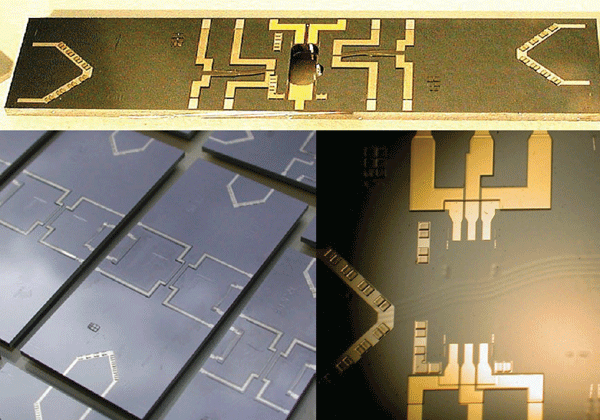 including monolithic fabrication and hybrid integration. In the first case, they are usually fabricated on indium phosphide (InP) using a metal-organic chemical vapor deposition (MOCVD) process that grows the active and passive regions of the device. In the second case, a planar optical circuit is built on silica with the optical waveguides, and the SOAs are then inserted (Figure 2). In this latter case, the alignment and coupling of light between the SOAs and the waveguides is crucial.
Having explained its structure, we will now discuss the basic operating principles of the SOA-MZI. Let's assume an optical data signal is applied to input port #2. In the absence of other signals, the signal will split in the 2x2 input coupler, travel through the two main branches of the interferometer (passing through the SOAs), and recombine in the 2x2 output coupler, exiting through port #7. This behavior is explained by the fact that both 2x2 couplers introduce a 90° phase shift to the optical signal in a 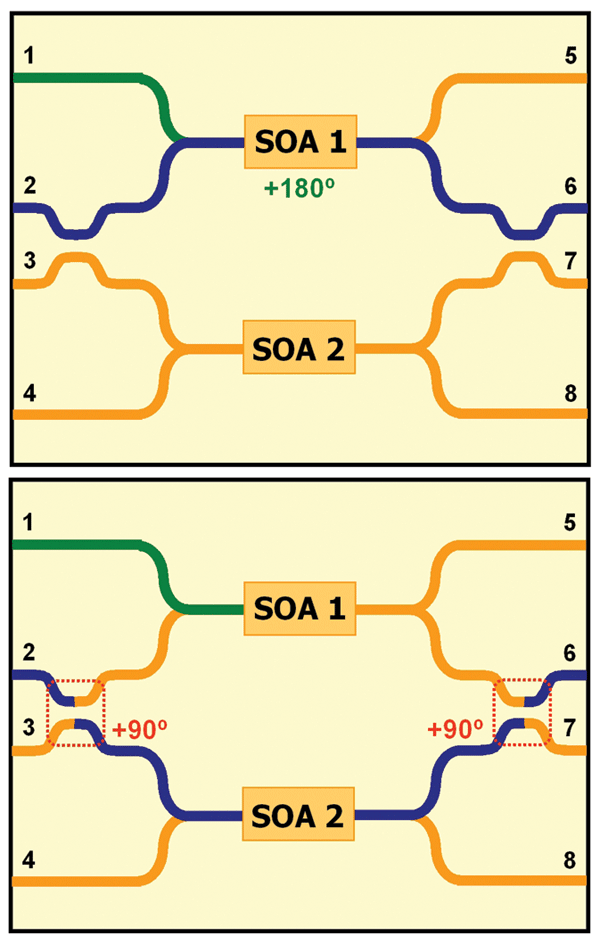 cross configuration, while they do not introduce any phase shift in the bar configuration. Therefore, the phase shifts experienced by the optical output signals through ports #6 and #7 are schematically represented in Figures 3 and 4, respectively. That is, in the absence of other signals, the input signal is canceled at port #6 (0° and 180°), while it is added in phase at port #7 (90° and 90°).
Now suppose a control signal is introduced through port #1. If the optical power is sufficient to induce a 180° phase shift on the signal passing through SOA1 thanks to the nonlinear process of cross-phase modulation (XPM), then a reversal in the behavior of the SOA-MZI will occur. Now, the signal will be canceled at port #7 (180° and 180°), while it will be added in phase at port #6 (270° and 90°). In this way, operation as a pulse-controlled optical switch is obtained (Figure 1). This is therefore the basic principle from which a large number of additional functions can be performed, simply by changing the type of signals and the input and output ports.
Commercial applications
As mentioned earlier, in recent years a number of component manufacturers have emerged offering SOA-MZI-based optical devices in their catalogs.
'
Among them, we can highlight wavelength converters with 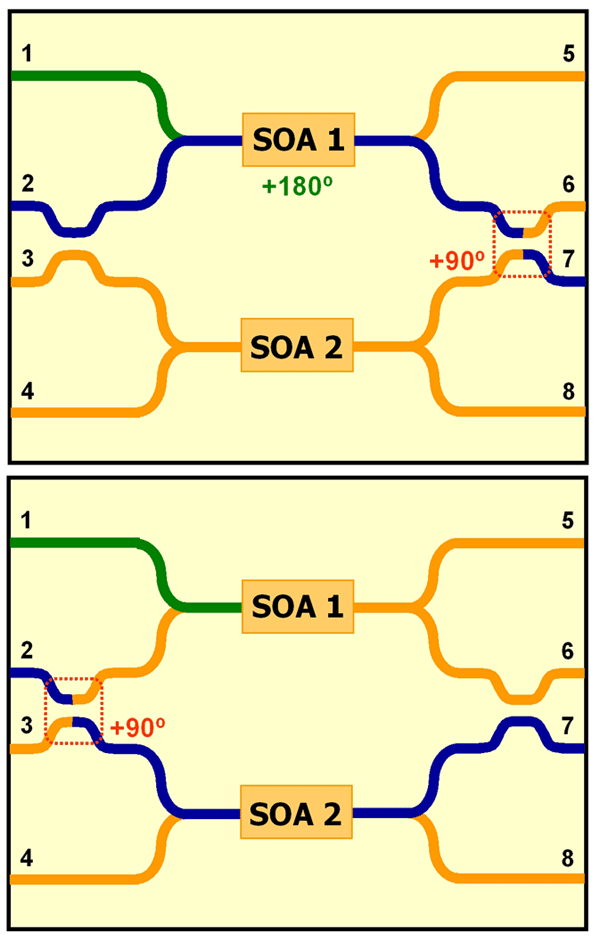 optical signal regeneration capabilities. For example, Figure 5 shows a photograph of the 2R wavelength converter and regenerator from CIP (The Centre for Integrated Photonics). This device allows working with 40 Gbit/s signals and covers the wavelength range of 1530 to 1565 nm. Among its features, it is worth noting that it requires low switching energies. (
As can be seen in Figures 5 and 6, the devices from all manufacturers incorporate both optical and electrical ports. The electrical ports are used to supply the bias currents of the SOAs, as well as to control their temperature, since a thermistor and a thermoelectric (Peltier) cooler are included inside the package.)
Other Applications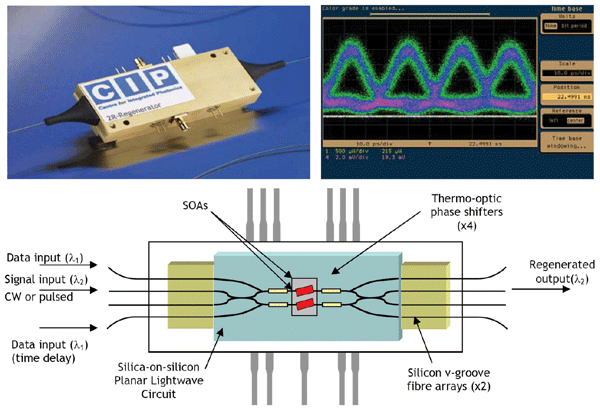 While they haven't yet fully entered the commercial market, other applications of SOA-MZIs are under investigation, especially in the field of optical computing. Specifically, it has been demonstrated experimentally that these devices can be used to implement logic gate and flip-flop functionalities. These functions are well-known in digital electronics, but not as widespread in photonics. This is mainly because, to date, photonics still lacks an equivalent of the electronic transistor.
'
Therefore, constructing optical logic gates requires employing other 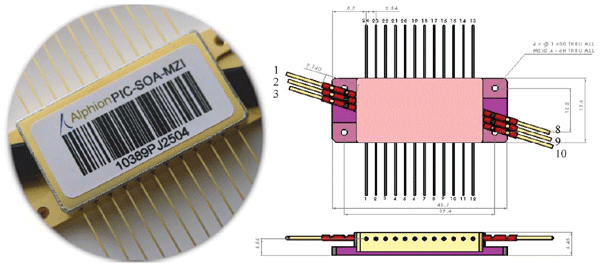 techniques, including the use of SOA-MZI. By feeding the SOA-MZI's optical ports with the appropriate data signals, a whole series of basic logic functions can be achieved: OR, AND, XOR, and NOT.
The applications of logic gates are countless, but one stands out in particular. The XOR logic gate can be used to perform comparisons between data words. This is crucial in the field of optical packet networks. At the nodes of an optical network, packet headers must be analyzed to route them to the corresponding output port. The optical XOR logic gate can be used to compare these headers with reference addresses directly in the optical domain, that is, without needing to convert the packets to the electrical domain. This offers several advantages, but the main one is a reduction in packet routing time, which will allow for an increase in the capacity that these nodes can handle, up to values of even Tbit/s. Unfortunately, we will still have to wait a few years for that, although as a first step, some reference to the SOA-MZI's ability to perform "optical logic" can already be found in manufacturers' catalogs.
Francisco Ramos Pascual. PhD in Telecommunications Engineering.
Full Professor at the Polytechnic University of Valencia.