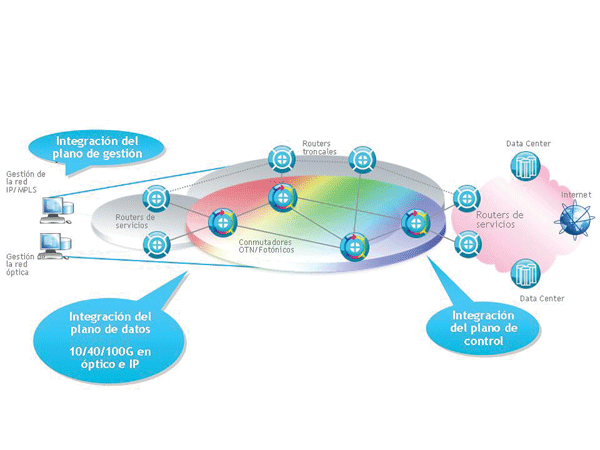
Alcatel-Lucent has introduced an innovative IP/Optical converged backbone solution designed to alleviate the strain on carrier backbone networks caused by the explosive growth of video services and other bandwidth-intensive applications. The Converged Backbone Transformation solution is a key component of Alcatel-Lucent's High Leverage Network™ strategy. Several key elements of this strategy have already been selected by leading service providers.
Internet video traffic is experiencing significant growth. Simultaneously, there is also increasing demand for dynamic IP-based services, such as enterprise data applications, telemedicine, video surveillance, enterprise collaboration applications (including telepresence), networked computing systems, backup and remote storage solutions, and data center security systems, among others. All of these services have very high Quality of Service (QoS) requirements. Backbone networks must be able to adequately handle both types of traffic, and this is increasing the pressure on backbone routers, through which almost all traffic passes. Continuously adding more capacity to backbone routers is an expensive solution, and as a result, backbone equipment is becoming a significant cost center with a low return on investment.
“Traffic continues to grow significantly on the backbone, and we don’t see this changing. We need to ensure that our capacity meets our customers’ needs and their growth expectations,” commented Pieter Poll, Chief Technology Officer at Qwest. “We have been examining new strategies to respond to the increase in traffic and the demand from our customers, and we recently announced that Qwest is working with Alcatel-Lucent to evolve our national backbone network, achieving industry-leading speeds of 100 Gigabits per second with the deployment of Alcatel-Lucent’s 7750 Service Routers and LambdaXtreme solutions.”
Reduction in Network Elements and Energy Efficiency:
Alcatel-Lucent's new Converged Backbone Transformation solution features greater integration of optical and IP transport resources, enabling service providers to optimize and strengthen their transport networks to handle rapidly increasing traffic while significantly reducing operating and maintenance costs. Alcatel-Lucent's new strategy can reduce the number of network elements required, improve energy efficiency and rack space utilization, simplify network provisioning and fault management, minimize latency, and enhance reliability. This will provide operators with greater robustness and efficiency and reduced complexity, resulting in capital expenditure (CapEx) savings of at least 30%, in addition to savings in energy consumption, floor space footprint, and operational complexity.
“Internet traffic—voice, data, and especially video—continues to grow, forcing service providers to find new ways to cut the cost of reliably transporting traffic while simultaneously offering new services,” explained Michael Howard, an analyst at Infonetics Research. “In a recent Infonetics survey, two-thirds of operators said they expected to combine their data and transport operations by 2010. Alcatel-Lucent’s strategy aligns with service providers’ goals of efficiently increasing capacity for many types of traffic in a converged optical and IP architecture and offloading traffic from backbone routers to help streamline their backbone networks.”
“The traditional solution of adding more capacity to backbone routers to keep pace with the growth of Internet traffic is simply unsustainable for our customers,” said Basil Alwan, Head of Product Strategy for Operators and President of Alcatel-Lucent’s IP division. “In analyzing the opportunities presented by this backbone transformation, we have found ourselves in a unique and enviable position. With our strong market presence and technological leadership in both IP routing and optical transport, Alcatel-Lucent is ideally positioned to help our customers overcome this challenge with a unique and highly effective solution.”
Alcatel-Lucent is introducing the integration of an intelligent control plane between the optical and IP layers, enabling rapid service provisioning and increased network robustness. Furthermore, optical and IP systems are evolving to support speeds of 40 Gigabits and 100 Gigabits in the data plane, thereby increasing network capacity. Alcatel-Lucent also offers integrated network management systems that will provide Network Operations Centers with end-to-end network visibility across both IP and optical domains.
The Converged Backbone Transformation solution offers a range of traffic consolidation options that increase the efficiency of the transport network and allow traffic to be redirected to the most cost-effective layer of the network. This includes IP traffic consolidation at the lambda (or wavelength) level, port level, and subport level to facilitate capacity increases where and when needed and to offload traffic from backbone routers in the optical transport network.
Next-generation, scalable, all-IP converged multi-service infrastructure.
The Converged Backbone Transformation solution is a key element of Alcatel-Lucent's High-Performance Network, a comprehensive, scalable, all-IP converged multi-service infrastructure that enables operators to process traffic more reliably, efficiently, and cost-effectively, while leveraging the network to generate new revenue streams from sophisticated applications and managed services solutions.
To help its customers get the most out of this strategy, Alcatel-Lucent offers a full range of professional services that support a multi-vendor environment: business case analysis, network design and implementation, and managed services.
Alcatel-Lucent is a global leader in optical transport and IP routing, with a leading position in optical systems since 2001 and a strong second position in IP routers.