PON Architecture: The PON (Passive Optical Network) physical layer
is the network architecture used for deploying FTTH (Fiber To The Home) services. As previously mentioned, it consists of passive elements: the fiber optic cable itself, multiplexers, connectors, network terminals, etc.
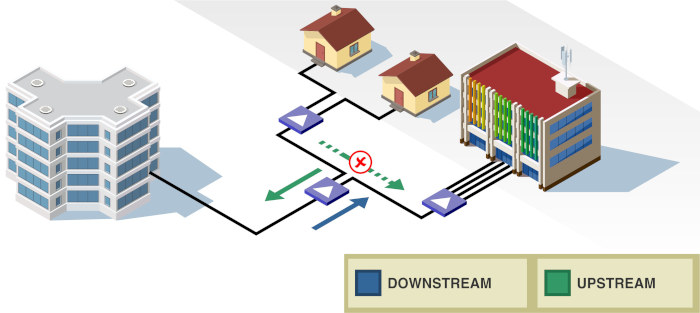
From the local central office, a backbone network of optical fibers branches out, dividing as it passes through different multiplexers, thus creating multiple branches that communicate bidirectionally with the backbone network but not with each other.
● The downstream bandwidth from the local central office is divided among all users and is a signal with constant power.
● The upstream bandwidth, from the users to the central office, is transmitted in burst mode: Time windows set for each user. This is known as TDM (Time Division Multiplexing).
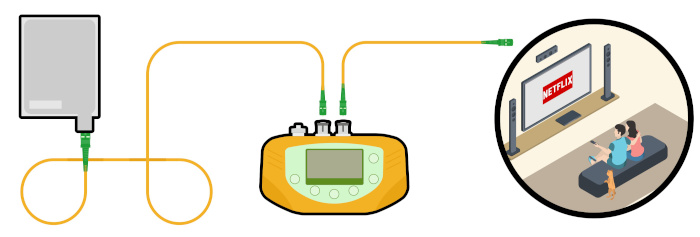
The PROLITE-67 optical analyzers indicate whether the signal is being transmitted in bursts. This confirms that the upstream channel is operating in TDM mode.
PON Network Transmission Standards:
Each transmission standard uses its own wavelength range. As these standards evolve, backward compatibility with previous standards is maintained by using unused areas in the light spectrum. This means using wavelengths not currently in use by previous standards.
We will focus on the three main standards, ordered from oldest to newest:
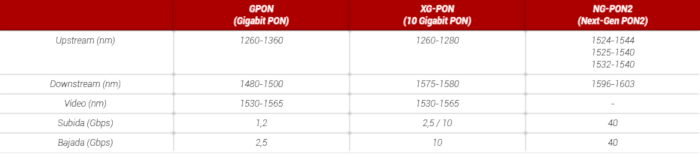
Main fiber optic transmission standards. These have been used and are still being researched in other standards. This table serves as an example of their evolution and the bandwidths achieved.
The XG-PON standard is also known as 10G-EPON.
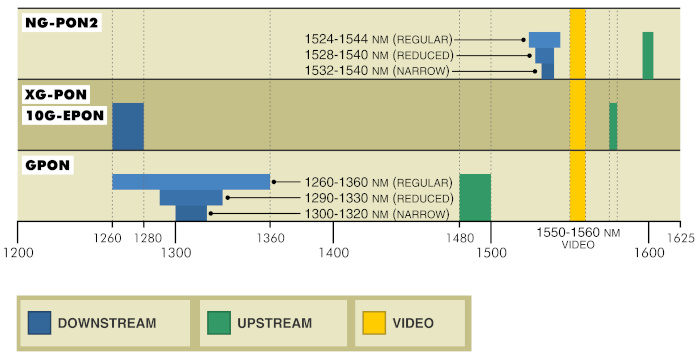
Did you notice? The downstream channels of the GPON and XG-PON standards share a certain wavelength range (between 1260 and 1280 nm). This is because, although GPON reserved that band, it never actually used it, and therefore XG-GPON was able to benefit from that small unused portion of the band.
Analyzers for XG-GPON / 10G-EPON Networks:
The PROLITE-67 optical power meters are compatible with both GPON and XG-GPON networks. This is because the integrated wavelength filter for the PON video band (1550-1560 nm) extends up to 1625 nm. This means that, in addition to PON video, this filter also covers the XG-GPON downstream.
How is the proper functioning of networks certified?
Proper functioning is verified using optical analyzers and optical certifiers. The difference between the two is that a certifier is calibrated to guarantee that the system meets the parameters required by legislation when used with a laser light source and the standardized ICT test is performed.
The PROLITE-67 optical power meter and optical certifier includes additional advantages that not all equipment on the market has.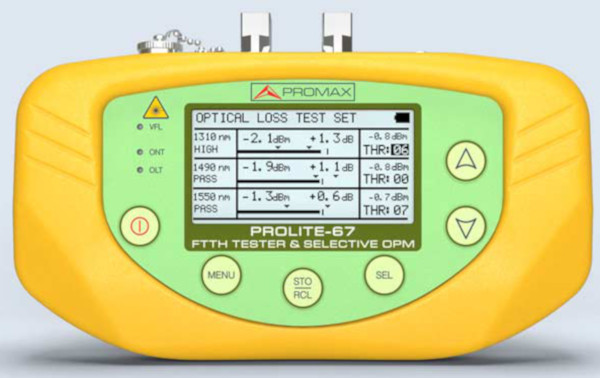
● Allows connection in loop-through mode to analyze the service without interrupting traffic, in exchange for minimal loss.
● It allows you to identify if the upstream signal is being emitted in bursts when operating in loop-through mode.
● The selective attenuation test (ICT test) is filtered across three bands, and each band can be calibrated independently for each wavelength.
● It includes a visual fault locator to find breaks in the optical fibers under test.