Representing Vertiv at the lunch were José Alfonso Gil, Sales Director for Southern Europe, Miguel del Moral, Indirect Sales Director for Spain, Portugal and France, Sergio Ferrer, Channel Development Manager, and Raquel Rubio, Marketing Manager for Spain and Portugal.
A Common Challenge: Energy Consumption.
A Goldman Sachs study forecasts a significant increase in data center energy consumption, estimated at 3-4% globally by 2030. To mitigate this impact, driven by the democratization of artificial intelligence, organizations are prioritizing efficient and alternative energy solutions, such as microgrids and fuel cells.
The adoption of battery energy storage systems (BESS) is also increasing as an alternative measure, as it provides energy backup and reduces dependence on the electrical grid. Furthermore, small modular reactors are also emerging as a promising energy solution. In this context, José Alfonso emphasized the importance of aligning energy solutions with availability and sustainability goals, exploring technologies such as BESS, microgrids, and alternative energy sources that improve resilience and minimize environmental impact.
On the other hand, Miguel del Moral added that “The energy consumption of data centers is generating a lot of discussion when compared to total energy consumption, but the data center industry remains the backbone of our country's economy. In fact, the energy consumption ratio in Spain is currently 1.2%, while in Ireland, for example, it is 20%. It is very likely that in the coming years, we will triple consumption.”
An important aspect to highlight is that industry members are joining forces. The development and adoption of shared tools are improving efficiency in the manufacturing and deployment of these new technologies. This collaborative innovation will transform data center capabilities, enabling greater flexibility and responsiveness to the rapid adoption of AI, thus ensuring a sustainable future for high-performance computing.
Another common front: cyber threats.
However, the rise of AI also brings new cybersecurity challenges. AI-driven attacks are increasing cyber risks, employing increasingly sophisticated methods to target control systems and connected infrastructure. This is why advanced AI technologies are becoming increasingly necessary to protect critical systems, identify potential threats, and proactively respond to attacks. Now more than ever, it is essential to implement a cybersecurity strategy that combines AI-based tools with best practices to prevent attacks and strengthen digital defenses.
As AI continues to transform the technological landscape, governments around the world are rushing to develop regulations that address privacy, data protection, and resource consumption. In an effort to control and regulate the development and deployment of AI, several countries are launching sovereign AI initiatives, such as Denmark's AI supercomputer. While initial regulations focused primarily on resource consumption, the focus is now shifting to the AI applications themselves. However, the application of these regulations remains regional, with different levels of rigor, which poses challenges for companies operating globally.
Latest Releases
In March, the company announced Vertiv™ Unify, a unified control platform designed to simplify, standardize, and accelerate data center operations by integrating visibility, management, and analytics for critical power and cooling infrastructure, while providing greater scalability and flexibility. As the only leading provider of a complete suite of power and cooling equipment, Vertiv offers seamless integration and coordination between systems through Vertiv Unify.
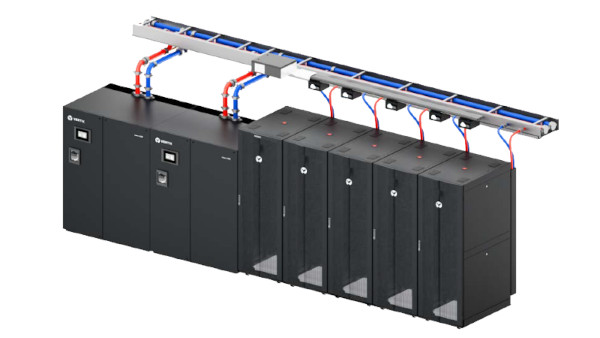
In addition, Vertiv recently announced a significant upgrade to its cooling product portfolio with the introduction of the new generation of Vertiv™ Liebert® EFC evaporative cooling units, which use low-GWP (Global Warming Potential) refrigerant. Designed to meet the stringent environmental standards of data centers, including cloud and colocation services, the solution is now available in the Europe, Middle East, and Africa (EMEA) region, with capacities ranging from 150 to 450 kW. The Vertiv Liebert EFC combines the capabilities of indirect air-to-air heat exchange and evaporative cooling in a single unit.

On the other hand, the expansion of the Vertiv™ Liebert® AFC chiller family includes high-capacity screw-compressor chillers that also use low-GWP refrigerant. Available in Europe, the Middle East, and Africa (EMEA), the new models provide cooling capacity of up to 2.2 MW in a single frame, resulting in lower carbon emissions, requiring fewer units to achieve the necessary capacity, and reducing installation and maintenance costs and timelines for data center operators.

Finally, Vertiv™ PowerDirect Rack is a high-density 50V DC power supply system in a 1U tray format designed to provide resilience even in the most demanding AI and HPC (high-performance computing) environments. The modular design can scale up to 132kW per rack by integrating multiple power trays, allowing for system expansion while minimizing space requirements. Available globally, Vertiv PowerDirect Rack offers a complete power infrastructure solution, capable of delivering twice the power in the same footprint compared to alternative solutions. Vertiv PowerDirect Rack is designed to help data centers maximize energy efficiency and facilitate scalability.
Vertiv
recently announced its partnership with Tecogen Inc. This alliance will enable Vertiv to offer Tecogen's advanced natural gas-powered chiller technology to data centers worldwide to address power constraints and facilitate the deployment of AI at scale. Tecogen's solution will expand Vertiv's cooling product portfolio, a leader in the data center infrastructure industry, and reinforces both companies' commitment to providing affordable and resilient infrastructure solutions that leverage alternative energy sources.