In 2022, Nvidia announced its new plan to reduce energy consumption in data centers, process massive amounts of data, or train AI models: liquid-cooled graphics cards. The company unveiled its new liquid-cooled version of its A100 compute card at Computex, reporting that it consumes 30% less power than the air-cooled version. Earlier this year (2023), Nvidia received $5 million from the U.S. Department of Energy to research innovative cooling approaches.
With the increasing thermal design power (TDP) of chips, traditional air cooling struggles to meet cooling requirements. Although direct-to-chip (D2C) cooling (also known as direct liquid cooling (DLC)) has been widely adopted, D2C can only cool a limited number of key components, such as chipsets and GPUs, and not the entire board. Immersion cooling, on the other hand, offers high and evenly distributed cooling, but the process of submerging servers in tanks can be cumbersome and require a significant retooling of existing rack-based data centers.
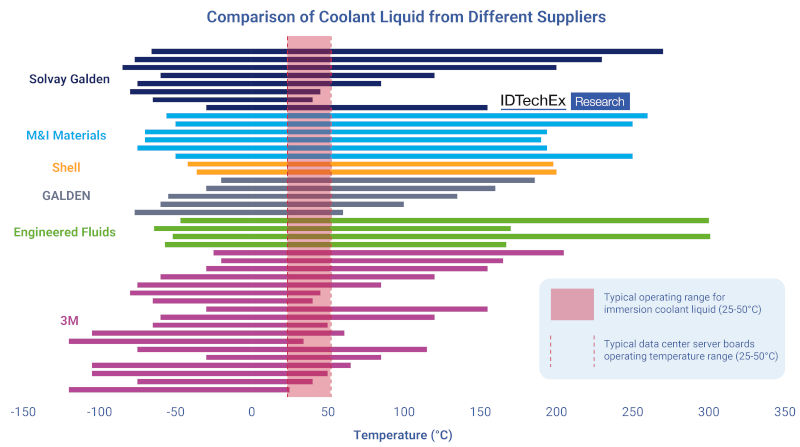
Regardless of whether it's D2C or immersion cooling, the coolant plays a crucial role. Depending on whether a phase change occurs, liquid cooling can be divided into single-phase and two-phase. While two-phase coolants offer higher cooling performance, they are susceptible to regulatory risks such as PFAS. In contrast, single-phase coolants utilize convection to dissipate heat, thus mitigating regulatory risks.
Liquid coolants for data centers can be classified into oil-based fluids and engineered fluids. Major companies include Shell, Castrol, ExxonMobil, Fuchs, M&I Materials, Engineered Fluids, 3M, Chemours, and Solvay.
Coolant prices can vary considerably, ranging from around $10/kg to over $100/kg. Several factors must be considered when choosing the right coolant. One of these is maintenance complexity. Oil- or hydrocarbon-based coolants often contain impurities, which can corrode server circuit boards and piping. In contrast, engineered fluids are typically free of this problem, offering simpler maintenance over time. As for initial costs, an immersion cooling tank can cost around $4,000, and the coolant itself can cost around $7,000 per tank.
Size of an immersion tank: Vtank = 1.5m x 0.655m x 1.2m = 1.18m3 = 1180 liters
Coolant volume = Vtank x 50% = 1180 liters x 50% = 590 liters
Coolant cost = 590 liters x 12 US$/liter ~= 7000 US$.