There are three main approaches to integrating liquid cooling into data centers:
- Designing data centers exclusively for liquid cooling: This involves creating smaller, more efficient data centers with high computing capabilities using immersion cooling. However, due to the high costs involved, IDTechEx believes that immersion cooling will grow, but in the short term, it is likely to be implemented on a smaller scale, such as pilot projects by large companies.
- Designing data centers with both air and liquid cooling infrastructures: This allows for a future transition to liquid cooling while initially using air cooling. However, designing data centers from scratch with redundant features (e.g., liquid cooling manifolds, piping, etc.) may not always be the preferred option for end users with limited budgets.
- Integrating liquid cooling into existing air-cooled systems: This is the most common approach and is expected to be the preferred solution in the short and medium term. It involves transferring some of the capacity of air-cooled systems to liquid cooling systems.
There are several reasons that explain its popularity:
Cost-effectiveness: Using existing infrastructure reduces complexity and initial costs compared to the other two options.
Limited demand for full liquid cooling integration: Despite the increasing density of data centers, IDTechEx believes the transition to full liquid cooling will be gradual, starting with a small number of data center racks and then gradually expanding to all racks.
Performance evaluation: Compared to air cooling, direct-to-chip cooling is still in its early stages. Therefore, many data center server vendors and end users prefer to evaluate its performance on a smaller scale before widespread deployment.
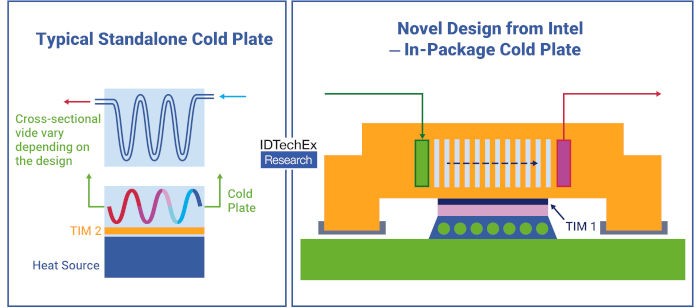
Driven by the demand for retrofitting existing air-cooled data centers, cold plate cooling, also known as direct-to-chip cooling, is the dominant liquid cooling solution in the data center industry. Traditionally, cold plates are mounted directly onto heat sources (e.g., chipsets, CPUs, etc.) with a layer of thermal interface material (TIM) between them to enhance heat transfer. Within the cold plate, the liquid flows through the microstructure and out to some type of heat exchanger. The diagram below shows typical cold plate designs for data center applications. Thermal interface materials can be found on various data center components, such as chipsets, processors, and power supplies. IDTechEx believes that the increasing adoption of cold plates will also drive increased demand for TIM in the data center market, particularly for processors and chipsets.
Intel's innovative approach in its new design involves integrating cold plates directly into the package, eliminating the use of TIM2 (Thermal Interface Material 2) and reducing thermal resistance or impedance. This integration offers advantages in terms of thermal management. However, it also introduces greater design complexity due to the micro-level embedding of the cold plate within the package.
Cold plate cooling for data centers offers a flexible and deployable solution for liquid cooling. The differentiating factor lies in the internal microstructure of the cold plates. Unlike immersion cooling, cold plate cooling allows data center integrators and server vendors to partially incorporate liquid cooling into their facilities at a relatively low upfront cost, with the ability to gradually transition to a fully liquid-cooled data center over time. IDTechEx anticipates a soft start to cold plate adoption, followed by rapid growth as more end users adopt the technology. Annual revenues for cold plate cooling are projected to grow at a compound annual growth rate (CAGR) of 16% over the next 10 years, and the rapid growth of cold plate hardware is also driving growth in component markets such as pumps and refrigerant distribution units (CDUs).