 The use of parallel optical modules is increasing because they can provide higher port density per rack and significantly greater bandwidth across the board. The use of parallel optics can therefore help reduce energy consumption in data centers and, consequently, the need for cooling, which in turn lowers operating costs.
Energy Savings:
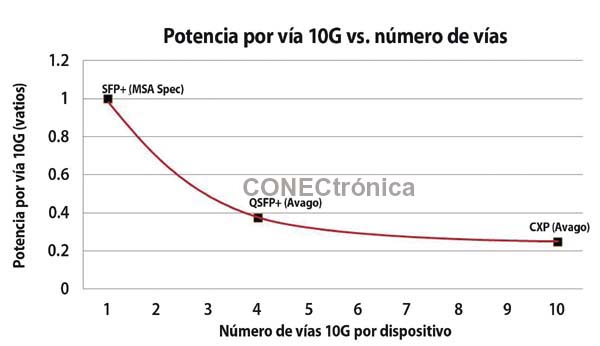
Parallel optical modules require less power for an equivalent 10G port than a single-channel module such as a 10G optical SFP+. This is achieved by utilizing a single ASIC device within the module to support either 4 or 12 optical lanes. This results in a power per lane for a 12-channel module, such as a pluggable CXP module, that is only one-quarter that of 12 individual SFP+ modules. Figure 1 illustrates the power savings when switching from a 4-channel QSP or 12-channel CXP module.
To illustrate the energy savings, let's consider a large, hypothetical data center with 10,000 servers. If those servers all have 10Gbps links to the switches and routers, they will need 10,000 ports to connect them. Using SFP+ modules, the energy wasted on those modules would amount to 10,000 watts. By using 12-channel parallel modules, the power consumption would be reduced to 2,500 watts, representing a saving of 7,500 watts. Over a whole month, that's a saving of more than 5,400 kWh of energy, or enough to power five individual households for a month!
By also moving rack-to-rack connections from single-path to parallel fiber optics, additional energy savings will be achieved.
Cooling Efficiency
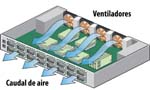
: Just as IC hosts can be positioned for optimal thermal management, recessed optical modules offer positioning flexibility to facilitate thermal management. A typical design of a high-capacity 1RU top-rack switch with side-mounted fiber optics is shown in Figure 2.
Cool air circulating around the rear of the enclosure is heated as it passes through the IC switches and other circuit components before reaching the front-panel-mounted modules, where the air exits through narrow holes drilled in the faceplate. Preheating the air by IC switches with high power dissipation presents a significant disadvantage for side-mounted fiber optics and can limit system density.
 In comparison, optical modules can be positioned so they are not exposed to preheated air, and because they consume less space in MTP adapters than side-mounted optical devices, there is more space at the front for air to escape. The air circulates faster through the relay, which improves fan efficiency and offers other potential benefits.
To understand and quantify the practical benefits of an in-wall optical implementation, a comparative thermal simulation was performed between a system populated with CXP modules, similar to the one illustrated in Figure 2, and one populated with Avago MiniPOD™ modules mounted on the center board. Both implementations offer the same optical communication capability and consume the same amount of power, but the in-wall modules are optimally positioned near the air intake. These simulations revealed that the MiniPOD modules operated up to 13 degrees Celsius cooler than their front-panel-mounted CXP equivalents.
This efficiency in cooling translates into better reliability in the devices as well as a reduction in cooling costs because the heat is transferred better and less cooling equipment is needed.
Parallel Optical Products for Data Centers:
Avago Technologies products are excellent examples of parallel optical products ideal for data center applications. The new AFBR-79EIDZ 4-channel iSR4 QSFP+ modules, the AFBR-83PDZ 12-channel pluggable CXP module, and the AFBR-81uVxyZ/AFBR-82uVxyZ MiniPOD™ recessed modules offer the port density and power savings required in today's data centers.
The Avago QSFP+ iSR4 module integrates four 10G lanes in each direction and enables interoperability of four 10G SFP+ links to more than triple the bandwidth without a line card, using 50% less power than a single-way SFP+ module.
MiniPOD modules deliver the industry's highest front-panel density, up to 36 times that of standard SFP+ solutions. For users requiring a pluggable solution, CXP transceivers offer half the cost per 10Gbps lane compared to pluggable SFP+ solutions. Both MiniPOD and CXP solutions operate at 25% of the power per 10Gbps lane compared to SFP+ modules.
In conclusion
, energy will remain essential for data centers, and solutions that can reduce overall energy consumption and help manage energy will continue to be of vital value to data center architects and equipment vendors. Parallel optical solutions will play a key role in data center energy management and will continue to improve energy savings as new technologies are developed.
Author:
Steve Sharp, Corporate Marketing Manager, Avago Technologies