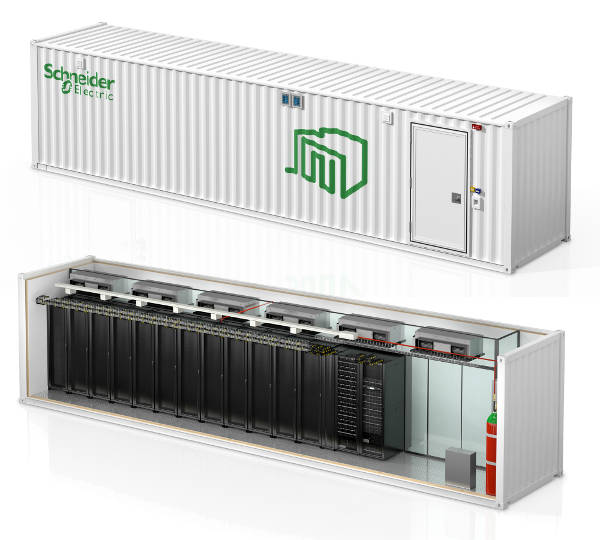
These systems dramatically reduce deployment time and complexity while ensuring full data center functionality. They are an ideal solution for harsh environments and can be deployed within a building structure or outdoors. Micro data centers often enhance the capacity of existing facilities, leading to significant cost savings compared to designing and constructing a new dedicated data center space and infrastructure.
They are available in sizes from half a rack to 10 racks, for both indoor and outdoor office space applications, and range from 1 kW to over 100 kW.
The Sagrada Familia, a canonical foundation for the management of this architectural work, was created in 1895, and in 2005, its Nativity façade was declared a UNESCO World Heritage Site. This organization continues a long history of transforming the building, with completion scheduled for 2016, coinciding with the centenary of Antoni Gaudí's death. Currently, the project is constructing the six central towers.
The basilica faced challenges and time constraints in the construction of a new data center, requiring a different approach to the design and construction principles traditionally employed in the IT industry.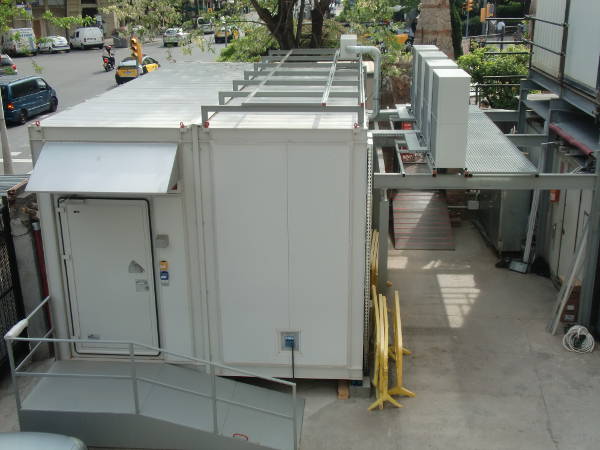 In just 16 weeks, Schneider Electric designed, manufactured, and delivered a complete data center infrastructure solution, including IT, racks, UPS systems, power distribution, precision cooling, environmental management, and a fire suppression system.
The Sagrada Familia's IT services were housed in a server room with insufficient space for expansion. To accommodate the need for increased digitization of its business processes and enhanced security, the Sagrada Familia was compelled to expand.
Since the Sagrada Familia is not only an active church but also a major tourist attraction with high daily attendance, the new data center needed to manage ticket revenue, souvenir sales, video surveillance, and the ongoing engineering and construction design for the subsequent phases of the construction project. Relocating the data center off-site was not an option due to concerns about latency and security; however, building a data center on a construction site introduced an additional risk of downtime, which would impact business processes.
In addition to the expanded data center requirements, there was a need to relocate the data center by 2026 to accommodate the various phases of construction. A "mobile" data center would reduce construction costs by eliminating the need to build two separate sites.
The Sagrada Familia's internal team worked to find a solution to meet these unique requirements and plan for future demand. Unfortunately, time constraints were becoming a barrier.
To address this situation, the Sagrada Familia staff worked directly with the Schneider Electric design team on a comprehensive data center solution tailored to their efficiency, mobility, and capacity needs. Schneider Electric designed and manufactured a turnkey, prefabricated data center solution that was factory-built and tested and delivered on schedule. The data center solution is transported as two independent, prefabricated modules with pre-installed racks, power, cooling, security, and management systems, which are then assembled on-site to create a functional and spacious environment. The units were delivered and installed outside of peak hours to minimize disruption to visitors and the congregation.
The solution comprises:
- Two prefabricated SmartShelter IT modules joined to form a single data center room.
- Ten NetShelter racks and 4 kW rack PDUs, expandable to 8 kW.
- Level N+1 DX fan coil air cooling systems with external condensers.
- Symmetra PX UPSs.
- Overhead cabling.
- Fire-resistant insulated panel construction.
- Fire detection and suppression system.
- Cold and hot aisle containment system
. - Power supply from two different utility substations and a dedicated 500 kVA generator.
Schneider Electric offers a wide range of prefabricated data center installation solutions.
The main benefits of these solutions are cost, installation time, and quality:
Cost: Depending on the application, prefabricated solutions aren't always cheaper. However, from an investment and scalability perspective, they are more beneficial in the long run.
Regarding time, because they are processed in a more standardized way at a manufacturing center, installation times are significantly reduced.
In terms of quality, the installation of a prefabricated data center involves a quality testing process performed at the factory before shipment. On-site testing is also minimized.
Schneider Electric focuses on standardized blocks for IT environments (server locations), power, and cooling, and vertically integrates 80-90% of the data center components.
The solutions offered are geared towards several types of clients:
- Multi-bay solution: hosting, colocation, and large cloud clients with a need for significant, scalable space, investing only for what is needed, incorporating blocks to create an open environment, similar to a conventional data center. Maximizing CAPEX. Pay as you grow.
- Non-ISO solution: (Sagrada Familia) with two interconnected modules that create a completely open space within them. They can range from "all-in-one" solutions with everything integrated (UPS, power, cooling, security, etc.) to 2-module solutions (for example: cooling, power, racks, but without UPS, which would be in other modules). This is an "Enterprise" solution.
- ISO: Each container is 2.4 meters (ISO standard), 20 or 40 feet high, and 2.9 feet long. Measurements are fully standardized internationally. Up to 9 containers can be transported by ship and on pillars.
- ISO solution: for clients in the Oil & Gas and mining sectors where the data center needs to be transported. Remote locations for harsh environments.
- Power-module or SKID solution: this is an open platform that integrates the power and cooling components within a building and can be replicated later.
It only needs to be connected because everything is tested, and more infrastructure can be added progressively as needed.
- Micro-Datacenter solution: geared towards edge computing, due to latency and proximity to the center. It houses all the necessary infrastructure at the rack level. One is aimed at... office (acoustic specifications), another industrial (thermal insulation, fully sealed), and another traditional room-level solution.
Globally, Schneider Electric has 121 projects with a total of 393 modules installed: hosting, hospitals, and education. 225 MW installed.
The approximate delivery time is around 20 weeks, depending on the project. The testing and pre-study phase varies by project. The standard timeframe is 2 weeks for design, 8 weeks for construction, and 1 or 2 weeks for testing, plus 1 or 2 weeks for transport depending on the destination, and the on-site phase of 2-4 weeks (depending on the work done by the client).