The higher the density of the patch panels, the greater the number of front patch cables and the more complicated it is to keep them organized according to the initial installation.
As the uses or requirements of the installation change, the connections are modified, and patch cables are reused without adjusting their routes or lengths. This can lead to chaotic situations, which can pose a serious problem in the event of a breakdown, service change, or migration.
 The patch cables are not always correctly identified or labeled, so sometimes it is difficult to follow them when the ends are not on the same splitter or even on different racks.
A seemingly normal action when faced with a change or malfunction is to disconnect one end and check what happened. This action isn't problematic if we're only interrupting traffic for a user or printer, but more complex scenarios are common.
 What can happen if a DWDM or 10G connection is dropped at a mobile telephony site, which carries traffic from 20 BTS, covering a rural area of 750km2
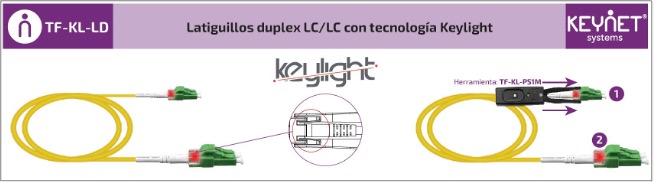
A simple and effective solution to this problem is the use of KEYLIGHT with light identification, from KEYNET SYSTEMS. They are available in different connector configurations, for both fiber optic and Cat6A cabling, and in a wide range of lengths.
Using a specialized tool, we supply continuous or intermittent power to the LEDs at both ends of the patch cable. This tool requires no batteries; it is powered by an extendable USB patch cable.
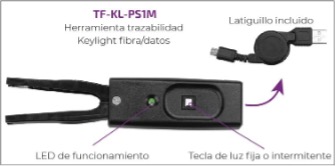
More information and a video demonstrating the operation.