A new dual-channel, ±60 V PSM features integrated 16-bit ADCs for precise voltage, current, and temperature telemetry, programmable sequencing, on-chip servo adjustments, lane tracking, and autonomous fault management. These capabilities ensure robust monitoring, optimized digital control, and PMBus® compatibility—key attributes for 48 V data center rack applications.
This article will discuss the advantages of the PSM and the design challenges of incorporating it into QB solution reference designs, with a focus on achieving high-precision monitoring, reliable sequencing, and advanced digital control in next-generation power subsystems.
Introduction:
Telecommunications and data communications power systems increasingly rely on high-efficiency 48 V intermediate buses using hot-swappable DC-DC converters in standard quarter-brick (QB) form factors. New industry standards now demand integrated PMBus® interfaces and robust protection circuitry, reflecting a clear shift toward digitally managed power solutions for rack servers and network equipment.
The LTC2971 is ideally suited to meet these requirements. It sequences and adjusts two regulated lines from -60 V to +60 V, implements programmable fault responses, and logs critical events to the onboard EEPROM. Its native PMBus interface enables seamless integration with standard system monitoring architectures, while its Digital Power System Management (DPSM) functions—sequencing, margin testing, fault detection, and telemetry—are now considered essential in complex power platforms. Internal EEPROM and a separate watchdog further support autonomous operation with minimal host intervention, improving overall system reliability.
QB solutions typically provide an analog tuning input (VADJ) for voltage adjustment. The PSM connects directly to the RUN/ENABLE, VOUT_SNS/FB, and temperature sensing pins, while its ISENSE inputs accurately measure output current using the inductor's DCR or an external shunt. Its precision VDAC output allows fine-tuning of the output voltage using resistor dividers. By integrating the power system manager (PSM) onto the power board, designers gain centralized, high-precision digital telemetry of all rail voltages, currents, and board temperatures via PMBus, offering significantly greater accuracy and flexibility than legacy analog monitoring solutions, which often struggle to meet the stringent performance specifications of data centers.
Quarter Brick Solution:
The 2 kW Quarter Brick reference design employs a highly reliable four-phase architecture utilizing Analog Devices’ latest DC-to-DC intermediate bus converter (IBC) and coupled inductors to deliver exceptional power output. Integrated telemetry provides continuous voltage monitoring, rapid fault detection, and real-time configuration via I2C/PMBus. Designed with a standardized form factor, the solution enables seamless integration across a wide range of customer platforms, enhancing system flexibility, efficiency, and ease of adoption. See Figure 1.
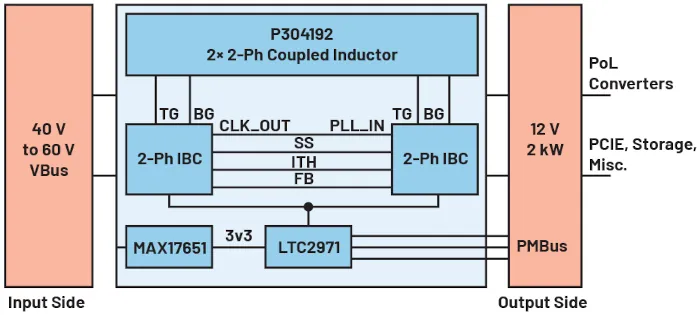
Figure 1. Block diagram of the QB solution reference design with the ADI 48V IBC, MAX17651 and LTC2971.
Key findings on the Quarter Brick solution and the need for integration
Integrating the LTC2971 with Quarter Brick converters offers several key advantages.
Precision Telemetry:
The PSM features high-resolution analog-to-digital converters (ADCs) that accurately monitor voltage and temperature. On the QB board, it demonstrated an accuracy of ±0.5% to 1.0% in output voltage and temperature measurements, enabling precise power management. Reliable voltage, current, and temperature measurements provide engineers with in-depth knowledge of the solution's behavior under varying conditions, allowing them to safely push performance to the limit. By programming EEPROM parameter limits and fine-tuning warning thresholds based on telemetry, engineers can ensure the solution consistently delivers peak performance without causing unnecessary failures. See Figure 2.
Digital Control and Sequencing:
A critical requirement in data centers is precise power sequencing to ensure that the QB solution delivers power and powers up processors safely, in a controlled manner, and on time. The PSM fully automates the startup, shutdown, and voltage margin of multiple lanes, supporting both time-based and cross-lane tracking sequencing. It also allows multiple QB solutions to be cascaded for scalable designs. The PSM's DRV_EN/RUN and VOUT_EN parameters, including power-up delays, rise times, and sequencing policies, are fully programmable via PMBus commands, ensuring that interconnected lanes always power up and power down in a coordinated fashion. This controlled sequencing minimizes voltage overshoots and undershoots during each power cycle, improving the reliability of data center racks.
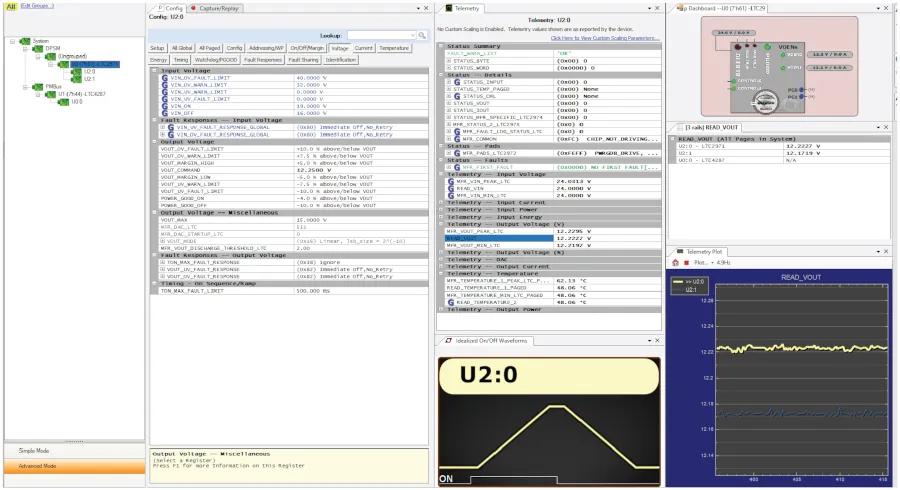
Figure 2. LTC2971 telemetry table for voltage, current, and temperature.
Fault Management:
A key advantage of the PSM is its robust integrated fault management and event logging system. Overvoltage or temperature spikes can be configured to trigger a lockout shutdown, an automatic retry, or a controlled power reduction. Importantly, the device continuously stores status and telemetry in RAM and, upon detecting a fault, automatically confirms and saves this data to a non-volatile EEPROM. This black-box functionality retains a complete snapshot of voltages, currents, and temperatures at the time of the fault, enabling accurate root cause analysis. As illustrated in the conceptual diagram in the LTC2971 datasheet, the circular buffer automatically transfers data to the EEPROM upon fault events. Unlike basic PMBus fault logs or external watchdogs, the PSM records the complete operating status rather than simply flagging errors. These advanced features enhance the reliability of the QB solution, enable detailed lifecycle assessment of the " ", and extend its useful life through continuous monitoring and recording. See Figure 3.
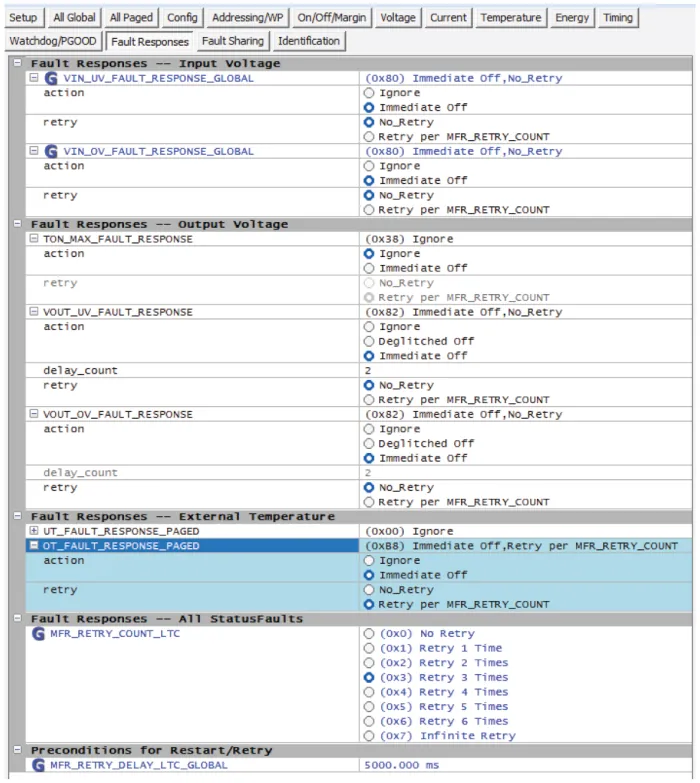
Figure 3. LTC2971 fault setting configuration table.
PMBus Integration:
Data center specifications demand a robust communication interface compatible with the PMBus protocol. As a PMBus-compliant device, the PSM meets industry standards and integrates seamlessly with existing system management platforms. Its monitoring and status control functions are fully accessible via standard PMBus commands, and it supports LTpowerPlay®for streamlined configuration. This allows design teams to define register settings, such as voltage rails, limits, and sequencing, offline and program them directly into the EEPROM, significantly reducing development time. Furthermore, the device's bidirectional FAULTB pin enables flexible fault management by allowing multiple devices to share or isolate fault lines as needed. Overall, digital control capabilities, including servo tuning and sequencing, provide a far more efficient path to implementing advanced power management compared to purely analog solutions.
Implementation Results
: Regarding the performance of the QB solution board, the PSM demonstrated reliable monitoring of IBC operation, input voltage, and performance parameters. PMBus telemetry remained stable and matched measurements taken with a calibrated digital benchtop multimeter (DMM). Fault injection testing confirmed that the device correctly blocked faulty channels and accurately logged events in the MFR_FAULT_LOG registers. System-level validation showed that the integrated digital power management did not introduce additional noise or instability, while the controlled soft-start algorithm effectively prevented gate driver shoot-through, resulting in clean output waveforms. The I2C interface is programmable from 100 kHz to 400 kHz to suit various communication requirements, and voltage and temperature readings closely matched manual data, with an accuracy of ±0.1% and ±0.5%, respectively. See Figure 4.
Taken together, these results show that the LTC2971 improves quarter-brick power supply solutions by adding high-fidelity monitoring, high-precision control, and detailed diagnostic data. Its PMBus compatibility ensures that it can be adopted in modern telecommunications systems with minimal interoperability issues. See Figure 5.
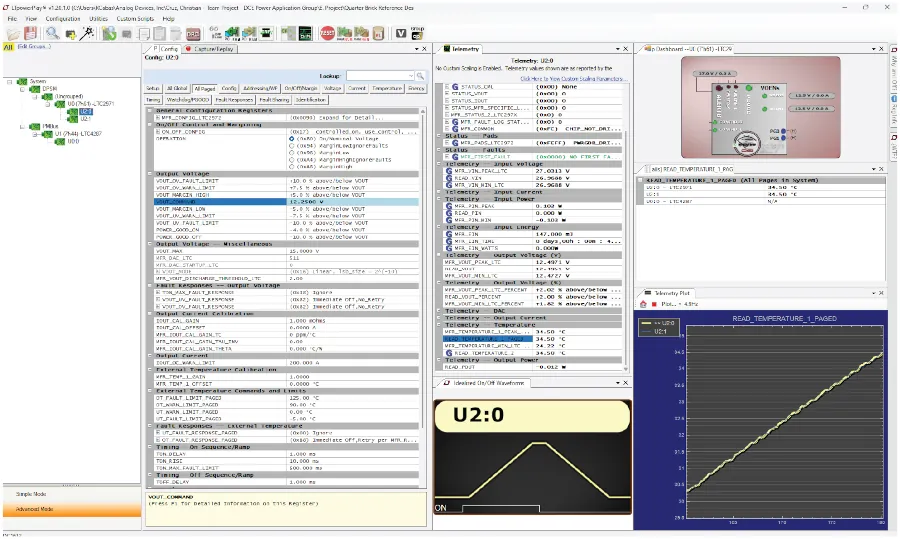
Figure 4. ADI reference design for a 54 V to 12 V system application connected to LTpowerPlay.
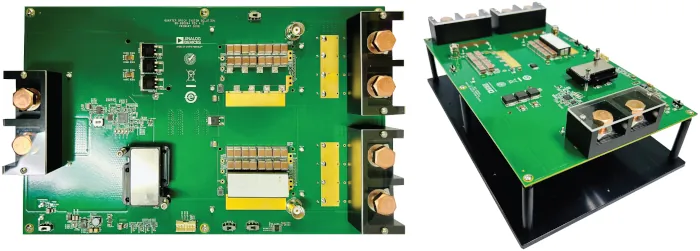
Figure 5. Reference design hardware of ADI's "quarter brick" solution for a 54 V to 12 V system application.
Conclusion:
Integrating the LTC2971 PSM into the QB solution reference design offers significant advantages for DC power systems. Its on-chip, 16-bit telemetry inputs provide high-precision monitoring that meets stringent DC accuracy requirements. Integrated sequencing and closed-loop tuning enable precise power-on/power-off control of multiple power lines, while the PMBus interface ensures seamless integration with modern rack management infrastructure. Standalone fault logging provides advanced diagnostics that are difficult to achieve with analog circuitry alone. These capabilities introduce additional design considerations, such as careful configuration, calibration, and reliable bus operation. However, the resulting improvements in reliability, visibility, and control typically outweigh these challenges. As telecom and data center applications increasingly demand automated, network-managed power subsystems, devices like the PSM are poised to become standard building blocks, enabling robust digital control and accurate telemetry for next-generation power platforms.
It should be noted, however, that for solutions requiring more than nine parallel power supplies, the PSM may be less advantageous due to PMBus addressing limitations. In such cases, other ADI PSM integrated circuits with advanced addressing capabilities are more suitable.
References
1 Karl Audison Cabas and Christian Cruz. “Enabling Future Innovations: Intermediate Bus Converter — Part 1: Benefits.” Analog Devices, Inc., July 2025.
2 Karl Audison Cabas and Christian Cruz. “Enabling Future Innovations: Intermediate Bus Converter — Part 2: Performance.” Analog Devices, Inc., July 2025.
About the Authors:
Christian Cruz is a Product Applications Engineer at Analog Devices Philippines. He holds a Bachelor of Science in Electronic Engineering from Eastern Manila University, Philippines. He has 14 years of engineering experience in the fields of power electronics and firmware design for power supply control, including the development of power management solutions, as well as AC-to-DC and DC-to-DC power conversion. He joined ADI in 2020 and currently works on power management solutions for the Consumer and Cloud-Based Infrastructure business units, as well as system communications applications.
Karl Audison Cabas has been an Applications Engineer specializing in power applications at Analog Devices since September 2020. He holds a Bachelor of Science in Electronic Engineering from the Polytechnic University of the Philippines and a postgraduate degree in Power Electronics from Mapua University. He has over four years of experience with DC-DC power converters. In his previous role, he handled customer inquiries and resolved design issues related to DC-DC converters. He currently works as a Power Systems Applications Engineer for cloud and data center applications.
Ralph Clarenz Matociños holds a Bachelor of Science degree in Electronic Engineering from Manila City University (PLM) in Manila, Philippines. He has over a year of professional experience in power electronics engineering, including the development of battery management systems and DC-to-DC power conversion. He joined Analog Devices in 2022 and currently works as a power systems applications engineer for cloud and data center applications.