When we talk about scalability, in practice we mean the need to adapt to increasing load. As power demand rises, the protection system must be adapted to guarantee a continuous and high-quality supply at all times. The rigidity of a monolithic solution is therefore inadequate, and a modular approach is necessary. This involves adding modules designed to gradually handle higher demand levels. However, this process should not entail an unmanageable cost; rather, the investment should be consistent with the evolution of the business. The modular nature of UPS systems facilitates this, as it involves adding modules to the same chassis, not replacing it entirely each time the load changes.
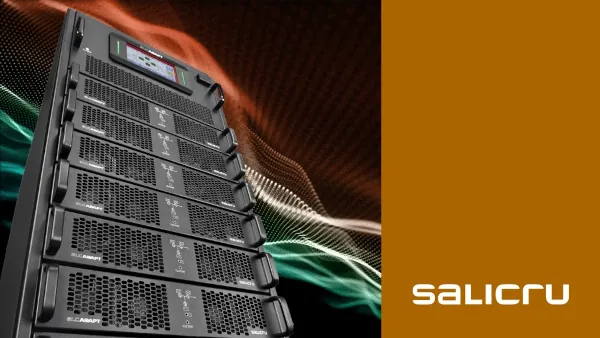
The SLC ADAPT2 is a prime example of this design philosophy. Its architecture allows for configurations ranging from 25 kVA to 1,500 kVA, thanks to the availability of 25 and 50 kVA modules, various configurable systems of 8, 10, or 12 modules, and the option of parallel or redundant operation of up to three 500 kVA systems. This "pay as you grow" approach means minimal initial investment, with expansion only as needed, directly improving the total cost of ownership (TCO).
From a technical standpoint, each power module incorporates online double-conversion technology with three-level DSP control of IGBTs. Its internal architecture includes a rectifier with PFC (power factor correction), a three-level NPC-type inverter, and an intelligent battery charger. The input power factor exceeds 0.99, and the total current distortion (THDi) remains below 3%, parameters that reduce losses in the electrical installation and minimize interference with other equipment connected to the same network.
The modules operate with a unity output power factor (kVA=kW) and an efficiency exceeding 96%, with a very flat performance curve across all operating regimes. They also feature various operating modes—Eco-mode, Hibernation, and Smart-Efficiency—that further enhance system performance. This last aspect is particularly relevant in data center environments where energy costs represent a significant portion of the operating budget.
The modularity of the Salicru SLC ADAPT2 also facilitates the incorporation of N+1 redundancy and allows for tier classification according to the internationally accepted specifications of the Uptime Institute. Starting with Tier I, which has no redundancy, the classification then progresses to Tier II, which includes redundant components to improve availability; Tier III, in turn, ensures business continuity for all components during maintenance. Finally, Tier IV is fault-tolerant, for which it has several redundant paths along with the ability to cope with total power outages without a direct critical impact.
A higher level of qualification also contributes to increased infrastructure reliability, measurable through parameters such as MTTF (Mean Time Between Failures) and MTTR (Mean Time To Repair). In a monolithic UPS, any failure requires a complete system shutdown, whereas with a modular structure, only the faulty module needs to be replaced (hot-swapped); that is, while the system remains operational and the loads are properly protected at all times. In the SLC ADAPT2, the three-level DSP control technology enhances response efficiency and, together with the redundancy of shared loads, significantly increases the MTBF (Mean Time Between Failures).
System management and monitoring are performed via a 7" color touchscreen displaying detailed data, alarms, and event logs, complemented by comprehensive communication protocols for BMS and SNMP management. Available interfaces include RS232, RS485, relays, and USB, ensuring compatibility with virtually any existing infrastructure management platform. Additionally, connection to Salicru's Nimbus service enables advanced remote maintenance options with the capacity for immediate action in response to incidents or the anticipation of anomalies.
Regarding overload tolerance, the system can handle up to 110% continuously, up to 130% for one hour, up to 150% for one minute, and can withstand overloads exceeding 150% for five seconds, providing a significant operational margin against transient demand spikes.
Superior reliability has a positive impact on profitability by reducing costs and thus widening margins, as well as enhancing the organization's reputation. From an economic perspective, modular UPS systems optimize investments by minimizing initial costs and allowing for gradual expansion as the infrastructure grows. Lower maintenance costs, reduced downtime, and greater energy efficiency are equally beneficial.
Article provided by Salicru – https:www.salicru.com