The number of application areas for these technologies is growing daily, encompassing business, industry, CPS, medicine, education, architecture, navigation, entertainment apps, serious games, gaming, military applications, cybersecurity, and more. In all cases, privacy and cybersecurity issues are becoming increasingly significant and critical, and it's time to address the risks professionally. Some emerging cybersecurity issues arise when multiple applications share an AR system output, while other risks appear in access control for sensor data, etc. Regarding privacy, issues arise concerning the protection of personal data, geolocation, violations of legal anonymity, and so on.
INTRODUCTION.
 Augmented Reality (or simply AR) is one of the four components of mixed reality. Mixed reality ranges from the pure real world through AR to augmented virtuality, and at the other extreme is the pure virtual world. AR is related to a more general concept called mediated reality, in which a view of reality is modified (possibly even diminished rather than augmented) by a computer. As a result, technological features enhance one's ordinary perception of reality. AR offers an ever-increasing set of benefits. It allows the combination of real-world and virtual reality environments, enables real-world environments (sensors, actuators, people, robots, drones, etc.) to interact with virtual objects (where avatars, people, machines, my-me tutors, etc., interoperate in Second Life-style virtual worlds and analog-digital real worlds), allows virtual objects to respond to physical actions in the real world, offers real-time interactivity, processes data in real time, generates data in real time, records data in three dimensions, enables 3D images, allows designers to create graphics and models, enables the creation of interactive covers, allows viewing emergency exits in contingency situations, and enables visualization of the skeleton and anatomy from photos, X-rays, CT scans, ultrasounds, etc. Alongside these benefits comes an expanding set of new risks, threats, and vulnerabilities that must be safeguarded through privacy and cybersecurity measures. For example, a malicious AR application might include an incorrect speed limit superimposed on the actual speed limit or intentionally provide an incorrect translation of real-world text written in a foreign language (the water in this well is drinkable when it is actually toxic). An application could even trick users into falsely believing in the presence of certain objects or animals in the real world (there are rabid wolves roaming the city). Among the most relevant security requirements currently identified for AR are: privacy, data confidentiality, data integrity, access control, availability, and source authentication (preferably mutual). Xcubelab estimates that the AR market will grow to US$5.2 billion by 2017.
AR AND ITS CONTEXTUAL ELEMENTS.
Augmented reality (AR) refers to computer-generated visualization that adds information to a user's sensory perception. What makes AR different is the way the information is presented; it's not a separate visualization but rather integrated with the user's perceptions. The main idea is to obtain the right information, at the right time, and in the right place. AR describes the kind of visualizations that are primarily of a real-world environment with enhancement or augmentation. AR can serve as a useful tool for committing crimes, enabling the convergence of social media data and facial recognition (it may not be long before a stranger approaches us on the street, identifies us, and deceives us using highly sensitive information).  Persuasive computing, or CAPtology (Computers as Persuasive Technology), allows the design and use of technology with the specific intention of influencing or modifying behaviors, perceptions, knowledge, values, or attitudes. Augmented reality falls under the definition of persuasive computing and technology. Almost all AR applications contain some kind of persuasive element or are designed with the intention of persuading the user in some way. In addition to aligning real and virtual objects in real time, AR applications and technologies can include various additional features such as: (i) A complex set of input devices and sensors that are always on (e.g., cameras, GPS, microphones, etc.). (ii) Multiple output devices (e.g., displays, headphones, speakers, medical prostheses, etc.). (iii) A platform that can run one or multiple applications simultaneously. (iv) The ability to communicate wirelessly (WiFi, Bluetooth, ZigBee, NFC-RFID, 2G, 2.5G, 3G, 4G, 5G) with other AR systems and with the cloud over long distances to deliver augmented content.
AR COMPONENTS. AR vs VR COMPARISON.
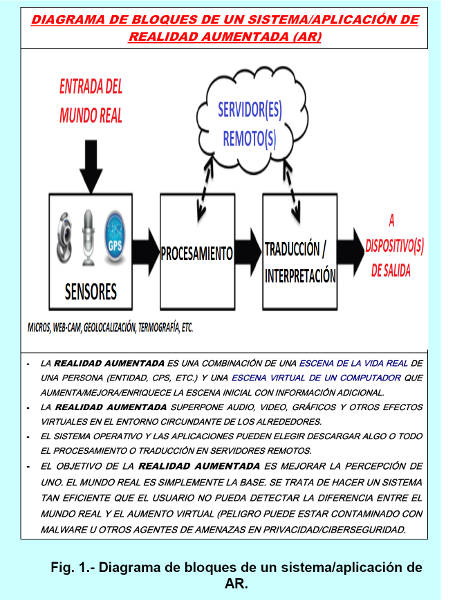
Augmented Reality (AR) allows users to view a live, direct or indirect physical environment whose elements are augmented and enriched by computer-generated sensor inputs such as sound, video, graphics, GPS/GLONASS data, knowledge, etc. AR technologies integrate several components:
1) Scene acquisition. This involves using either a camera or video capture device with microphones (for audio) or viewing the scene through a display system.
2) Scene identification. The scene is scanned to determine where the virtual content will be embedded. The position can be identified through geolocation and/or traceability technologies such as RFID-NFC sensors, differential GPS, GLONASS, QZSS, infrared, laser, satellite, 2G/3G/4G triangulation, WiFi 802.11b/g/n, Bluetooth, etc.
3) Scene processing. The computer analyzes the captured and synthesized data and the augmented position. Virtual content is obtained from the internet or some type of local/remote repository.
4) Scene visualization. The AR system generates the image and sound by blending the real physical world with virtual objects and content. Screens, holograms, headphones, speakers, gyroscopes, accelerometers, compasses, sensors, processor-level computing power, mobile devices with internet connection, etc., are used. Sensors can measure movement using accelerometers, magnetometers, and gyroscopes, as well as environmental factors such as light, temperature, humidity, pressure, and electric and magnetic fields. Voice recognition systems translate words into computer instructions, and gesture recognition interprets the user's body movements through visual detection.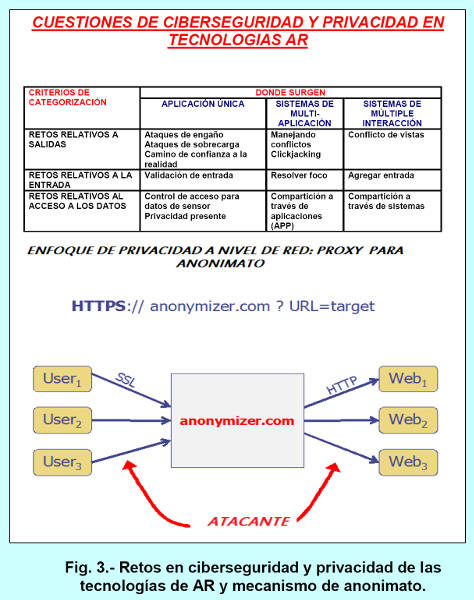 A key metric for any AR system is how realistically it integrates augmented reality with the real world. IHS iSuppli forecasts the integration of over six billion motion sensors into mobile devices and tablets in 2016. Virtual reality (VR) replaces the real world with a simulated, artificial, and entirely synthetic one (featuring avatars, robots, drones, Second Life, etc.). With the help of advanced AR technology (adding computer vision and object recognition), information about the real world surrounding the user becomes interactive and digitally manipulable. Artificial information about the environment and its objects can overshadow the real world. In the field of medical applications, augmented reality has the potential to improve the efficiency of consultations, operations, and diagnoses with virtual X-rays, real-time ultrasound images, MRI scans, etc. However, if compromised, it could lead to erroneous diagnoses and even fatal consequences for human life. Because smartphones incorporate most of the components of an AR system-service, they quickly flooded the smartphone market, making AR a commercial success.
PERSONAL IDENTIFICATION ELEMENTS IN AR.
Gary Marx identifies the following elements of personal identification or facets of anonymous communication:
(1) Legal name. This implies a person's true identity and can be linked to biological, social, demographic, and other information.
(2) Locatable. If a person's or entity's address or position is known, they can be located and reached.
(3) Traceable pseudonymity or pseudo-anonymity. A person or entity using a pseudonym can be linked to that person or their address under restrictive conditions. In the case of internet communications, online services act as intermediaries and allow participants to use pseudonyms in chat rooms, AR environments, etc. Online services retain an identifying record for each person.
(4) Untraceable pseudonymity. A person or entity using a pseudonym that is not linked to the person or their address by any intermediary due to protective policies or the inability to trace it. In the case of internet communications, individuals using pseudonyms can make their identities untraceable by using a MIX-style server-router chain.
(5) Pattern recognition. A person or entity can be identified by reference to their pattern of behavior or appearance. Individuals who establish anonymous communication or email can be recognized by the content and style of their messages.
(6) Social characterization. A person or entity can be identified through social categories such as age, religion, gender, class, employment, sex, etc.
(7) Symbols of eligibility or ineligibility. A person or entity can be identified by the possession of knowledge (passwords, codes) or artifacts (tattoos, uniforms, implanted RFID/NFC prostheses, etc.) as eligible or ineligible.
RISKS IN CYBERSECURITY AND PRIVACY.
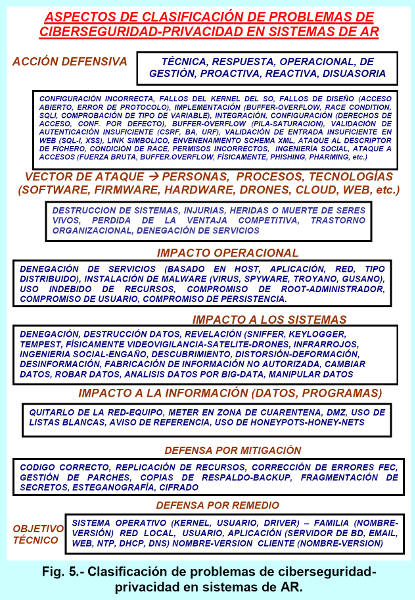
 AR technology is persuasive, which implies novelty (the intentions of application designers can be masked, questionable, completely hidden, and potentially coercive. If an end user is unaware of the persuasive attempts directed at them in applications, they will be uninformed and will be inclined to participate), and the exploitation of positive reputation (the fact that there are hundreds of millions of smartphones and people wanting new products creates trust and an opportunity for persuasive AR applications). Malicious applications on AR platforms for emergency applications can use mechanisms to overload users' sensors. Although Augmented Reality technologies can be useful in various areas (industry, business, architecture, medicine, navigation, etc.), they can also have negative consequences (economically and even disastrous for human life). For example, Wikitude's (mobile augmented reality whose information is for entertainment purposes) ability to track and physically locate things that correspond to virtual notes may pose the risk of an invasion of personal privacy. This is because Wikitude, which is based on locating points of interest, is not limited to commercial public places but also extends to the online activity of individuals. For example, Wikitude is linked to the Twitter social networking website, and whenever a user of both Twitter and Wikitude posts a message online, their location is recorded. This allows the application to provide information related to the location of the user who posted a message on Twitter. Privacy risks have been identified from a geolocation perspective, as well as copyright issues related to copyrighted maps. To protect privacy and confidentiality in public areas and crowded spaces, safeguards already exist to prevent unauthorized viewing of information on displays and screens from the sides of our tablets, smartphones, or PCs. This is achieved through the use of privacy filters and screen protection for monitors and large displays.
'
 FINAL CONSIDERATIONS.
AR technologies promise to enhance our perception of and interaction with the real, analog-digital physical world. However, they can also facilitate the emergence of a growing number of privacy and cybersecurity threats and risks. Our research group has been working for over fifteen years in the area of privacy and cybersecurity protection in AR (Augmented Reality) environments.
LITERATURE.
- Areitio, J. “Information Security: Networks, Computing and Information Systems”. Cengage Learning-Paraninfo. 2015.
- Areitio, J. “Need for protection in environments based on ambient intelligence and CPS”. Conectrónica Magazine. No. 165. April 2013.
- Areitio, J. “Identification and analysis of SCMP technology for data protection in network-based computing environments”. Conectrónica Magazine. No. 171. November 2013.
- Areitio, J. “Exploration and analysis of cyber-physical systems from the perspective of their cybersecurity”. Conectrónica Magazine. No. 181. November 2014.
- Schmalstieg, D. and Hollerer, T. “Augmented Reality: Principles and Practice”. Addison-Wesley Professional. 2015.
- Wassom, B. “Augmented Reality, Law, Privacy and Ethics: Law, Society and Emerging AR Technologies.” Syngress. 2014.
- Google Glass URL: https://glass.google.com/
- Kipper, G. and Rampolla, J. “Augmented Reality: An Emerging Technologies Guide to AR.” Syngress. 2012.
- Craig, AB “Understanding Augmented Reality: Concepts and Applications”. Morgan Kaufmann. 2013.
- Mullen, T. “Prototyping Augmented Reality”. John Wiley & Sons. 2011.
Author:
Prof. Dr. Javier Areitio Bertolín,
Professor at the Faculty of Engineering, University of Deusto.
Director of the Networks and Systems Research Group.