Operators jump from camera to camera, align timelines, rewind footage, and manually reconstruct events within a video management system. It's a necessary job, but also slow, repetitive, and demanding. Indeed, in recent years, several scientific studies have warned that video surveillance subjects operators to a high cognitive load, with risks of fatigue, distraction, and perceptual overload.
In this context, technological evolution is beginning to make a tangible difference. Modern video management systems are no longer limited to simply storing recordings. They incorporate metadata indexing, advanced analytics, and natural language search, transforming how security teams approach investigations. Instead of manually reviewing endless timelines, operators can filter results based on visual attributes, motion, or contextual information. This is confirmed by State of Physical Security 2026 , based on more than 7,000 interviews with end users, channel partners, and consultants worldwide, which highlights the use of tools such as intelligent search and artificial intelligence in investigative processes.
In this context, solutions like Genetec Omnicast reinforce this evolution by acting as the core of modern video surveillance systems. This open-architecture VMS allows for the centralized management, recording, and analysis of video, integrating multiple cameras and data sources into a single platform. Its ability to scale, optimize storage, and facilitate rapid access to information is key for environments where operational efficiency and responsiveness make all the difference, especially when combined with advanced analytics and intelligent search tools.
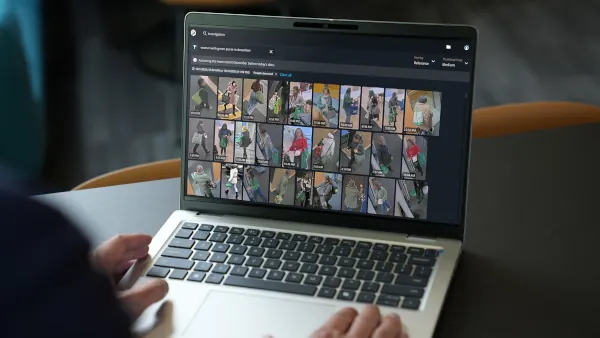
Interpreting the Video Beforehand:
One of the major contributions of this new generation of tools is that it accelerates the location of relevant recordings and, moreover, presents the results in a way that is more useful for investigation. Until recently, the operator relied almost entirely on timestamps, camera names, and a great deal of patience. Now they can work in a much more natural way, describing what they are looking for or using a person or vehicle already visible on screen as a starting point.
Let's consider a simple query like searching for a black car within a specific time frame. Instead of requiring the operator to review every camera from that period individually, the system analyzes the recorded video and returns a smaller set of thumbnails and sequences related to that description. This way, the investigation starts with a much clearer focus and a more defined starting point.
This not only improves speed; it also changes the logic of the work. The operator no longer spends time on mechanical screening tasks and can focus more on interpreting what happened. This difference is especially important in environments where multiple incidents are managed simultaneously or when operational pressure requires a rapid response.
How Investigations Change in Practice:
The true usefulness of these features is best seen in concrete cases. Imagine a vehicle theft is reported in a parking lot. With a traditional approach, the usual procedure would be to start with the camera closest to the scene and, from there, expand the review to determine when the vehicle entered, how long it remained there, and where it exited.
With intelligent search, the process can begin differently. The operator enters a description of the vehicle or selects it directly on the screen. From there, entry and exit detection helps build a clearer timeline. If the driver then leaves the vehicle, the investigation can continue focusing on that person, tracking their movements through multiple cameras using similarity-based search functions, even when the viewing angle or lighting conditions change.
The most significant difference lies not only in speed, but also in continuity. Related clips can be linked within a single investigative view, facilitating an understanding of what happened before, during, and after the incident. What previously required lengthy rewinding, comparing, and cross-referencing sequences is now transformed into a more streamlined and coherent workflow.
Context makes all the difference.
In research, finding a specific image is important, but often it's not enough. What's truly useful is understanding its context. That's where intelligent search adds a competitive edge over more rigid tools that only return predefined results based on fixed criteria.
If the operator focuses the investigation on a person, the system can display other recordings showing individuals with similar characteristics. If the focus is on a vehicle, it can highlight nearby activity in time or place. This ability to relate seemingly disparate elements helps connect events that, viewed in isolation, might appear irrelevant or unrelated. In practice, this allows for a better reconstruction of a sequence, rather than relying solely on a single image. Because a useful investigation isn't just about locating a moment, but about understanding its relationship to other moments. And that difference is what transforms a set of clips into an explanation.
Another key aspect is that natural language search reduces reliance on complex filters and in-depth technical knowledge of the system. The operator doesn't need to rely solely on menus, parameters, and advanced structures to find relevant information. They can frame the search in a way that more closely reflects how they think about the problem. This simplifies the process and reduces friction, especially in time-sensitive situations.
Direct Impact on Incident Response
All of this has very concrete consequences for the operational response. When a team has earlier access to relevant recordings, it can establish timelines more quickly, identify key moments sooner, and make more informed decisions about whether to escalate an issue, share evidence, or close a case.
This impact isn't limited to serious incidents. It's also felt in routine investigations, which represent a significant portion of the daily workload in safety. Shortening review cycles helps maintain momentum, prevents backlogs, and promotes greater consistency across shifts. Furthermore, clearer findings facilitate collaboration with other stakeholders. When findings can be more easily interpreted and shared, coordination with facility teams, management, or external partners becomes smoother. And in safety, where many decisions are made collaboratively, that clarity is invaluable.
A Help for Operators:
There's another aspect that sometimes goes unnoticed, but is also important: training and onboarding new staff. Learning traditional video review workflows can take time, especially in large or complex environments. Tools that allow natural language searches and more intuitive visual interaction help lower that barrier.
This has a double advantage. On the one hand, new operators can start adding value sooner. On the other, more experienced staff reduce some of the repetitive workload that has accompanied manual video review for years. In other words, it's not just about making the technology faster, but about making the daily work of those who use it more sustainable.
In parallel, the recent evolution of intelligent video surveillance demonstrates that the combination of object detection, recognition, and advanced analytics is no longer a distant promise; but a consolidated line of development, increasingly focused on improving speed and accuracy in real-world applications.
Ultimately, the real transformation isn't about recording more, but about finding things faster. For years, security teams have grappled with the uncomfortable paradox of having a wealth of video footage but taking far too long to translate it into answers. Modern search technology is beginning to break that cycle. And when an incident lasting only a few minutes no longer requires hours of review to understand, it's not just the technology that improves; it also enhances the actual ability to respond, make decisions, and act in a timely manner.

Rafael Martín, Sales Director, Southern Europe, Genetec