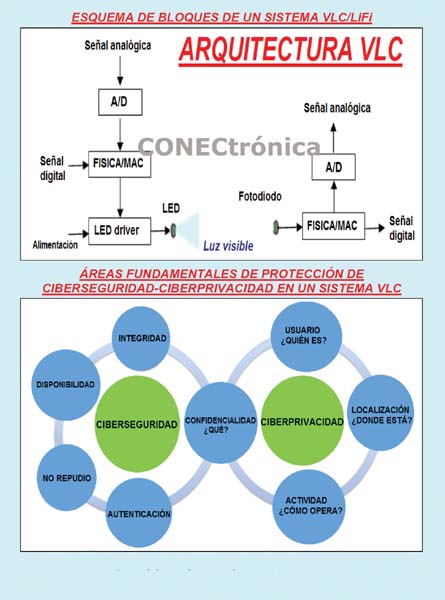
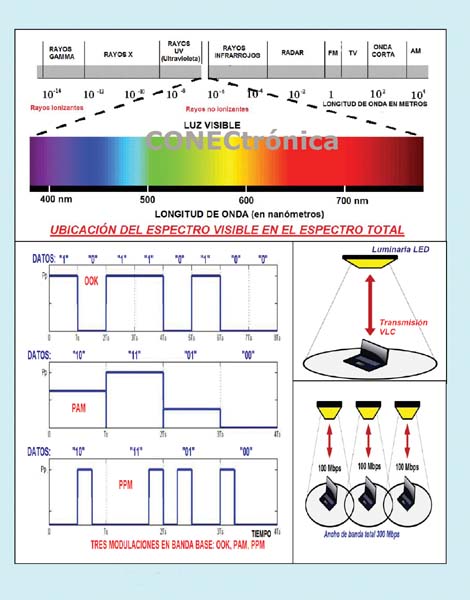
 VLC allows for the establishment of dedicated channels and simplex, half-duplex, and full-duplex communications. A VLC system can transmit digital signals by controlling the ON/OFF repeat of a light-generating device such as an LED (solid-state Light Emitting Diode) or emerging technology like OLED (flexible Organic Light Emitting Diode used in HDTVs and smartphones), or by controlling the color-frequency of the transmitted light, without the human eye perceiving it.
LED technology is evolving in three categories: (i) Phosphor LEDs. Speeds of up to 40 Mbps can be achieved. (ii) RGB LEDs. Speeds of up to 100 Mbps can be achieved. (iii) RCLEDs or resonant cavity LEDs. Speeds of up to 500 Mbps can be achieved. In VLC, the visible light channel is defined by different wavelengths ranging approximately from 375 nanometers (violet) to 750 nanometers (red), or by the frequency range approximately from 400 THz (red) to 800 THz (violet). VLC technology is a category of OWC (Optical Wireless Communications) technologies, which also includes IR (Infrared) and UV (Ultraviolet) technologies.
Characterization. Properties. Applications.
According to a 2011 Cisco VNI report, user demand, measured in exabytes per month, is growing faster than spectral efficiency. Specifically, user demand is projected to grow by 32% between 2010 and 2015, while spectral efficiency is expected to increase by only 12% during the same period. Cisco also notes that the Compound Annual Growth Rate (CAGR) for mobile data usage is around 80%. Furthermore, by 2015, wireless device traffic is expected to surpass wired device traffic, and mobile video is projected to become the primary mode of internet traffic in the coming years. These increases in network traffic necessitate radical changes in how wireless communications are conceived. VLC technology is presented as an alternative to consider compared to RF technologies such as Wi-Fi/WLAN (IEEE 802.11a+b+g (x1), IEEE 802.11n (x10), IEEE 802.11ac (x200)), GPRS, WCDMA, HSDPA/HSUPA, HSPA, LTE, etc.
VLC/Li-Fi technology, which dates back to the beginning of the 21st century, allows data to be transmitted through visible light by sending data via LEDs that vary in intensity faster than the human eye can perceive. One of the elements of this technology is the new generation of high-brightness LEDs. It is possible to encode data in light by varying the rate at which the LED flashes from ON to OFF to produce different strings of binary ones and zeros. The LED intensity modulates so rapidly that the human eye cannot perceive it. Speeds of up to 500 Mbps have already been achieved (Siemens 2010).
The main properties of VLC technology are: (1) It is a LOS (Line of Sight) type. In principle, the transmitter and receiver must be aligned. (2) It allows for high-density wireless communications. It allows for space reuse. (3) It is an open technology; its spectrum is not subject to licensing. (4) It is not affected by radio frequency (RF) noise. (5) It does not affect or cause health problems, unlike RF emissions, especially those with high voltage per meter (V/m). (6) It uses light, and our society is inundated with light everywhere. (7) It allows for indoor positioning and geolocation. (8) It uses FSO (Free Space Optics). (9) Data can be present wherever there is light. (10) Light can be transmitted underwater. (11) Light does not penetrate walls, but RF signals do; therefore, this mitigates potential eavesdropping, although it can be intercepted and captured by reflections. (12) Light is not affected by RF electromagnetic interference, nor by RF inhibitors, however transmissions based on RF signals can be disabled using such devices, making it impossible, for example, to talk on a mobile phone in the vicinity of these devices.
Entities involved in VLC. Application areas.
Currently, there is an extensive and varied ecosystem of VLC technology developers, including: the LiFi Consortium, IEEE 802.15.7 (the IEEE 802.15.7 specification defines a seven-color channel for the physical layer (L1) in VLC. This evolving standard allows modulation schemes such as OOK/VPPM and CSK), VLC Ltd, Intel, Samsung, ETRI, VLCC (Visible Light Communication Consortium, comprised of Casio, Toshiba, Sony, NEC, Sharp, NTT, etc.), Siemens, ByteLight, LVX Systems, Philips, IBSEMtelecom, MIT, JEITA (Japan Electronics and Information Technology Industries Association), UCR, etc. At the European level, VLC activities are prominent in the OMEGA Project.
The range of applications for VLC is growing significantly, for example: (1) Indoor location services, i.e., geolocation, LBS (Location-Based Services). These enable navigation and tracking of entities (people, animals, machines, objects) within buildings where GPS is unavailable. This is particularly useful in hospitals, warehouses, offices, etc., where LED technology is increasingly prevalent. (2) High-density communications. VLC can supplement Wi-Fi spectrum by providing additional bandwidth in environments where unlicensed and/or licensed communication bands are congested. Examples include convention centers, conference hall lobbies, airports, beaches, transportation hubs, sports stadiums, etc. (3) Controllable LED lighting (casinos, hotels, stadiums, office skyscrapers, etc.). (4) Smart home networks. VLC enables wireless communication in residential and industrial lighting, including internet access and media streaming. (5) Commercial aviation. It enables wireless data communications for personal communication and in-flight entertainment and games. (6) Underwater communications. For divers, submarines, etc. (7) Hazardous environments. It enables communications in hazardous environments such as mines, gas facilities, petrochemical plants, explosives, etc. (8) Hospitals and healthcare facilities. It allows mobility and communication between patients without affecting their health. (9) Military and defense applications. It enables high-speed wireless communications within military vehicles and on battlefields. (10) Communications where Wi-Fi may present risks of data leakage through walls. (11) Three major markets can be identified: wireless access and networks, energy efficiency in lighting, and smart lighting control. VLC enables all types of mobile applications, WSN, augmented reality, indoor applications, toy networks in mobile environments, M2M communications, applications in AmI, and smart cities.
Components of the Technology.
Basically, a VLC transmission has two fundamental components:
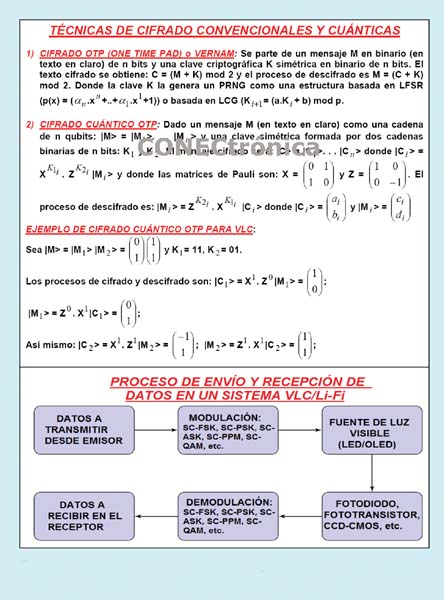
(1) Transmitter Unit. This generates light using various types of LEDs to emit visible light modulated by the data to be transmitted in a unidirectional/simplex, bidirectional HDX, or FDX manner. Some modulation methods/schemes are: (i) VPPM (Variable Pulse Position Modulation). Similar to PPM, but it allows control of the pulse width to compensate for the light decay. (ii) SM (Spatial Modulation). This allows the source of an optical signal to be determined. If the source can be determined, multiple information sources can be used to carry multiple independent data streams (one from each source), or the signal source can be used as part of the information encoding itself. Several sources can be multiple LEDs within a single device or luminaire. (iii) OFDM (Orthogonal Frequency Division Multiplexing). This uses a set of subcarriers, each at different frequencies but harmonically related. It offers good spectral efficiency but is somewhat complex to implement. (iv) PWM (Pulse Width Modulation). This allows information to be transmitted encoded in the pulse duration. More than one bit of data can be transmitted in each pulse, but longer pulse lengths may be required than for OOK, so it doesn't offer significant advantages. It is easy to implement. (v) CSK (Color Shift Keying). This is used in systems that employ RGB LEDs. By combining different colors of light, output data can be transmitted using the color itself, so the output intensity can be constant. Its implementation is complex. (vi) PPM (Pulse Position Modulation). Data is encoded using the pulse position within a frame. More than one bit can be sent in each pulse; however, the frame duration must be longer than for a single-bit OOK, so it is not necessarily more efficient. Each frame contains the same amount of optical energy. (vii) OOK (On-Off Keying). Data is generated by turning the LED on and off. A logic one is achieved by turning the LED ON, and a logic zero is obtained by turning the LED OFF. It is simple to implement but not optimal in terms of lighting control and data throughput. (viii) PAM (Pulse Amplitude Modulation). Information is carried in the pulse amplitude. PAM can carry more data in each pulse than OOK but is more susceptible to optical channel noise. For example, in 256-ASK modulation, each signal element carries the base-two logarithm of 256, resulting in 8 bits. (ix) Other schemes include 512-QAM (a mixture of ASK in amplitude and PSK in phase), 1024-PSK, BFSK (Binary Frequency Shift Keying) in frequency, and SS-kPPM (SubCarrier-Pulse Position Modulation), where k is a power of two, for example, two or four. Data is represented by the presence and absence of the carrier wave.
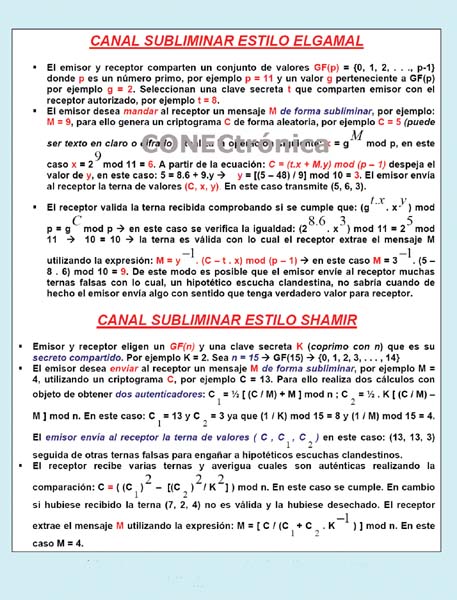
(2) Receiver unit. They use various elements to demodulate/decode light into received data, using photodetectors such as photodiodes, CCD arrays, phototransistors, etc., and suitable cryptographic-steganographic mechanisms to uncover visible ciphers and uncover the subliminal aspects of unobservable/unidentifiable data.
Protection of VLC Transmissions:
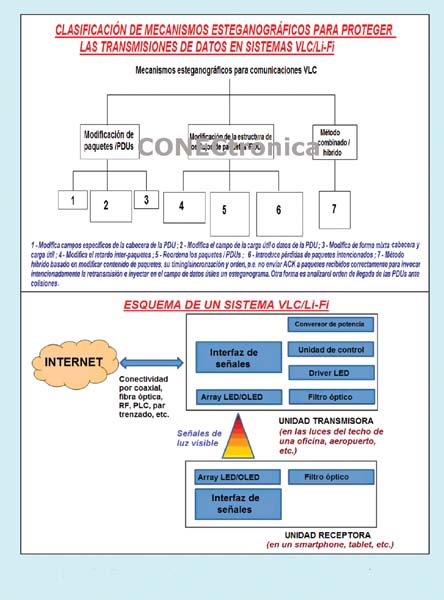
VLC transmissions can be maliciously altered, and therefore must be protected using cryptographic hash functions or digital signatures, since linear error detection functions such as CRC/VR/LRC are unreliable for handling potential unauthorized manipulation of messages sent via VLC technology. Steganography and cryptography are two different information concealment techniques that provide cybersecurity and cyberprivacy. Since ordinary light is multi-photon, some photons could be analyzed to decode the data it carries. Steganographic techniques allow the transmission of secret/private messages called steganograms in a VLC channel where other types of public information are already being transmitted. The goal of steganography and subliminal channels is to physically hide critical messages within other digital media so that the presence of these secret/private messages cannot be detected. Cryptography, on the other hand, only allows the meaning of the content of the secret messages to be hidden from potentially unauthorized entities. In cryptography, the encrypted message or ciphertext is visible even if it is not understood. The noise can be encrypted data, and the challenge is to find a key that transforms the noise into data intelligible only to authorized, legitimate entities. Cryptography and steganography differ in how they conceal transmitted data, but they are currently used together. VLC optical signals do not penetrate walls, preventing potential eavesdropping, unlike, for example, 2.4 GHz RF signals. RF signals at the same frequency can interfere with each other, and bandwidth can be limited by contention; however, in VLC, multiple LEDs can be used to increase bandwidth. In VLC, interference appears as noise (no signal cancels out) related to multipath fading. In VLC, path redundancy is achieved using multiple LEDs. Quantum cryptography is key in single-photon transmissions.
Final Considerations:
The emerging VLC technology appears to be a suitable alternative for integration with RF-based transmission technologies and those wired via copper cable (PLC over power lines, Gigabit Ethernet), as well as fiber optics. However, appropriate protection mechanisms must be integrated to manage cybersecurity and privacy risks in accordance with the type of applications deployed. Incandescent, fluorescent, and halogen lights cannot be modulated at speeds as high as LEDs.
This article is part of the activities developed within the LEFIS-Thematic Network.
Author:
Prof. Dr. Javier Areitio Bertolín – E.Mail:
Professor at the Faculty of Engineering.
Director of the Networks and Systems Research Group. University of Deusto
Bibliography
Areitio, J. “Information Security: Networks, Computing and Information Systems”. Cengage Learning-Paraninfo. 2013.
Areitio, J. “Identification, analysis and correlation between physical protection and cybersecurity”. Conectrónica Magazine. No. 161. October 2012.
Areitio, J. “Technical protection considerations regarding Bluetooth for WPAN”. Conectrónica Magazine. No. 160. September 2012.
Norman, TL “Risk Analysis and Security Countermeasure Selection”. CRC Press. 2009.
Shieh, W. and Djordjevic, I. “OFDM for Optical Communications”. Academic Press. 2009.
Arnon, S., Barry, J., Karagiannidis, G., Schober, R. and Uysal, M. “Advanced Optical Wireless Communication Systems”. Cambridge University Press. 2012.
Ghassemlogy, Z., Popoola, W. and Rajbhandari, S. “Optical Wireless Communications: System and Channel Modeling with Matlab.” CRC Press. 2012.