 Characterization of AmI systems. Application areas
Some of the technologies integrated into Ambient Intelligence (AmI) include computer vision-based intelligence, video surveillance (which analyzes people's language, faces, gestures, and emotions, for example, using augmented reality), biometric/perceptual interfaces with voice management, the use of nanotechnology-based materials such as artificial skin, multimodal interaction, ubiquitous networks, and more. AmI technology enables the creation of imperceptible/invisible, intuitive environments of intelligent network devices that are aware of human presence. Combined with advanced data mining capabilities, this allows people's data to be invisibly captured, analyzed, and exchanged among countless sensors, processors, databases, and devices to provide contextualized and personalized information services, even in countries with vastly different legal systems. The development of AmI environments is focused on creating systems and services that incorporate the following characteristics: networking, mobility, imperceptibility, and scalability. These features enable optimal connectivity at any time, regardless of location, for all the embedded elements in everyday objects (RFID tags, nanosensors/actuators). This intelligent and personalized approach allows for greater user focus, rich content and experiences, and visual and multimodal interaction. The rapidly evolving AmI technology identifies a growing number of technological developments that enable heterogeneous networked systems and devices with varying computing capabilities to cooperate in recognizing the daily activities of people, animals, and objects, supporting and participating in those activities.
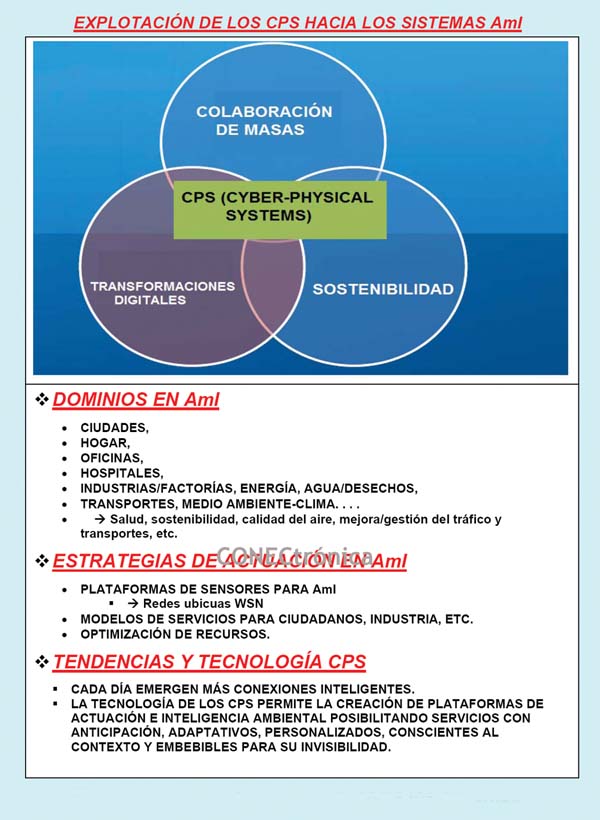
Ambient intelligence encompasses diverse deployment domains: home, home healthcare/hospitals, consumer electronics/leisure/work/home automation, traffic/vehicle management, air navigation, accident safety, entertainment, city management, urban life (smart cities), e-democracy, offices, cultural/educational centers, healthcare facilities, logistics, e-commerce/business, etc. Key components of AmI include ubiquitous super-wideband communications, distributed computing, and intelligent interfaces. AmI is characterized by several aspects, some of which are currently neglected: (i) A sensitive, context-aware, adaptive environment that responds to the presence of people and objects. (ii) An environment where technology is invisible, embedded, and hidden in the background. (iii) An environment that augments activities through implicit and intelligent assistance. (iv) An environment that must preserve cybersecurity, cyberprivacy, and reliability while using information only when needed and deemed appropriate (by whom?). This feature is currently given very little consideration in specific instances and practically no consideration at all globally. Cyber privacy, which is a right, is already being considered by some as a commodity (to be bought and sold) and a privilege for the few. (v) A recent, emerging paradigm based on artificial intelligence where computing units (tablets, smartphones, laptops, etc.) are used as proactive tools that help people with their daily activities, trying to make life more comfortable. The inclusion of increasingly sophisticated communication technologies and computing power in everyday objects is growing, and their embedding in our environments must be as invisible as possible. For AmI systems to succeed, the entire cybersecurity-privacy-trust machinery must be hidden and reliable; furthermore, human interaction with computing power and embedded systems in the surroundings must be seamless and occur without people noticing. People's awareness of AmI systems should be geared towards making them safer, more reliable, respectful of cyber privacy and cybersecurity, comfortable, and conducive to well-being.
 AmI technologies integrate sensor capabilities, processing power, artificial intelligence reasoning mechanisms, miniature network devices, applications and services, digital content, and distributed actuation capabilities within the surrounding environment. Although a wide variety of different technologies are involved, the goal of AmI is to conceal its presence from users, providing unobtrusive and implicit interaction paradigms. People and their social context should be at the heart of design considerations, from individuals to groups, from work teams to families or friends, and their corresponding work environments such as smart office buildings, smart factories, smart homes, smart public spaces, smart hospitals, business intelligence, smart factories, smart transportation, and so on.
Threats and Countermeasures in AmI:
AmI environments are comprised of various autonomous computing devices found in modern life, from consumer electronics and embedded electronics to mobile phones. People in an AmI environment are not meant to be aware of these devices (some based on nanotechnology) but rather to take advantage of them. The devices are aware of the presence of people in these environments, reacting to their gestures, actions, voice, and context. In the increasingly near future (the AmI world), every manufactured product (clothing, money, hardware devices, the paint on our walls, the carpets on our floors, our vehicles, etc.) will be embedded with intelligence, networks formed by very small sensors and actuators (some authors call them "smart dust"). Surveillance systems, biometrics, mobile personal communications, and other technologies have existed for some time. AmI enables personalized services and allows for much more information about us on a global scale via the Internet.
Recently, interest in Ambient Intelligence (AmI) environments has grown significantly due to new societal challenges that demand highly innovative services such as VANET (Vehicular Ad-hoc Networks), AAL (Ambient Assisted Living), e-Health, IoT (Internet of Things), home/business automation, and more. Ambient Intelligence aims to contribute to more sustainable and intelligent environments such as smart cities, smart cars, smart grids, and the orchestration of environmentally conscious (eco-aware) devices.

Ubiquitous/pervasive computing integrated into AmI environments is characterized by a very high number of heterogeneous intelligent devices (such as smartphones/PDAs, smart clothing, objects with embedded electronics-intelligence, fixed and mobile nanosensors, etc.) with different capabilities considering the communication channels, the power of their CPUs, the size of their memories, the level of their batteries (with the ability to self-recharge by vibration, light, movement, surrounding electromagnetic field, ambient sound, heat), etc.
The inherent cyber-privacy challenges of Ambient Intelligence (AmI) systems stem from two innovations necessary for their success: (a) An enhanced capacity to collect data on people's everyday interactions (across multiple modalities and over large spatial and temporal spans). (b) An enhanced capacity to rapidly search and correlate the collected data across large databases, creating greater possibilities for generating profiles and other forms of data mining. A potential set of generic cyber-privacy concerns surrounding Ambient Intelligence systems for users includes: (i) A ubiquitous and widespread network of interconnected communications and devices will result in a massive and significantly increased amount of personal information in circulation (a boon for attackers). (ii) The introduction of biometric and sensor interfaces for certain applications will transform the qualitative nature of the personal information in circulation. (iii) The ubiquitous networks integrated into AmI environments will require the tracking and collection of significant portions of users' everyday activities to provide personalized services. If these services are free or even have a cost, the economic advantages for the controllers of these AmI environments can be unimaginable.

Secure Multiparty Computing Scenarios.
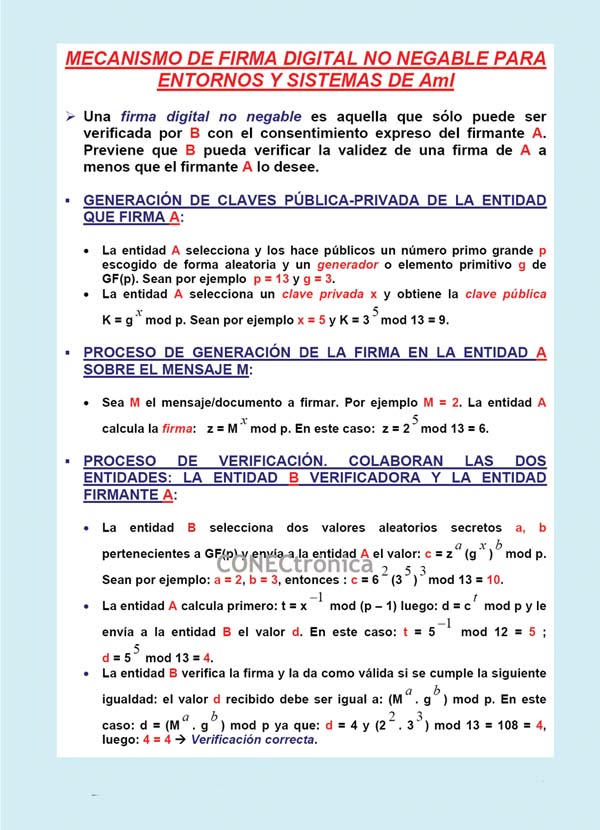
Consider N clients communicating with a server S using anonymous bidirectional channels. The server stores an input X for each client i and keeps a secret value qi. The goal is for each client to know the output value of a function f(qi, X) while keeping qi private from the server and preventing clients from learning information about X. These two cyber-privacy properties are called client privacy and server privacy. Suppose f is a linear function, for example, f(q, X) = (X, q), where X is a matrix stored by the server and q is a column vector stored by the client. The protocol for secure multiparty computing is: (1) Each client divides its input vector q into k additive fragments q1, . . . ., qk. Anonymously, k messages of the form (j, qj) are sent to S. (2) Server S responds to each message with the value (X.qj + rj) where rj are random masks whose sum is zero. Each client can now retrieve its output by adding k messages to what it received. Due to the choice of the rj masks, each client will not know any information about X.
Final Considerations
: To reap real benefits in the short, medium, and long term from increasingly sophisticated Ambient Intelligence environments, it is urgent to implement professional cybersecurity/cyberprivacy protection mechanisms and services, including those based on cybersecurity techniques developed using artificial intelligence and ubiquitous IoT network methods. 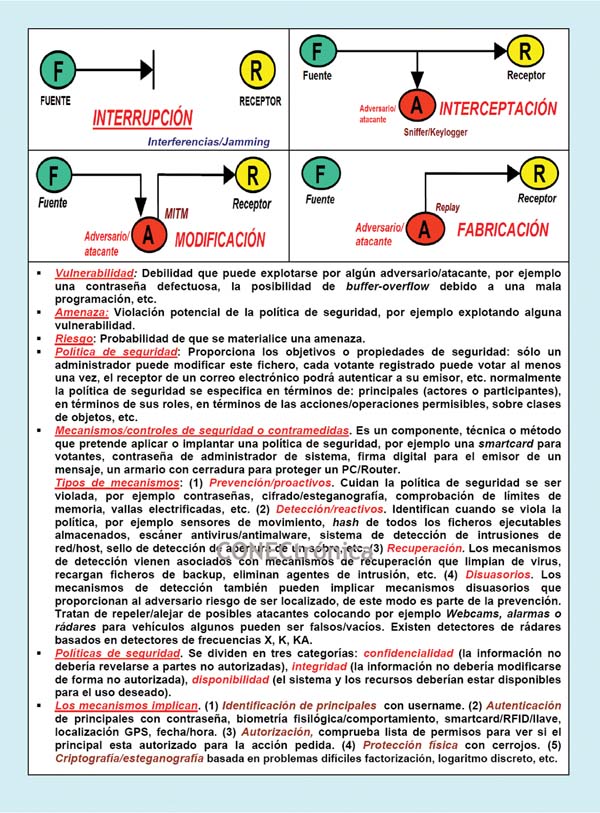 This article is part of the activities carried out within the LEFIS-Thematic Network.
Bibliography
Areitio, J. “Information Security: Networks, Computing and Information Systems”. Cengage Learning-Paraninfo. 2013.
Areitio, J. “Technical Considerations for Bluetooth Protection in WPANs”. Conectrónica Magazine. No. 160. September 2012.
Areitio, J. “Identification and Analysis of Web Application Protection”. Conectrónica Magazine. No. 143. January 2011.
Weber, W., Rabaey, J. and Aarts, EHL “Ambient Intelligence”- Springer. 2010.
Wright, D., Gutwirth, S., Friedewald, M., Vildjiounaite, E. and Punie, Y. “Safeguards in a World of Ambient Intelligence”. Springer. 2010.
Petkovic, M. and Jonker, W. “Security, Privacy and Trust in Modern Data Management: Data-Centric Systems and Applications.” Springer. 2010.
Eldar, YC and Kutyniok, G. “Compressed Sensing: Theory and Applications.” Cambridge University Press. 2012.
Schneier, B. “Economics of Information Security and Privacy.” Springer. 2011.
Nicastro, FM “Security Patch Management”. CRC Press. 2011.
Norman, TL “Risk Analysis and Security Countermeasure Selection.” CRC Press. 2009.
Wright, D. and Hert, P. “Privacy Impact Assessment.” Springer. 2012.
Fuller, R. and Koutsoukos, XD “Mobile Entity Localization and Tracking in GPS-less Environments. Second International Workshop”. Proceedings. Orlando. USA. September. 2009.
Craig, T and Ludloff, ME “Privacy and Big Data.” O'Reilly Media. 2011.
Bettini, C., Jajodia, S., Samarati, P. and Wang, XS “Privacy in Location-Based Applications: Research Issues and Emergency Trends”. Springer. 2009.
Tinm, C. and Perez, R. “Seven Deadliest Social Networks Attacks.” Syngress. 2010.
Axelrod, WW, Bayuk, JL and Schutzer, D. “Enterprise Information Security and Privacy.” Artech House Publishers. 2009.
Kostopoulos, G. “Cyberspace and cybersecurity.” Auerbach Publications. 2012.
Author:
Prof. Dr. Javier Areitio Bertolín – E.Mail:
Professor at the Faculty of Engineering.
Director of the Networks and Systems Research Group. University of Deusto.