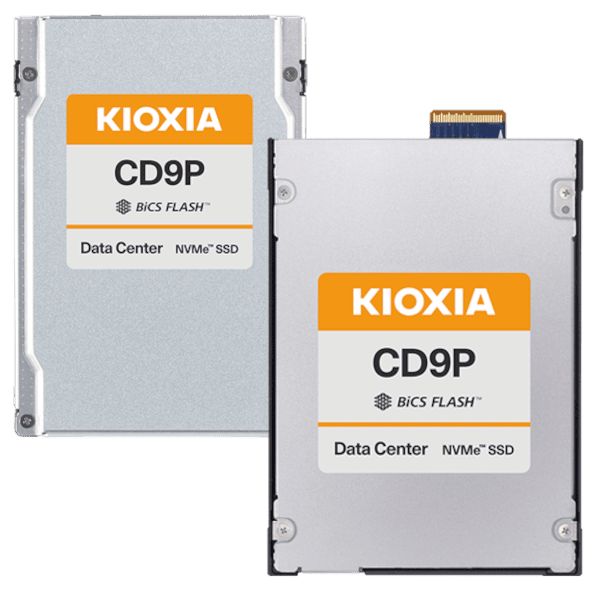
As GPU-accelerated AI servers increase demands on storage infrastructure, maintaining high throughput, low latency, and consistent performance—including keeping valuable GPUs fully utilized—is critical. The KIOXIA CD9P Series is designed for these next-generation environments, delivering the speed and responsiveness required by AI, machine learning, and high-performance computing workloads to ensure GPUs remain well-supplied with data and operate at peak efficiency.
The CD9P Series leverages KIOXIA’s most advanced 3D flash memory to date, featuring a CBA-based architecture that reduces heat generation, improves thermal management, and delivers greater overall value through improved performance and power metrics and a lower total cost of ownership.
The KIOXIA CD9P series drives offer performance improvements across the board of up to approximately 125% in random write speeds, 30% in random read speeds, 20% in sequential read speeds, and 25% in sequential write speeds compared to the previous generation[2].
In addition, performance per watt of power consumption has improved by approximately 60% in sequential read speeds, 45% in sequential write speeds, 55% in random read speeds, and 100% (2x) in random write speeds [2]. (Applies to the 15.36 terabyte (TB) model)
KIOXIA CD9P Series SSD highlights include (preliminary and subject to change):
▪ Supports PCIe 5.0, NVMe 2.0, NVMe-MI 1.2c
▪ Supports Open Compute Project NVMe™ Datacenter SSD v2.5 specification (not all requirements met)
▪ Form factors: 2.5-inch, 15 mm thick, EDSFF E3.S
▪ Read-intensive (1 DWPD) and mixed-use (3 DWPD) durations
▪ Sequential throughput (128 KiB/QD32) - 14.8 GB/s read and 7 GB/s write
▪ Random throughput (4 KiB) - 2600 KIOPS (QD512) read and 750 KIOPS write (QD32) write speed
▪ 2.5-inch capacities up to 61.44 TB and E3.S capacities up to 30.72 TB
▪ CNSA 2.0 algorithm support 3
“Achieving energy efficiency while addressing the growing demands of all data processing challenges for AI, machine learning, or high-performance computing is arguably the most pressing issue today and in the future,” says Axel Stoermann, Vice President and Chief Technology Officer of Integrated Memory and SSDs at KIOXIA Europe GmbH. “At KIOXIA, we are already addressing this need by offering the CD9P series, a leading energy-efficient, high-performance solution that delivers speed and responsiveness for heavy workloads and optimal operation.”
Further Information
Notes
[1] Compared to the 6th generation BiCS FLASH
[2] Compared to the KIOXIA CD8P series
[3] The KIOXIA CD9P series supports the Leighton-Micali Signature (LMS) algorithm, recognized by CNSA 2.0[4] as a digital signature algorithm to prevent firmware tampering in anticipation of the threats that quantum computers pose to conventional cryptographic algorithms. The Advanced Encryption Standard (AES-256) with a 256-bit key length, which is the data encryption algorithm used in the CD9P, is also recognized by CNSA 2.0.
[4] CNSA2.0: Commercial National Security Algorithm Set 2.0
- 2.5 inches indicates the form factor of the SSD drive and not its physical size.
- Read and write speeds can vary depending on several factors, such as the host device, software (drivers, operating system, etc.) and read and write conditions.
- Performance is preliminary and subject to change without notice.
- Definition of capacity: KIOXIA Corporation defines a kilobyte (KB) as 1000 bytes, a megabyte (MB) as 1,000,000 bytes, a gigabyte (GB) as 1,000,000,000 bytes, a terabyte (TB) as 1,000,000,000,000 bytes, and a kibibyte (KiB) as 1024 bytes. However, a computer's operating system reports storage capacity using powers of 2, defining 1 GB = 2^30 bytes = 1,073,741,824 bytes and 1 TB = 2^40 bytes = 1,099,511,627,776 bytes, thus indicating less storage capacity. Available storage capacity (including examples of various media files) will vary depending on file size, format, configuration, software and operating system, and/or pre-installed software applications or media content. Actual formatted capacity may vary.
- One kibibyte (KiB) means 2^10, or 1024 bytes.
- IOPS: Input Output Per Second, or the number of input/output operations per second.
- The following trademarks, service names, or company names (HPE, Hewlett Packard Enterprise Company, NVMe, NVMe-MI, NVM Express, Inc., PCIe, PCI-SIG) are not registered, created, or owned by KIOXIA Europe GmbH or its affiliated companies. However, they may have been applied for or registered by third parties in various jurisdictions, created by them, or owned by them, and are therefore protected from unauthorized use. All other company names, product names, and service names mentioned herein may be trademarks of their respective third-party companies.