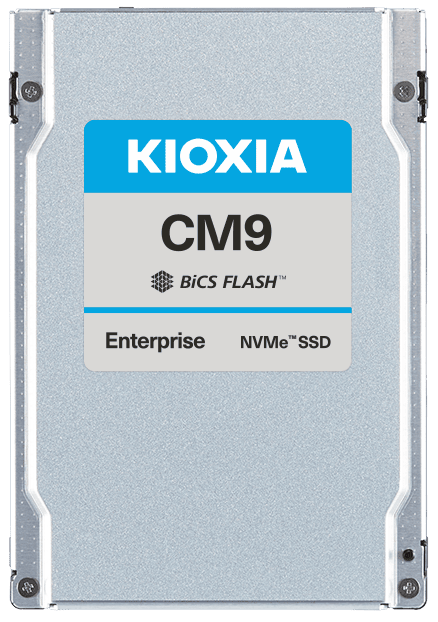
As the demands of modern computing increase, applications such as AI, machine learning, and high-performance computing require sophisticated solid-state storage infrastructure that demands not only enterprise-class performance but also greater energy efficiency to ensure scalability and affordable operating costs. Meeting these demands is central to the design of KIOXIA's CM9 Series, which has been specifically built to support the workloads of next-generation data centers.
KIOXIA's 8th generation BiCS FLASH™, the company's most advanced 3D flash memory to date, is a key component of the CM9 series. This technology utilizes a CBA-based architecture that significantly increases NAND interface speed, improves density and power efficiency, and reduces latency, resulting in higher SSD performance.
The KIOXIA CM9 Sseries SSDs offer performance improvements of up to approximately 65% in random writes, 55% in random reads, and 95% in sequential writes compared to the previous generation, the KIOXIA CM7 series. Furthermore, the performance-per-watt gains include approximately 55% greater sequential read efficiency and 75% greater sequential write efficiency.
Axel Stoermann, Vice President and Chief Technology Officer of Integrated Memory and SSD Products at KIOXIA Europe GmbH, emphasizes: “Along with processing power and energy efficiency, memory is critical for enabling AI, machine learning, and high-performance computing applications. Featuring our 8th generation BiCS FLASH™, the CM9 series is designed to address these storage demands by providing the highest level of bit density, fast data transfer, and exceptional energy efficiency—all of which contribute to the superior performance of our SSDs.”
Key features of the KIOXIA CM9 Series SSD include (preliminary and subject to change):
Compliance with PCI 5.0, NVMe 2.0, NVMe-MI 1.2c and OCP Datacenter NVMe SSD 2.5 specifications;
Dual-port support in 2.5-inch and E3.S form factors;
Read-intensive (1 DWPD) and mixed-use (3 DWPD)
endurance; Sequential performance (128 kibibytes (KiB)/QD32): 14.8 GB/s read and 11 GB/s write
Random throughput (4 KiB): 3400 KIOPS (QD512) and 800 KIOPS (QD32)
2.5-inch capacities up to 61.44 terabytes (TB) and E3.S capacities up to 30.72 TB