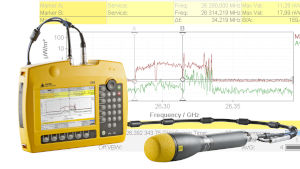
 Narda Safety Test Solutions has developed two new 5G antennas for its SRM-3006, opening up the upper 5G FR2 frequency band to the handheld unit system for measuring field strength. An omnidirectional downconverter antenna and a directional antenna will now record electromagnetic fields (EMF) and their sources in the 24.25 to 29.50 GHz range.
 The SRM-3006 can now also be used in the millimeter wave range. Selective measurement allows, for example, the specific consideration of the 5G band and, more specifically, that of a particular vendor. Given the requirements of 5G NR (5th Generation New Radio), thanks to the frequency extension of the SRM-3006 to FR2, metrology professionals do not need to learn, let alone purchase, new measuring equipment.
Installing the new antennas is straightforward. After connecting the new 5G downconverter antenna, the metrology professional sets the desired frequency band and begins the series of measurements as usual. The respective frequency sensitivity and frequency response are also stored in the 5G antennas themselves. This data is read and adopted by the SRM base unit when it connects via a Narda antenna cable.
The new 5G antennas are compatible with 5G bands ranging from 24.25 to 27.50 GHz and also from 26.50 to 29.50 GHz. Since high FR2 frequencies experience significant losses due to attenuation, even over short cable runs, the downconverter is connected directly to the antenna module. The cable running to the base station now only transmits frequencies up to 6 GHz, resulting in lower cable losses and a much more robust cable type.
The antennas have their own integrated battery for an approximate operating time of 4 hours. With a commercially available external Power Pack, they can be used for extended measurements.
To cover the third dimension (Z), the antenna must be rotated during measurement. The second, highly sensitive 5G downconverter antenna is ideal for reliably detecting very weak signals thanks to its directional characteristic. Especially when taking measurements indoors, attenuation of up to 30 dB is common at these frequencies, for example, due to window glass. Its directional characteristic is also ideally suited for isolating or locating mobile phone transmission antennas through measurements.