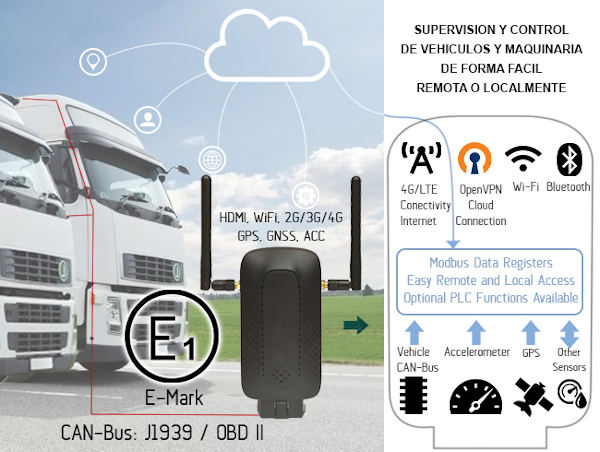
With the Vehicle-RPI, you can access vehicle FMS data intelligently "on demand," avoiding the constant transmission of data and saving on data usage. It connects via OpenVPN, allowing you to extend a local area network (LAN) from the office to any vehicle securely with certificates that encrypt the communication (similar to online banking).
Vehicle data can be accessed from anywhere in the world (using a smartphone, tablet, or PC, all with a VPN and each with its own certificate) for vehicle and asset tracking, driver management, and maintenance.
• Stores vehicle FMS data in its database at the management offices.
• Records data on driving style, acceleration, turns, braking, and impacts.
• Stores precise GPS/GNSS position data, including longitude, latitude, and altitude.
• Create your own on-board office and control it remotely via Ethernet or Wi-Fi.
• Remotely access vehicle devices such as temperature sensors, humidity sensors, load sensors, gauges, actuators, etc.
The Fleet Management System (FMS) is a standard interface for data from commercial vehicles. Six European manufacturers—Daimler AG, MAN AG, Scania, Volvo (including Renault), DAF Trucks, and IVECO—developed the so-called "FMS standard" in 2002 to enable manufacturer-independent telematics applications.
FMS Gateway Features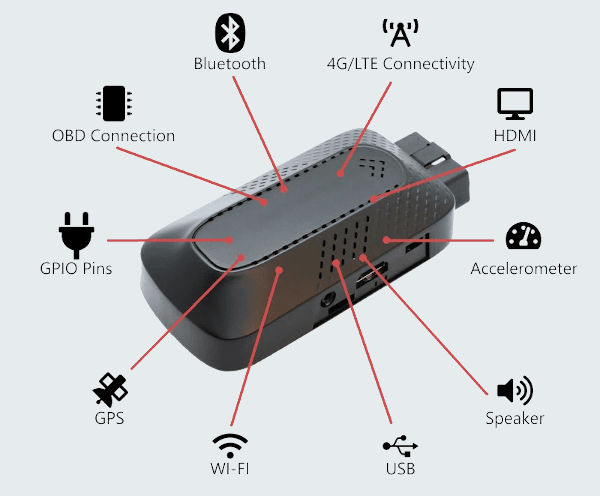
• Configuration via a web page.
• Transmission of CAN-Bus, J1939, OBD II, GPS, and Accelerometer data via Wi-Fi/WLAN, Bluetooth, OpenVPN, or a 2G/3G/4G mobile connection.
• Selection of data to be transmitted: PGN (Parameter Group Number), SPN (Suspect Parameter Number).
• Mapping to Modbus TCP.
• Display of vehicle data via an HDMI screen or a web page.
The following data is transmitted on the standard FMS interface:
1. Vehicle speed (based on wheels)
2. Vehicle speed (from tachograph)
3. Clutch switch (on/off)
4. Brake switch (on/off)
5. Cruise control (on/off)
6. PTO Power take-off (status/mode)
7. Accelerator pedal position (0-100%)
8. Total fuel used
9. Fuel level (0-100%)
10. Engine speed (RPM)
11. Axle weight (kg)
12. Total engine hours (h)
13. FMS standard software version (supports various modes)
14. Vehicle identification number (ASCII)
15. Tachograph information
16. High-resolution vehicle distance
17. Service distance
18. Engine coolant temperature (°C)
FMS data is derived from the vehicle's J1939 bus and encoded according to the SAE J1939 protocol.
The data refresh rate depends on the data type (its dynamic content) but ranges from 20 ms (e.g., engine speed) to 10 seconds (e.g., vehicle identification number).
With the FMS standard, manufacturer-independent applications and data evaluations are now possible. The amount of available FMS data depends on the vehicle manufacturer and model.
We have access to all J1939 data if the FMS data vector is insufficient for our application. With the FMS Gateway implemented in this Raspberry Pi Vehicle Computer, this is not a problem, as we can choose which PGNs and SPNs to access without restrictions.
The GPS system provides information that can be received from the GPS receiver:
1. GPS latitude.
2. GPS longitude (two-dimensional or three-dimensional model).
3. GPS altitude in meters above mean sea level (WGS 84 geoid ellipsoid model).
4. GPS vertical and horizontal accuracy.
5. Number of satellites visible to the receiver.
6. Number of satellites used in the position calculation.
7. Direction of movement: Degrees [0-360] from true north.
8. Speed of movement in m/s.
9. GPS UTC time (Coordinated Universal Time).
10. GPS UTC time validity indicator.
It receives data from the built-in accelerometer, MMA8x5x chip.
The accelerometer indicates acceleration in the X, Y, and Z directions, allowing for the detection of impacts caused by accidents and the identification of unexpected accelerations (such as sudden braking or sharp turns) by the driver (driver behavior).
With the Vehicle-RPI, an Eco-Driving system can be developed to reduce fuel consumption and extend the life of the equipment by reducing wear.
receives data from other external sensors connected to the vehicle.
It incorporates multiple communication and control interfaces. Through its Ethernet TCP/IP connector, it is possible to access other sensors and transmitters installed in the vehicle using different protocols that can be channeled over Ethernet TCP/IP, such as RS232, RS422, RS485, etc.
The Vehicle-RPI allows you to perform calculations and execute control tasks.
It's possible to install software modules for Raspberry Pi, such as IEC 61131-C PLC-type industrial control software (CodeSys). This software supports programming in Instruction List, Ladder Diagram, Structured Text, Function Block Diagram, and Sequential Function Block Diagram, among other formats.
CodeSys allows communication with Profinet, Ethernet/IP, Modbus RTU and TCP, EtherCAT, BACnet, OPC-UA, MQTT, and more.
It also supports NodeRED software, specifically designed for flowchart programming and MQTT.
The Vehicle-RPI supports major programming languages, such as C, C++, and Python.
The Vehicle-RPI can be configured as a web server for data visualization, graphics, file downloads, and other functions.