The new 96xx series contains 12 different DDS generators capable of producing up to 50 sine wave cores on a single output channel.
 The 96xxs series comprises 12 different models in three distinct formats: PCIe cards, PXIe modules, and Ethernet instruments. A single PCIe or PXIe card can produce up to 50 different variable-frequency tones with low phase noise and is available with up to 4 channels. Standalone Ethernet instruments offer from 2 to 24 channels. For applications requiring more than 50 tones, larger NETBOX units support up to 300, or multiple cards can be linked with the Star Hub synchronization module to create systems with up to 400 tones. All models feature integrated output amplifiers with programmable signal amplitudes up to ±2.5 V into 50-ohm loads, or ±5 V for high impedance.
Extremely Fast Parameter Changes:
The speed at which these products can change the characteristics of a tone is what sets them apart from conventional signal generators. Fully programmable, changes can be made almost instantaneously using simple commands. New frequency, amplitude, and phase settings for a tone, as well as amplitude and frequency slopes, can be initiated during runtime or via preloaded DDS command sequences. Millions of DDS commands can be stored in the onboard memory. Adjustment changes can be triggered externally, by an internal timer, or immediately after the command. There are no jitters or transition failures, and the time resolution of the sequencing commands is as low as 6.4 nanoseconds.
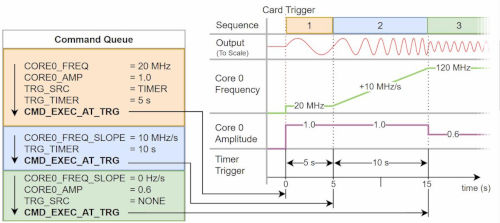
In DDS mode, only a few commands are needed to, for example, generate a sine wave (orange block), accelerate the frequency (blue block) and reduce the amplitude (green block).
DDS Controls Waveforms in Test & Measurement, Communications, and Quantum.
The 96xx series DDS generators offer users an easy and programmable way to produce waveform trains, frequency sweeps, or fine-tuning references of various frequencies and profiles. Applications can be found in industrial, medical, and imaging systems, network analysis, or even communications technology, where data is encoded using phase and frequency modulation on a carrier. Another application is laser control using AOD and AOM, as is often done in quantum experiments. Laser control can be performed at very high speed with just a few simple commands, in contrast to the more processing-intensive method using an Arbitrary Wave Generator (AWG), which requires large calculations of data matrices. By issuing a small series of slope commands, the user can control advanced functions such as custom S-shaped frequency transitions, custom pulse envelopes, AM or FM modulation, and much more.
Easy System Integration:
The 96xx Series DDS generators, which run on Windows or Linux operating systems, can be programmed using sample programming for C++, Python, C#, Java, LabVIEW, MATLAB, and others, as well as a high-level Python API that provides a simple way to control the products.
Two Instruments in One:
If more complex waveforms ever need to be generated, the 96xx Series can also be converted into a fully functional AWG. A firmware option is available that transforms the DDS generator into an AWG, allowing the synchronous playback of arbitrary waveforms on all active channels. Supported operating modes include single-shot, loop, single-reset, multiple-repeat, controlled-repeat, broadcast (FIFO), and sequential-repeat.
Availability:
The DDS 96xx series generators are now available. The products come with a 5-year warranty, free software and firmware updates, and lifetime customer support from the engineering team.