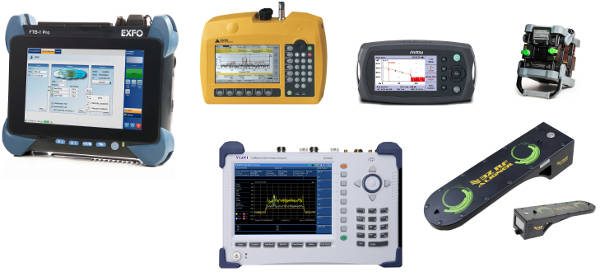
The multiple communication standards currently used in wireless networks (LTE, UMTS, GSM-900, DSC-1800, and in many cases TETRA) make the work of test engineers increasingly complex. This is further complicated by the diverse base station topologies, such as remote radio heads, fiber-to-antenna systems, and hybrid systems (with a combination of fiber optic and coaxial cables). Congestion reduces available bandwidth, while the much greater presence of shared installations raises concerns due to increased interference.
Given the diversity of technologies, along with the higher performance levels expected, it is essential that engineers have access to a wide range of advanced instruments capable of providing greater accuracy. With this in mind, Microlease is now able to provide its customer base with a complete rental package comprising the various equipment needed for these purposes, as well as offering a comprehensive range of options that are combined and matched with an ever-expanding selection available directly from stock. In addition, renting maximizes flexibility, as equipment can be returned when no longer needed or exchanged for other models to obtain different test parameters.
The Microlease Wireless Tool Box includes the following:
• Cable and antenna testers for fiber optic testing, such as the Viavi Cell Advisor (available with optical power measurement capability).
• Transmission testers, such as the EXFO FTB-880-V2, for evaluating emerging wireless communication protocols supported by consortia (CPRI, OBSAI, etc.).
• Short-range optical time-domain reflectometers (OTDRs), such as the Anritsu MT9090, to ensure that installed fiber optic cable meets the required quality levels.
• Ultra-portable antenna alignment systems from 3Z and Kathrein.
• Personal radiation meters, such as the Radman ESM-20, to protect field personnel.
• Equipment for monitoring electromagnetic field strength, such as the Narda SRM-3006.
• Sophisticated tools to facilitate base station integration, such as the Ascom TEMS Pocket and the SwissQuall Qualipoc.
• Finally, the importance of combating passive inter-modulation (PIM) is increasing as next-generation networks are deployed. This is why dual-band PIM analyzers, such as the Kaelus ITA series, are gaining acceptance, as single-frequency measurements may not be suitable.
Addressing the challenges of multiport and multisite testing
Devices with multiple ports require fast and accurate multiport network analysis. Optimize your vector network analyzer configuration to minimize testing costs for these devices.