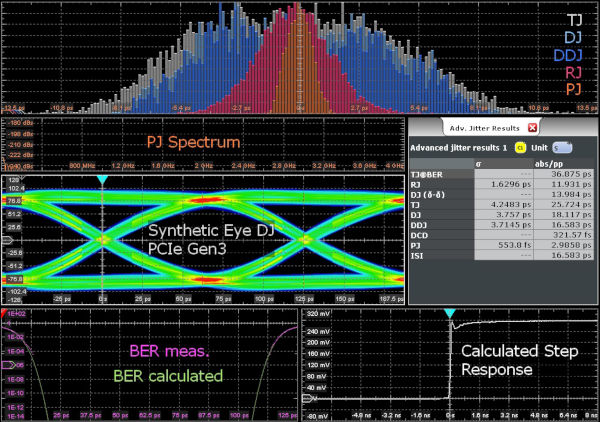
The new R&S RTO-/ RTP-K133 option for advanced jitter analysis introduces an analytical approach that separates the various jitter components, such as random jitter and deterministic jitter components (such as data-dependent and periodic jitter). This approach is based on a parametric signal model that fully characterizes the behavior of the transmission link under test.
A key benefit of this method is that the jitter model includes the full waveform characteristics of the signal under test, in contrast to conventional methods that reduce data to a set of time-interval error measurements. The result is consistent data even from relatively short signal sequences, as well as previously unavailable information such as step response or the difference between vertical and horizontal periodic jitter. Engineers benefit from comprehensive jitter representations such as synthetic eye diagrams, histograms of all the different jitter components, spectral and periodic jitter peak views, and the bathtub diagram for estimating the bit error rate.
This new jitter separation option expands signal integrity debugging capabilities for engineers. It combines time-domain reflectometry (TDR) and time-domain transmission (TDT) measurements, along with real-time debugging, on a single oscilloscope.