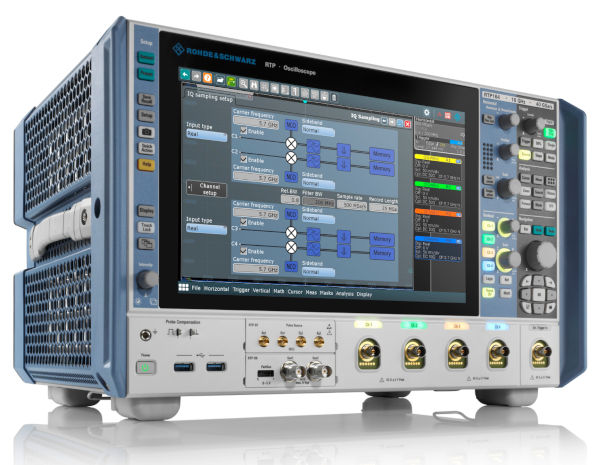
The new R&S RTP134 with a 13 GHz bandwidth and the R&S RTP164 with a 16 GHz bandwidth support four channels at 8 GHz or two interleaved channels for the respective higher frequencies. Upgrade options for all R&S RTP models support bandwidth increases up to 16 GHz.
The new models support all the features already present in models up to 8 GHz, including high acquisition and processing rates and real-time de-embedding. The bandwidth of the industry-leading digital trigger is expanded to 16 GHz to offer maximum accuracy and detect very small and intermittent signals. The R&S RTP triggers de-embedded signals in real time and supports all types of triggering, including pulse width, setup and hold, or short frame, up to the full bandwidth of the instrument.
The new math module introduced after the real-time de-inclusion block is ideal for debugging high-speed differential signals and is available with triggering and data acquisition functions. It also supports the addition or subtraction of any two signals, as well as signal inversion and common-mode operations.
R&S RTP users can analyze high-speed serial signals at rates up to 16 Gbps with the R&S RTP-K140/K141 serial pattern triggering options, including hardware-based clock data recovery for extracting the embedded clock signal as a trigger reference. Triggering supports bit patterns up to 160 bits in length, as well as decoding schemes such as 8B/10B or 128B/132B. Eye charts for debugging signal integrity based on the embedded clock enable at-a-glance analysis with the quick mask test or histogram function, providing results in seconds.
The RTP family supports debugging and compliance testing on DRAM memory interfaces using DDR4, DDR4L, and LPDDR4 with the new R&S RTP-K93 option. It combines multiple functions such as READ/WRITE decoding, up to four DDR eye displays, and automated compliance testing according to the relevant JEDEC standards.
The new I/Q mode option on the R&S RTP-K11 converts modulated signals into I/Q data for analysis, saving memory and extending the maximum acquisition time. The R&S VSE vector signal explorer is the ideal tool for in-depth analysis of broadband radar signals or demodulation of wireless communication signals, including 5G NR. The I/Q data can also be processed with any suitable external proprietary signal analysis tool.
The R&S RTP now offers comprehensive analysis of all the functions of a time-domain reflectometry (TDR) and transmission (DTT) analysis system for characterizing and debugging signal paths such as traces, cables, and PCB connectors. The new R&S RTP-K130 option combines the highly symmetrical differential pulse signals from the R&S RTP-B7 signal source with analog input channels to provide simple, differential DTT/TDR analysis of output signals. The software guides the user through setup, calibration, and measurement.
The R&S RT-ZM family of modular probes has interchangeable probe tips and instant mode switching, plus excellent RF performance, and has been expanded with the addition of the 13 GHz bandwidth RT-ZM130 and the 16 GHz bandwidth RT-ZM160.
The R&S RTP oscilloscope is aimed at electronics developers in the automotive, aerospace and defense, industrial, and telecommunications sectors. It is ideal for debugging embedded designs, including high-speed buses (such as USB, PCI Express, MIPI, or DDR memory), multi-channel RF interfaces (radio or radar), complex power management units, and simple control and programming buses like I2C and SPI. It is the only instrument on the market that compensates for transmission loss from the source to the oscilloscope in real time, making it extremely fast even with signal correction enabled.
The high-performance R&S RTP oscilloscope is now available from Rohde & Schwarz with a choice of 4 GHz, 6 GHz, 8 GHz, 13 GHz and 16 GHz.