Rail Requirements: Rugged Connectors.
The rail industry has strict safety-critical design parameters that must be met when purchasing connectors, including size, voltage specifications, and resistance to environmental elements. The ability to withstand temperature fluctuations is also a major concern, particularly in undercarriage system applications such as traction, motor, and brake controls, where cables and interconnects can experience extreme temperatures. Furthermore, rail connection solutions must be fire-resistant. High-temperature connectors are often constructed with machined copper-silver alloy contacts and a machined stainless steel protective cover with ceramic inserts. Conventional connector inserts are made of plastic or rubber, but these materials melt at the extreme temperatures present during a fire. Ceramic is resistant to fire and the embrittlement caused by moisture evaporation; thus, the rigidity of the ceramic material makes it less susceptible to vibration and braking. A ceramic insert is held in place within the protective cover by a metal retaining ring. As a result, the connector is easy to disassemble, allowing for quick, simple, and field-based maintenance.
While materials like neoprene are suitable for temperatures ranging from -55°C to +25°C, connectors using silicon are capable of operating in a range of -55°C to +200°C. Furthermore, some connectors are designed to meet the European CEN/TS 45545 standard governing fire safety in railways, and therefore must be able to withstand exposure to high temperatures for at least 15 minutes on the ISO 834-1 heat curve, where the maximum temperature is 800°C. The connectors with reverse bayonet coupling have been tested to meet European standards CEN/TS 45545 and withstand temperatures up to 800°C for the specified time, making them ideal for use in safety-critical railway applications such as electronically controlled pneumatic braking and motor diagnostic controls.
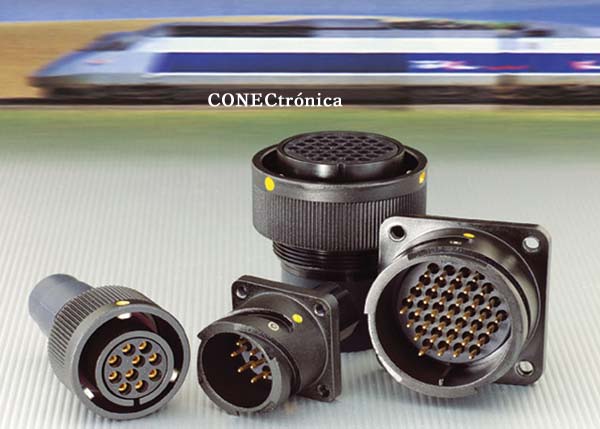
Railway connectors require resistance to high pressures, corrosive liquids and gases, as well as high temperatures. The development of thermoset elastomers and PEEK (polyether ether acetone) engineering plastics achieves the required environmental tolerance limits while providing smaller and lighter circular connector solutions. For example, ITT's VBN series connectors (Figure 1) are made of thermoplastic material conforming to NFF16-101 and NFF16-102 standards and are available in sizes as small as three inches in diameter, with corresponding weight reductions associated with each size. The connector's mating gasket and other parts are made of silicone rubber and fire-resistant rubber, while the metal parts of the connector are made of a RoHS-compliant aluminum alloy with a black urethane epoxy varnish. Connectors that feature IP67 sealing protection to withstand harsh environments can be specified for applications ranging from instrument panel and power interfaces to air conditioning and junction boxes.
Rail Requirements: High-Speed Connectors.
Cost, functionality, and performance are also critical parameters for rail customers, in addition to robustness and reliability. Designed to reduce costs and increase functionality in public transport applications, manufacturers have developed connection solutions that package multiple Ethernet and MVB lines into a single connector. These high-speed bayonet databus circular connector solutions decrease the number of components and lines, reduce cost and weight, and increase functionality and performance. High-speed connectors meet high durability and reliability specifications and are therefore capable of meeting the requirement for high connection cycles.
One such solution, the ITT CIR-M12 connector (Figure 2), offers reliable data transmission between cars and allows a variety of different data types (including Ethernet, MVB, WTB, and video signals) to be transmitted between cars in mass transit systems. The connector system consists of innovative QXM12 contacts mounted on their proven FRCIR bayonet circular connector hardware. Four conductor wires and the associated braid of shielded wires are integrated into the QXM12 contact, and a special plastic insert channels multiple QXM12 contacts and their wires into a single connector.
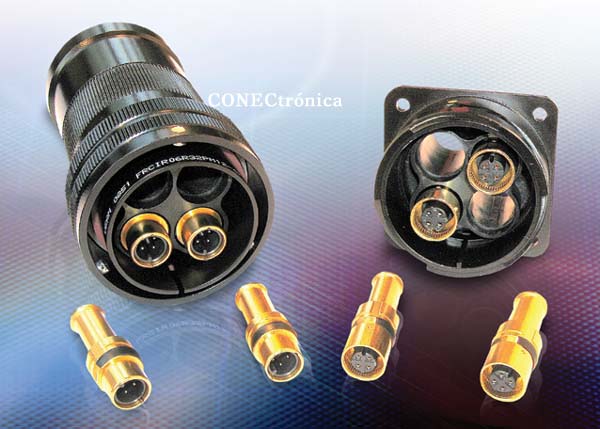 This technology allows designers to incorporate data transfer from Ethernet, MVB, WTB, and video lines, in accordance with VG95234 (where applicable), within the same connector, managing data feeds from various sources such as engine diagnostics, brake controls, environmental conditioning, passenger display systems, network control, and lighting. The databus connector contacts are rated at 3 A (the maximum current for 1 ms is 10 A), while the operating voltage is 100 VDC and the insulation resistance is 10 GΩ. Mechanically, the insert conforms to UNI-CEI 11170 (I2F2) and UL94-V0 specifications.
Railway Standards:
Global standards for railway applications differ from country to country. This is particularly true for DIN rail specifications. The IRIS (International Railway Industry Standard) certification is recognized worldwide for qualifying component manufacturers to work with railway equipment manufacturers, systems integrators, railcar assemblers, and their suppliers. IRIS was created to develop and implement a global system with a uniform language, consistent assessment guidelines, and mutual acceptance of audits for evaluating railway industry suppliers, with the aim of creating a high level of transparency throughout the supply chain.
Partnering with a connector manufacturer experienced in each of these areas eliminates design guesswork for high temperatures, high-pressure interfaces, and a host of other design challenges. Because these parts are used in critical applications, customers don't want to be part of the supplier's "learning curve." To maintain high levels of quality and performance and avoid hazardous outcomes, they want components from a manufacturer with a proven track record.
Working with a manufacturer familiar with the testing parameters of regulatory standards for components and bodies further simplifies the design and development processes, while ensuring that connectors meet all necessary regulations. In-house testing services and continuous quality improvement programs further strengthen a connector manufacturer's position as a proven supplier of railway connectors.
Constantly exposed to shocks and sudden vibrations, high pressure and temperature, as well as fluctuating environmental factors, railway connectors must be robust enough to withstand these harsh environmental conditions and function correctly at all times. Customers must select connectors specifically designed for harsh environment applications. Ensuring a rugged and reliable connector with high-performance characteristics that meets cost and functionality requirements is essential for developing a relationship with a connector company experienced in designing applications for harsh environments and familiar with the regulatory parameter testing procedures of the railway industry.
Author
Mike Gardiner is product manager at ITT Interconnect Solutions, and has over 30 years of experience in the connector industry.