
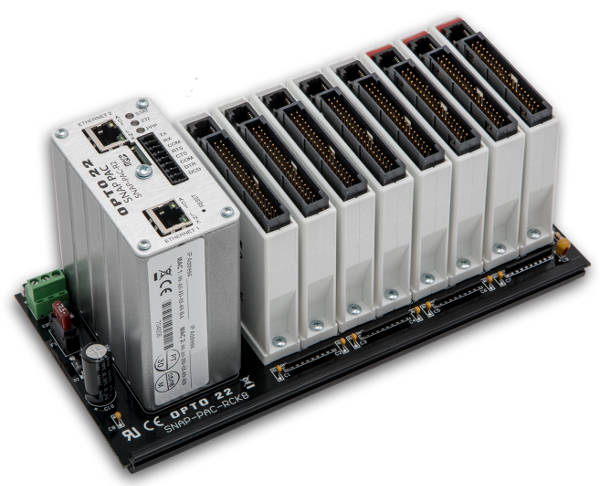
The addition of a secure RESTful server and an open, documented API to a programmable automation controller (PAC) is a revolutionary and groundbreaking innovation in the industry. REST architecture and its underlying technology are intrinsic to the Internet of Things and of paramount importance for web and mobile application development. Opto 22's implementation of REST directly into an already commercially available industrial programmable automation controller is unique in the market, positioning the company as the first and only industrial automation and control manufacturer to offer this industry-changing technology.
Through this new REST API, developers have secure programmatic access to new or existing resources via control variables and input/output (I/O) data using any programming language that supports JavaScript Object Notation (JSON). Available through a free firmware update for Opto 22 SNAP PAC (Single-Point Programmable Automation Controllers), the REST API includes an HTTP/S server accessible from any HTTP/S-compatible client. Rapid ROI for the IIoT.
Billions of sensors, machines, and devices already exist in the industrial infrastructure, but currently, they cannot connect to the IIoT. This equipment possesses valuable untapped data needed to improve business processes and decisions in almost every company and every industry. The Opto 22 platform enables developers to quickly design, prototype, and deploy applications to connect existing resources to the IIoT and share their data, capabilities, and resources with other connected systems and resources.
“The industrial automation and control industry is currently in transition,” says Benson Hougland, Vice President of Marketing and Product Strategy. “Vendors who have relied on a product development strategy based on proprietary and closed technologies have become obsolete. The future of the industrial automation and process control industry lies in the increased use of APIs and the increased data made possible through open standards-based technologies.
Our goal with the release of these new features is to enable IIoT developers to build their applications faster using familiar internet tools and technology.” Through a REST API to our PACs, we have enabled our customers and partners to quickly design and deploy IIoT applications using the language and tools they are familiar with, while simultaneously protecting their decades-long investments in technology for the future.”
An API to the Real World™ “The Industrial Internet of Things is based on the idea of seamlessly sharing data between disparate assets to identify new opportunities for businesses to become more competitive,” said Matt Newton, Director of Technical Marketing at Opto 22. “With these new features, when our customers and partners ask us how to connect their existing and future systems to the Industrial Internet of Things, we can simply say, 'there's an API for that'™.” Optimizing the IIoT Architecture A communication disconnect between the physical and digital worlds is slowing down the adoption and deployment of IIoT. Industrial assets exist in the physical world and use physical electrical signals such as current and voltage levels to communicate. Digital Internet systems do not understand or communicate with these signals. These types of signals. To address this lack of connectivity, current Industrial Internet of Things (IIoT) applications involve layers of gateways and middleware to translate between the physical and digital worlds.
As a result of this complexity, companies have been slow to reap the benefits of IIoT applications and technologies.
To accelerate the return on investment for IIoT applications, Opto 22 flattened the IIoT architecture by bridging the communication gap with open standards-based Internet tools and technologies. Opto 22's REST API for its automation controllers, combined with HTTP/HTTPS access, provides IIoT developers today with secure access to the billions of physical assets existing in the industrial system infrastructure. These features minimize the integration time and cost of IIoT applications by eliminating complex protocol converters, gateways, and middleware.
“To accelerate the development, deployment, and return on investment of IIoT applications, Opto 22 has cut through the complexity of current system architectures and has “We’ve provided a robust and scalable platform designed to meet the needs of IT and operations technology professionals,” says Hougland. “These new capabilities support the increasing convergence that businesses are seeing between information technology and operations technology.”
“We built this platform to provide our customers and partners with a solution that offers three key features,” says Bob Sheffres, vice president of sales. “First, it had to be tough enough to survive the harsh environments of industrial applications. Second, it needed to be appealing to both industrial automation and IT professionals to bridge the gap between IT and OT, while also appealing to the millions of developers who know and apply these technologies every day. And finally, and most importantly, we wanted to offer the platforms, technologies, and tools that enable our customers, partners, systems integrators, and OEMs to differentiate themselves from their competitors, future-proof their technology investments, accelerate their time to market, and solve tough automation problems faster than ever before.”





