 The rules
We cannot delve deeper into PoE technology without understanding the standards. These standards are strict guidelines on how it should be used and must be followed.
The 802.3af PoE standard, or PoE standard as it's known, was published in 2003. This document establishes the method for supplying power to powered devices (PDs) from power supply equipment (PSE), along with a new generation of PoE-enabled Ethernet switches or, in the case of traditional installations, mid-range PoE power injectors. They were designed to provide 15.4 watts, but given the distances and potential losses in the cable and connectors, a total of 12.95 watts was expected for the powered devices.
In 2009, the 802.3at standard was published, responding to the demands of some end-device manufacturers who had been requesting more power to take full advantage of their features. For example, CCTV manufacturers with PTZ (pan, tilt, and zoom) capabilities were experiencing problems with the PoE standard. This new standard dramatically increased the limits, effectively doubling the power levels to 34.2 watts of power supplied by the PSE and 25.5 watts of power available from the PD.
Double the power?
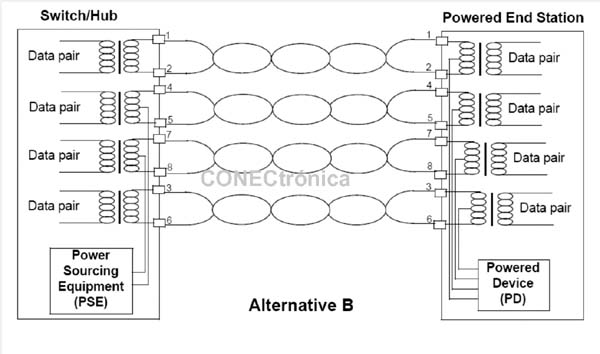
The exact power achievable with PoE technology has been much debated and has caused great confusion, but the answers can be found by consulting the standards. PoE technology uses two pairs, but even though the load can be received on all four pairs, as in Figure 33-5 of the standard, this does not mean that we can double the power by using all four pairs.
At any given time, only 2 of the pairs can supply power, even if 4 pairs are used, so the power could not be doubled in this case.
The following excerpt from the 802.3at standard should clarify this point. Please remember that, according to standards terminology, “shall” is an obligation and “should” is a recommendation.
“PSEs shall implement Alternative A, Alternative B, or both. Although PSEs may implement either Alternative A or Alternative B, they shall not use both alternatives on the same link segment simultaneously.”
Figure 33-7 shows the same alternative model, but using medium-range feed.
Higher power means higher temperature.
Some people still think it's possible to increase the wattage of the energy used. As an isolated argument, this might be true, but it has consequences.
I remember doing experiments with a battery and a light bulb in school. The basic demonstration was that when you connected the circuit and the current started flowing, the bulb would light up. This was caused by a thin resistor that heated up until it glowed brightly.
This simply demonstrates that an electric current produces heat. Thus, if we apply energy to a copper wire, it will also heat up.
With the increase in PoE+ power levels, we now face greater challenges related to heat dissipation. This reality has led ISO/IEC to develop a Technical Report on heat dissipation entitled “Telecommunications cabling requirements for external power supply to terminal equipment” TR29125.
This document outlines the impact of power input on structured cabling and how to mitigate its effects. Table 1 provides examples of the temperature levels that can occur in a cable bundle.
The document then highlights several methods for mitigating this temperature increase. Among others, we can power all the cables in the bundle and also: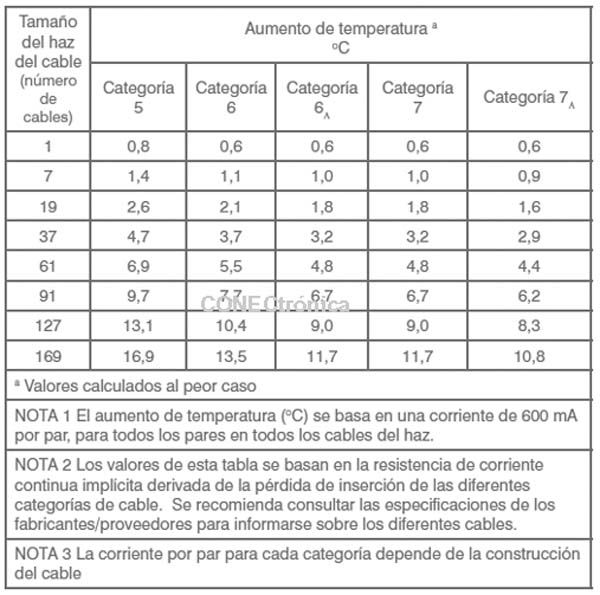 • Use a higher category cable – (at least 24AWG Category 5e).
• Select a larger conductor size, as this reduces DC resistance per unit length.
• Choose routes and spacers with good airflow.
• Select applications and devices that use lower current
All heat calculations are based on standards, which are the only data available.
Another reason why understanding heat is so important is that increased operating temperature can reduce the length at which an application is compatible. The EN 50173 series provides information on reference applications at temperatures above 20°C.
standard
highlights another important factor: the impact of current on connected equipment. Each time the RJ45 connector is plugged in and unplugged, an arcing effect occurs between the two contact points. When the pins are disconnected, there may be a point where current flows through a single pin. This can cause damage over time, reducing the product's lifespan. The number of connections allowed in the standards for components is reduced from 750 to just 200 for connectors under 600 mA load conditions.
TR29125 advises switching off the power supply every time sockets are plugged in and unplugged, but it's hard to believe that in the real world anyone is going to make such an effort every time they have to move and reconnect a device.
What's next?
As more and more devices demand more power, expectations for PoE technology are constantly rising.
Any increase in power has to lead somewhere. Generally, it will be used by the end device, but we've already established that a percentage will be lost in transmission, and this loss is reflected in an increase in temperature inside the cable.
We've illustrated which standards PoE and PoE+ can be compared to, but there are a few PSE device vendors that require more than 100 watts.
This worries me. If, as in the TR29125 example, a bundle of 170 Category 5e cables increases by 16.9°C, what would be the impact if the power were tripled? Could we see a doubling of the temperature? If so, it would have consequences for data transmission capacity. A simple calculation is that for every degree above 20°C, system performance drops by 0.2%. Therefore, 20 degrees above the distance reduces performance by at least 4%.
The second problem is how to control this temperature increase in the environment. Will additional ventilation be necessary in areas with raised floors?
The IEEE is already studying the next level of PoE, but it's still in its early stages. However, a group of manufacturers, called the HDBase-T Alliance, has taken the lead. Their goal and ambition is to offer IP television at home by providing external power to LCD screens throughout the property, up to 100 meters. Since international standards bodies haven't given them enough leeway, they've published their own standard for delivering 100 watts over up to 100 meters of Category 5e cable.
My main concern is that the cable will be installed behind walls, which contain various insulating products for cavity walls, meaning that the heat generated will continually increase, as there is no means to dissipate it.
It's clearly possible, but the consequences must be considered. The rules are there to help us.
In conclusion,
PoE is a welcome technology and will encourage the growth of converged IP-enabled systems. When designed and installed correctly, it can be a simple "plug and play" solution, but as power and installation size increase, so does the potential for problems.
I recommend using it, but make sure you understand it and don't get carried away.
Author:
Article provided by EXCEL