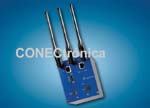
BAT300 with industrial Ethernet. (Photo: Belden).
However, Ethernet isn't always just Ethernet, especially in industrial environments, because in addition to standard Ethernet, there are two widely used versions of industrial Ethernet: Profinet and Ethernet I/P. Now, for the first time, these variants are fully integrated into WLAN devices, further enhancing the integration of WLANs into industrial networks.
Since many industrial networks were originally built on fieldbus technologies, Ethernet-based variants of these fieldbuses were developed to ensure compatibility between new and existing network technologies. Protocols such as Ethernet/IP and Profinet serve to interconnect fieldbus devices, controllers, and Ethernet network components. They are required in network components like switches and WLAN access points to make them identifiable by the controller or management software so they can be controlled. Due to their flexibility and variability, wireless networks cannot be managed using the same management methods developed for wired networks.
Until now, no WLAN devices on the market supported both protocols. Therefore, integrating these protocol stacks makes Hirschmann™ BAT devices the ideal solution for a wide range of applications.
Profinet
The Profinet protocol was originally developed by Siemens and the member companies of the Profibus User Organization. Based on the Ethernet TCP/IP protocol, Profinet enhances Profibus technology for applications requiring high-speed data communication over Ethernet networks in conjunction with industrial IT functions. Profinet is used in manufacturing, process automation, building control systems, and across the entire spectrum of drive technologies, including synchronous motion control applications. In fact, Profinet is the second most widely used industrial protocol after Ethernet/TCP and fully complies with IEC 61158 and IEC 61784 standards.
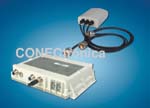
BAT MiMo3. (Photo: Belden).
Profinet IO is, generally speaking, the most frequently used variant. This version of Profinet is intended for communication between a controller and decentralized devices on a network. Profinet IO is based on the Profibus functional model and uses Fast Ethernet technology as the physical transmission medium. This explains why it is possible to install typical WLAN or Ethernet devices in Profinet environments: because the transmission of Ethernet packets is always transparent. The Profinet system has been designed for the fast transmission of input/output (I/O) data, as well as real-time critical machine data, parameters, and IT functions. Network components that cannot evaluate this data and these functions, and that do not respond to queries from Profinet I/O-enabled network components (e.g., SPS), are essentially invisible to the network administrator and are therefore unmanageable.
With Profinet, network components are integrated into the development tool through a device description. The device attributes (Profinet IO Device) are described by the manufacturer in a GSD file. Peripheral signals from network devices are read from the SPS in cycles, processed there, and then returned to the devices. In addition to the cyclical exchange of payload data, Profinet also offers additional functions for transmitting diagnostics, parameter settings, and alarms, and supports real-time (RT) functions.

WLAN application in a wind turbine. (Photo: Belden).
Ethernet/IP
Ethernet/IP is also an industrial communication network based on Ethernet technology and the TCP/IP and UDP/IP transport protocols. This means that Ethernet-enabled devices can also be used with Ethernet/IP, as was the case with Profinet. In the current market, Ethernet/IP ranks third among industrial protocols in use.
As with Profinet IO, Ethernet/IP enhances Ethernet with an industrial protocol called the Common Industrial Protocol (CIP), which functions as an application layer for automation applications. This protocol's functions include data capture from networked workstations, online system configuration and programming, and real-time control of peripheral and field input/output devices via Ethernet. CIP acts as the application layer and is used in three open bus systems: Ethernet/IP, ControlNet, and DeviceNet. This protocol uses implicit input/output messages and individual query/reply telegrams for configuration and data capture (explicit messages).
The maintenance and development of the CIP protocol is jointly handled by the Open DeviceNet Vendors Association (ODVA, www.odva.org) and ControlNet International (www.controlnet.org).
Exclusive features of a WLAN
It has already been stated that a wireless network cannot be considered or treated in exactly the same way as a wired network, because a wireless network is inherently variable. Network clients, i.e., users, change location and move from one access point to another, and consequently, the network topology is constantly changing. Even in the case of fixed wireless installations, such as buildings interconnected via a point-to-point wireless connection, connection parameters are not always stable. Weather conditions, disruptive influences (not just radar), or simple mechanical changes, such as antenna displacement caused by strong winds, can cause variations in actual transmission speeds and data transfer rates, as well as potential channel changes, etc. A key parameter, especially in Profinet and Ethernet/IP-based networks, is the actual transmission time (throughput).
Wireless networks, by their very nature, cannot achieve the low latency of simple wired connections. An ideally configured 802.11n WLAN achieves latency similar to wired Fast Ethernet.
The WLAN's MAC layer is designed so that packets cannot be sent indiscriminately: every other user on the network must be considered first, and if necessary, the packet must wait. Therefore, low latency cannot be guaranteed for all transmitted packets. This is not the case with wired connections because they only have two ends, whereas wireless networks have many "ends," and all users must be taken into account.

Profinet in the automotive sector. (Photo: Belden).
These aspects also need to be considered in Profinet and Ethernet/IP networks. Neither Profinet IO nor CIP are adapted to WLANs. Until now, there has been a complete lack of appropriate parameters, and consequently, WLAN devices have either been completely ignored in these networks (they are not actually visible to the PLC or the SPS) or have been managed incorrectly.
Implementation of CIP and PNIO in WLAN devices
Integrating WLAN devices into these networks requires much more than simply installing the software package. A list of new parameters now allows for control of the WLAN connection, enabling the controller to be properly adjusted for efficient communication with the network's wireless devices and to account for their latency. Furthermore, the controller can be programmed to react to unexpected events along the WLAN path. Various threshold values can be defined to trigger alarms if, for example, the connection quality falls below a specified value.
Hirschmann™ BAT devices now also support the typical management software widely used in industrial Ethernet environments, which means there is no obstacle preventing the integration of WLAN devices into Ethernet I/P or Profinet networks.
Conclusion
Wireless networks based on 802.11-compliant WLANs represent the means for transmitting Ethernet over the air, but closer examination reveals that simply supporting the Ethernet I/P and Profinet IO protocol stacks is not enough to effectively utilize WLANs in networks. Hirschmann™, a pioneer in this field, has developed a comprehensive range of new parameters and alarms that help adapt networks to the specific characteristics of WLANs. This opens up the market for WLANs in all areas where these protocols are used, a particularly important development in the automation and automotive sectors, cornerstones of the German economy.
Author:
Author: Olaf Schilperoort
Hirschmann Automation and Control GmbH, Neckartenzlingen