

If we consider the effects the new standard will have on communications infrastructure, there is no doubt that interoperability should be a key focus, both within the electricity generation system and between its various components. Communication interfaces, for example, have been standardized to ensure that automation components supplied by different manufacturers can work together.
By choosing Ethernet, the electric power sector benefits from the widespread use of this technology and ongoing development. Fast Ethernet (100 Mbps) is already the standard in other sectors (factory automation, manufacturing, and materials handling), and Gigabit Ethernet (1000 Mbps) is becoming increasingly popular. Higher-speed versions are always backward compatible, giving Ethernet the flexibility to adapt to upgrades.
High-speed redundancy mechanisms and wireless solutions continue to evolve and create new applications. The rigorous use of available security technologies and access protection for data networks is vital, as communications are not limited to the local site and include data transmission between substations and control centers.
 High-speed redundant rings:
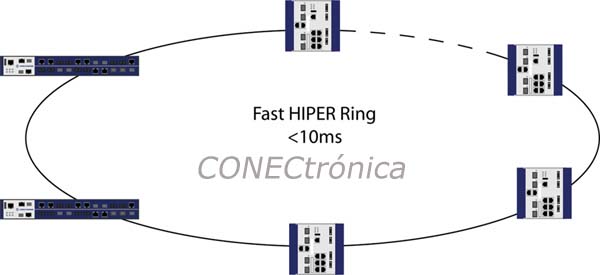
Hirschmann has developed the HIPER Ring to maximize availability. All network components are interconnected to form a ring. A redundancy manager, built into each switch, establishes a physical link to standby mode. If a line failure occurs, the affected devices send a signal to the manager, which activates the standby link. Configuring the HIPER Ring simply requires designating one switch as the redundancy manager. Aside from assigning the ring port to the other switches, no further configuration is necessary.
With the current version of the technology, the Fast HIPER Ring, the changeover in the new MACH 1000 and RSR switches for a full ring with ten devices takes place 10 ms after the fault occurs, as shown in Figure 2. The technology supports large rings with up to 200 network components, and switching times increase very little (less than 60 ms).
 Military Standards:
In addition to redundancy techniques, data network availability also depends on the mean time between failures (MTBF). There are several ways to determine the MTBF of an Ethernet switch. The most stringent method is based on a military standard, MIL-HDBK-217F, and is the one used by Hirschmann.
Our OpenRail rail-mounted switches have an MTBF of over 70 years. However, if one of them needs replacing, it's important that the replacement can be done quickly and easily without requiring specialized networking expertise.
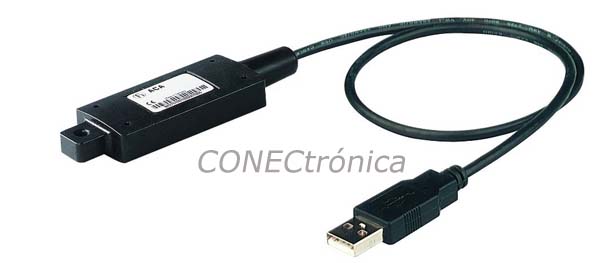
The entire configuration package and switch software can be saved to an external storage device. Whenever the data is downloaded to a new switch, that switch becomes a fully operational replacement (see Figure 3).
 High-voltage protected switches.
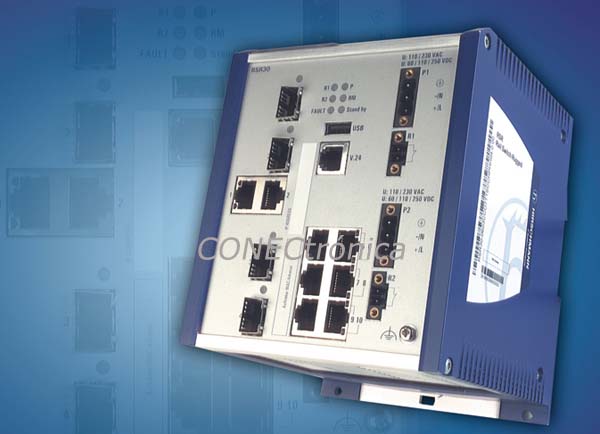
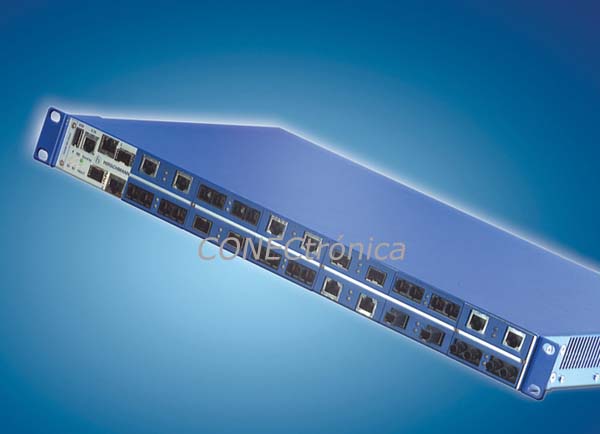
The new families of Gigabit Ethernet switches that comply with IEC 61850, MACH 1000 (see Figure 4) and RSR (shown in Figure 1) standards have been specifically designed for power automation applications. They offer exceptional immunity to electrostatic discharge and magnetic fields. The 19" MACH 1000 family of switches is designed for installation in control cabinets, while the compact RSR switches can be DIN rail or panel mounted.
Both product families offer numerous options in terms of port count and transmission media. Their software includes comprehensive management, diagnostic, and filtering functions, and supports high-speed redundancy mechanisms such as RSTP, MRP, and Fast Hyper Ring. Other features include a wide operating temperature range (-40°C to 85°C) and redundant AC or DC power supplies (18V DC input - 300V AC/DC output). A conformal coating can be applied to the printed circuit boards to protect them against condensation.
 Summary:
The international standard IEC 61850 establishes a suitable design framework for deploying Ethernet to support power grid automation. Its open architecture and interoperability offer robust investment protection. Extremely robust network devices, suitable for the power sector, are now available. There is no longer any reason not to migrate to the latest technology during substation construction or modernization projects.
Author: Jürgen Schmid, Belden





