
However, to ensure the desired long-term performance, during the project design process and component selection, network designers must take into account the subtle differences in nomenclature.
With the arrival of 10 Gigabit Ethernet support over twisted-pair copper infrastructure, new revisions of generic telecommunications cabling system standards have emerged.
The EIA/TIA published the Category 6A specification in February 2008, and ISO/IEC did the same with the Class EA channel standard during the same period. Unfortunately, these two specifications do not define the same performance, which has led to confusion in the market.
When we also look at the components, especially the connection hardware, this confusion is even greater. EIA/TIA and ISO/IEC specify different quality standards, even though the component nomenclature is very similar. Therefore, the user must pay close attention to their selection, or they will not obtain an infrastructure with the expected performance.
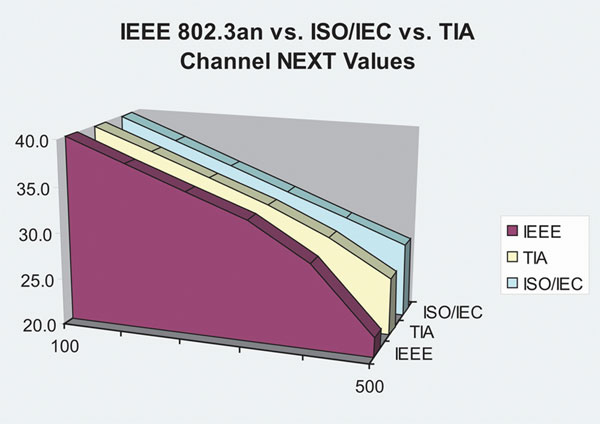
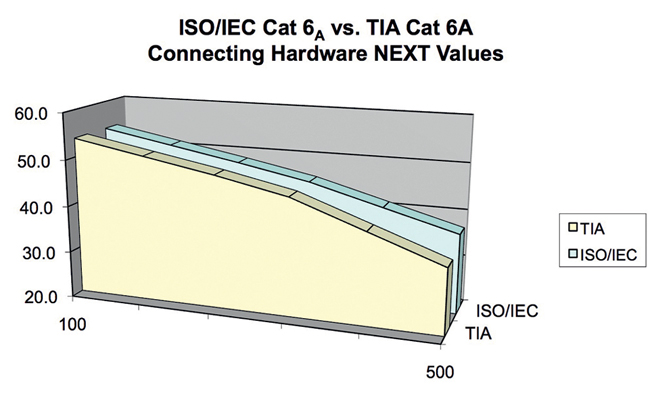
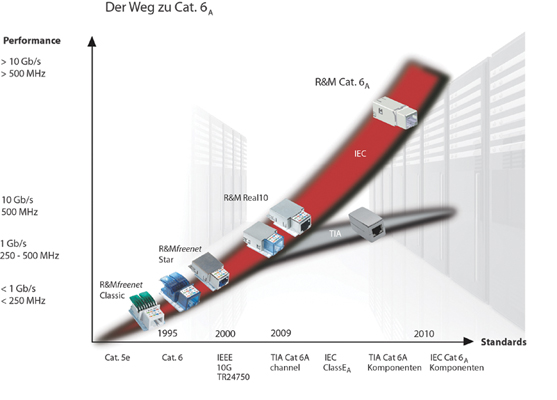
New Cabling Standards: In July 2006, the IEEE protocol for 10 Gigabit Ethernet over twisted-pair copper cable (802.3an) was published. Since this protocol extended the frequency range to 500 MHz, and Category 6 compliant cabling was only suitable for 250 MHz, it was necessary to develop new standards to support it. The alternative was to use Category 7 systems, designed for 600 MHz. However, these cables only had a 4% market share worldwide, so this option alone would not have been sufficient to guarantee the success of the new Ethernet protocol. The IEEE 802.3an standard established the minimum channel requirements that cables had to meet for the protocol to function. In fact, a good shielded Category 6 system, with stable operation at high frequencies, could meet these minimum requirements, as demonstrated by R&M's shielded Real10 systems. Despite this, alien crosstalk posed a problem for unshielded systems: the use of higher frequencies and the application of complex encoding methods made the weak 10GbE signal more vulnerable to external interference than previous protocols. This led to limitations in unshielded Category 6 systems. Therefore, various working groups began specifying new system categories with performance up to 500 MHz and based on RJ45 technology. EIA/TIA published its Category 6A standard in February 2008, and ISO/IEC released the channel requirements for Class E A at the same time. Unfortunately, these standards do not specify the same quality. Figure 1 illustrates the differences in the NEXT channel parameter. The EIA/TIA Cat. 6A channel requirements reflect a gentle 27 dB slope starting at 330 MHz, while ISO/IEC Class E A presents a straight line. Therefore, the ISO/IEC concept offers better and higher transmission quality in twisted-pair copper systems operating with RJ45 technology. At 500 MHz, this means that Class E A requires NEXT quality 1.8 dB better than a Category 6A channel. In practice, this superior quality translates into more reliable operation that minimizes errors. Furthermore, this maximizes the lifespan of the cabling infrastructure. The Importance of Components: Once the characteristics of the channel standards are clarified, the next step is to define the component standards. EIA/TIA defined the specifications for the channel, the link, and the components in a single package. This is all contained in the Category 6A standard (568B.2-10), which has already been published. ISO/IEC first defined the channel specifications in Amendment 1 to 11801 and is currently working on defining the permanent link and components (this will be published in the same document). The need for a standard for components arose when customers began demanding interoperability, or the ability to mix and match components from different manufacturers without compromising channel quality. For example, combining a Cat. 6 module from brand X, a Cat. 6 installation cable from brand Y, and a Cat. 6 patch cable from brand Z to achieve Class E quality. To meet these needs, the de-embedded test was created in 2003. This procedure uses a known reference female socket to test male connectors in a mated connection. The effects of the reference socket are subtracted from the mated connection values to obtain the connector's NEXT characterization. This method is used to select 12 reference connectors across low, mid, and high ranges, which are then used to test the connection hardware. In the case of 10 Gigabit Ethernet, systems that met the protocol's channel requirements were initially offered. The requirements for the new components will allow for interoperability, or the mixing and matching of systems, as was the case in the past. For Category 6A (EIA/TIA) and Category 6A (ISO) components , the re-embedded test has been created . The essence of this procedure is similar to that of the de-embedded test , but in this case, a reference connector is first selected using a new, more precise measurement setup called a direct probe. The difference between this reference connector and the 12 de -embedded connectors is then calculated . Next, the connection hardware is tested with the single reference connector. Finally, the results that would have been obtained with the 12 de-embedded reference connectors , instead of testing them separately, are calculated. In short, the process of finding and testing the 12 de-embedded connectors has been replaced by precise measurement followed by difference calculations. This ensures faster and more consistent results. As with the channel, an ISO-specified Cat. 6A connector will offer higher quality than an EIA/TIA-specified Cat. 6A connector. The current draft specifies a 40 dB slope starting at 250 MHz for Cat. 6A and a 30 dB slope for Cat. 6A. At 500 MHz, this means that a Cat. 6A module must offer NEXT quality at least 3 dB better than a Cat. 6A module. The product name is important . This situation has become confusing as a result of the standardization of connection and cabling components. The component specifications needed for a Category 6A (EIA/TIA) channel are significantly different and less stringent than those required for a Class E A (ISO) channel. Therefore, if a user wants quality on a Class E A channel, they should use components that meet Category 6A specifications . However, a channel made up of components that meet Category 6A (EIA/TIA) specifications will not guarantee Class E A quality . Therefore, the difference in the "A" (specifically whether it is written as a subscript or not) is very important. Cat. 6A ≠ Cat. 6A . Table 1 shows the two new cabling categories and the names of the components associated with them.
A Complex Challenge
You may now be wondering why ISO/IEC takes longer to specify components than EIA/TIA. One reason is an organizational difference: ISO/IEC comprises different organizations responsible for cabling and connection hardware specifications. Coordination between these groups takes more time than it does for EIA/TIA, where all stakeholders are in the same group (and in the same country).
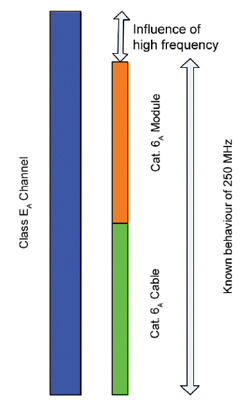
However, there are other reasons, such as technical complexity and, above all, venturing into uncharted territory. Until now, we understood the behavior of components and their dynamics of working together at frequencies up to 250 MHz.
Currently, the frequency is doubling, and using prototypes under such conditions is unstable. These prototypes must take into account secondary and tertiary effects, such as transverse modal coupling, which significantly increases complexity. These phenomena are less frequent in Cat. 7 connection hardware thanks to the contact geometry that separates the wire pairs.
We have seen that, to achieve quality in a Class EA, a Category 6A module must offer NEXT values 3 dB better at 500 MHz than a Category 6A module( Figure 3). This is important because it requires developing entirely new modules rather than modifying existing designs, which is often the case with currently available Cat. 6A modules.
Specifically, more elements are needed to compensate for the additional coupling mentioned earlier. Greater attention must also be paid to separating pairs at the splicing stage. Furthermore, the splicing process must be very precise and accurate to ensure consistent quality.
Enhanced Security with Class EA and Cat. 6A. Currently, a Class E A channel offers the highest quality available with RJ45 technology, the de facto standard today. It not only supports 10 Gigabit Ethernet applications but also extends cabling lifespan and ensures more reliable operation. For all these reasons, Class E A channels are recommended for data networks requiring high-quality transmission in new installations. When interoperability is needed, it is crucial to choose ISO/IEC-compliant Cat. 6 A connection hardware. EIA/TIA-compliant Cat. 6 A modules cannot guarantee the superior quality offered by Class E A. Although Cat. 6 A component standards are taking longer to be published, the wait is worthwhile, as the cabling system will benefit from added quality that will save the user headaches.
Precise Definition of LAN Parameters:
If you need a LAN for broadband applications and want to use the cost-effective and common RJ45 connection format with twisted-pair copper cabling, you should be aware that you will have to deal with new standards. The ISO/IEC, EIA/TIA, and IEEE standards committees have defined different quality criteria, yet they have chosen similar terminology. In the future, it will be necessary to precisely define the expected quality and the components used from the planning stage. The combination of Class EA with Cat. 6A (with the "A" as a subscript) offers the highest quality and a more reliable signal transmission margin.
Sources: R&M White Paper, IEEE 802.3an, ISO/IEC 11801 Amendment 1, Amendment 2 (draft), EIA/TIA 568B.2-10.
Author:
JuanPablo Muñoz, Technical Manager, R&M Spain and Portugal