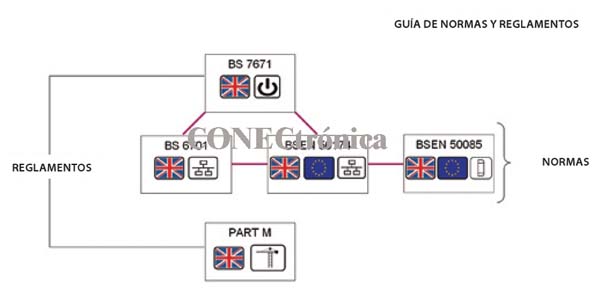
 These aspects include a combination of regulations and standards. The former are the legal requirements that electrical systems must meet, which, obviously, can be deadly.
Therefore, containment and junction are usually included in the electrical package, but how many structured cabling installers are familiar with the following standard, or even want to be?
UK Cabling Regulation BS 7671
Safety.
- Protection against:
> Electric shock.
> Thermal effects.
> Overvoltage.
 - Inspection and testing.
- Requirements for special locations.
Currently, the 17th edition, dated July 1, 2008
, is the most important standard for cabling installers. It is divided into three main sections:
Part 1. Specification of IT cabling installation;
Part 2. Planning and practices INSIDE buildings; and
Part 3. Planning and practices OUTSIDE buildings.
Part 1 also addresses all aspects of containment quality and installation, stipulating that trunking systems MUST have smooth surfaces and be free from burrs, sharp edges, and other projections that could damage cables. Furthermore, trunking systems SHOULD provide all components with physical protection, and IT trunking SHOULD NOT be allowed in other supply systems, such as heating and ventilation junctions, etc.
Note: In standards terminology, the use of "SHALL" indicates a prescriptive nature, while "SHOULD" indicates a recommendation.
Much has been written in the last 12 to 18 months about the transition from Cat6 to Cat6A, and all the articles have focused on performance, as well as related advantages and merits. One critical factor that is rarely discussed is its impact on containment. Currently, more time than ever is spent inspecting and evaluating the adequacy of containment. With careful planning, this inspection aspect could be minimized, and costly, time-consuming errors in installation projects could be avoided.
However, before reaching this stage, a significant amount of training is needed at all levels, from installers and construction service consultants to mechanical and electrical engineers, and even some containment manufacturers. The fundamentals have changed with Cat6A and are further complicated by the capacity requirements imposed by some containment manufacturers.
In addition to all this, the situation is further complicated by the increasingly critical factor of separating power and data; nowadays, the more susceptible the bandwidth is to interference, the more common the use of a shielded cabling system.
Whether shielded or unshielded, both Cat6A solutions present separate, though not vastly different, challenges stemming from their physical construction. The common factor is their physical dimensions. The outside diameter (OD) has increased significantly—an astonishing 25–30%, from approximately 6 mm for Cat6 to around 8 mm for Cat6A. For example, where four 25 mm lengths of Kopex Cat6A cable could previously be run into a GOP box, it would now be difficult to fit three Cat6A cables.
And the issue doesn't end there; the repercussions occur at all levels. Socket connections are one of the most sensitive areas. Many of these product designs were based on electrical and Cat6A requirements, but without proper precautions, they can cause problems not only with capacity but, more importantly, with bend radii. A capacity requirement imposed by manufacturers has already reduced the number of Cat6A cables from 14 to just 3 due to the design of their bends, which yielded because of the angled parts that must be secured and the screw positions located inside the external compartments.

The next critical factor is the splice depth.
Not only does it contribute to the overall capacity when splice-in with Cat6A, but great care must be taken with the bend radii. This increase in cable OD has natural repercussions. What was a 24 mm bend radius in Cat6 has suddenly become a 40 mm bend radius (MBR) with Cat6A. Such a bend radius can be achieved in the splice bends, but it is severely hampered by the depth of the back box. If you add a socket and an angled formwork module, which can add up to 200 mm, the problem becomes apparent. While the splice is 60 mm deep or more, with the exception of the MK Prestige 3D which is only 57 mm deep, its overall dimension has been designed to meet the needs of the data market and can accommodate even the thickest Cat6A cables, provided good installation practices are followed.
It might seem odd, but when routing cables in rear boxes, sometimes less is more. By creating a loop inside the box (i.e., with the entry point at the bottom), routing the loop upwards to terminate in a downward-angled connector makes repositioning the faceplate easier.
Attempting to bend a short length of thick cable can not only be difficult but also result in the cable being crushed in place with a reduced bend radius. Part 1 of BS/EN 50174 states that the design of termination points MUST:
Allow safe access
; Ensure link performance (maintain minimum bend radii);
and Leave sufficient clearance for installing components according to the cable manufacturer's instructions.
One socket splice manufacturer that has given these issues careful consideration is Rehau. They consulted extensively with cable manufacturers and even members of standards bodies before finalizing their design. The result is their Profila Data product, one of the best on the market, with a total depth of 65 mm and a variable-depth back box with slots drilled at various angles to ensure that even the bulkiest cables fit without too much trouble.
While socket connections are the area of greatest concern, not all the issues with perforated and basket trays have been resolved. These problems extend beyond the upper outer diameter (OD) to include weight. In both shielded and unshielded cables, conductor thickness has increased from 24 AWG to 23 AWG—a difference that, while seemingly small, adds up quickly. In the US wire gauge standard, the lower the gauge number, the thicker the wire, which is also related to the number of times the wire has been drawn.
Although the last factor has more to do with how the basket is fixed or mounted than with the possibility that the volume of the cable bundles will crush those on the lower levels, it is an aspect that must be taken into account.
The increased outer diameter (OD) primarily affects capacity.
A 300 mm section of cable tray can comfortably hold 320 Cat6 cables with 20% capacity remaining. Using the same criteria, it would be difficult to fit 200 Cat6A cables. This is a critical consideration when planning main horizontal cable runs, as approximately 35% more cable tray space will be needed for the same amount of cable.
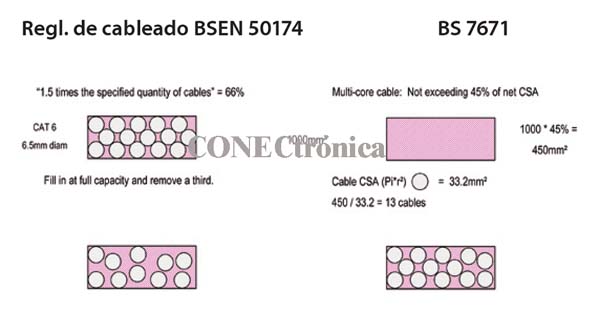
The UK cabling regulations BS/EN 50174 and BS 7671 use different calculations to determine capacity. For consistency, cable installers should follow BS/EN 50174.
Finally, two elements should be considered: Part M of BS7671 and BS/EN 50085 and the European junction standards; in BS/EN 50174-2, the latter are referenced as follows:
The junction should comply with EN50085-2-1
 This is the safety and performance standard for the junction and covers:
Fire hazard,
Access to moving parts,
Mechanical strength,
Heat resistance
Part M is probably the least used or applied building regulation and deals, among other things, with visibility requirements (BS 8300 – 2009). It stipulates that power outlets must be identified by visual contrast. This visual contrast is achieved through a 30-point difference in light reflectance values (LRV). LRV is the proportion of light reflected by a color. Essentially, pure white = 100 and jet black = 0
Conclusions:
Containment used to be something "installed by others," which doesn't necessarily have to change. However, the cable installer should receive information about it at an early stage to ensure the suitability of the installed components.
Author:
Article provided by Excel-Networking