


The 1FINITY T250 is an All-Photonics Network (APN) (3) solution , an end-to-end optical network with higher transmission capacity, lower latency, and reduced power consumption. It is equipped with latency tuning technology that controls delays and enables seamless switching of the paths (4) connecting the optical transmission equipment nodes.
By using the 1FINITY T250 to configure a backup line, you can eliminate the risk of line failures caused by unpredictable factors (including natural disasters, accidental equipment failures, and other external factors such as the relocation of existing equipment due to road construction) while maintaining network services. It will be possible to switch lines automatically and more reliably without causing a line failure, enabling the delivery of APN services more securely and reliably.
With the supply of 1FINITY T250, Fujitsu will support the construction and social deployment of optical networks in fields such as telemedicine, remote robotics, and infrastructures such as electrical transmission network monitoring systems that require high reliability and low latency, in addition to continuing to contribute to the realization of high-reliability APNs based on the IOWN initiative, in which users can enjoy high-quality services.
Background
Several use cases for optical transmission via APN are currently being studied to realize the IOWN initiative, for example, power transmission lines using optical ground wires (OPGW) (5). Although this is economical and easier to maintain, it also carries the risk of signal errors due to the effects of the external environment, such as lightning strikes and electromagnetic interference. Furthermore, even in conventional fiber optic networks, high reliability and low latency are constantly required for operation (6) in telemedicine and power transmission network monitoring systems, as an accidental failure of network equipment can have a significant impact on services.
To solve these problems, Fujitsu has developed 1FINITY T250, an optical transmission solution equipped with Fujitsu's proprietary latency tuning technology that visualizes and controls network delays and fluctuations and enables seamless switching of paths between optical transmission equipment nodes.
Features of Fujitsu Network 1FINITY T2501.
Latency tuning technology maintains high-quality network connections even during outages.
1. The FINITY T250 measures the end-to-end delay of each path connecting optical transmission equipment nodes and controls the amount of delay so that the delay difference between each path is zero, resulting in consistent latency (response time) across the entire network. This eliminates the time lag caused by geographical factors in use cases such as remote concerts and matches between distant locations, ensuring fairness.
By applying this latency adjustment technology, for example, in the event of a line failure, it is possible to instantly switch to a backup line, thus avoiding momentary line interruptions and maintaining high-quality network lines.
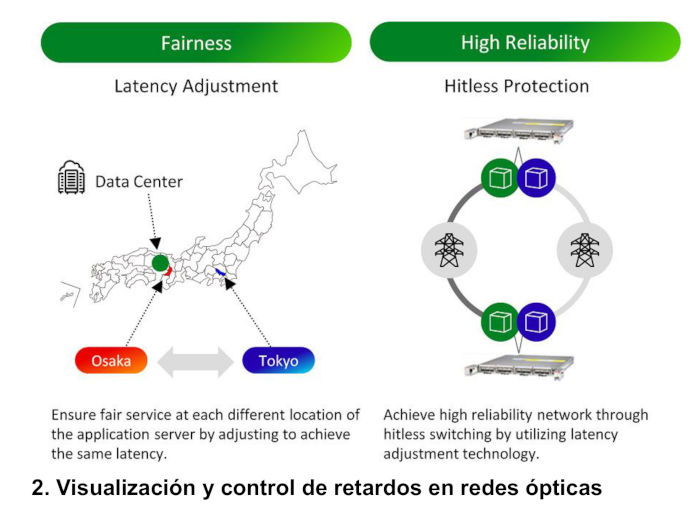
2. Visualization and control of delays in optical networks
The delay time between sites in the optical network is measured and transmitted as a record. This allows the path delay time to be monitored in 1-microsecond increments based on the measurement results.
3. It can be added to existing transponders (7) that transmit and receive optical signals
It has a 1RU chassis size (8) designed for open network equipment and supports unbundling, allowing for the convenient addition of switching functionality without impact to existing optical network configurations. It features an OTU4 interface (9) that can be directly connected to existing transmission equipment. By connecting to the existing transponder client that sends and receives optical signals, the existing network can be upgraded to a highly reliable network.
Future plans
Fujitsu aims to improve the reliability and quality of its services in fields such as redundant line management in data centers and telecommunications facilities in the event of a disaster, and remote control services such as telemedicine and remote construction, by building a resilient optical network infrastructure that can more securely connect reliable services.
Notes
- 1] Disaggregation type: Unlike the conventional shelving type, which had multiple interface cards installed in one unit, this model uses blades for each function
- 2] IOWN Initiative (Innovative Optical and Wireless Network): IOWN is an initiative whose objective is to optimize network and information processing infrastructure to provide high-capacity, high-speed communication systems that overcome the limitations of conventional infrastructure in order to realize a smarter world where data, activities, and people from different sectors come together to create a fully connected and intelligent society where people and society benefit from advanced technology perfectly adapted to them and their environment. https://iowngf.org/
- 3] APN (All Photonic Network): A new type of communications network that achieves greater transmission capacity, lower latency, and lower power consumption by connecting all sections of the communications network with optical fibers.
Visit the following link to learn about Fujitsu's vision for APN: https://www.fujitsu.com/global/documents/about/research/technology/iown/Fujitsu_All_Photonic_Network_Vision.pdf
- 4] Route: A network path that connects links between destination nodes
- 5] OPGW (Optical Ground Wire): An optical fiber installed inside an aerial ground wire
- 6] Manipulation: To act upon an object and manipulate it using a robot arm, etc.
- 7] Transponder: A device that transmits and receives optical signals
- 8] 1RU (1 rack unit): Measures 19 inches wide (approximately 482.6 mm) and 1.75 inches high (approximately 44.5 mm)
- 9] OTU4 (Optical Channel Transport Unit 4): OTUk is an ITU-T standard for sending and receiving optical signals, and OTU4 mainly supports 100GE






