Next-generation wireless communication is already operating near its maximum capacity. The only viable option to meet the growing demand for increased data transmission is to increase usable bandwidth. This is precisely what the Wireless Networking Group at IMDEA Networks, led by computer scientist and head of research Dr. Joerg Widmer, has achieved within the framework of the recently concluded SEARCHLIGHT project. Dr. Widmer, who received a €1.7 million ERC Consolidator Grant to conduct this research, has developed a ubiquitous, robust, flexible, interoperable, and cost-effective wireless networking technology that operates in previously unused high-frequency bands, such as the license-free 60 GHz band.
As congestion in low-frequency networks accelerates and spectrum becomes an increasingly scarce resource for telecom operators, the contributions of this project will gain importance. While millimeter-wave-based consumer electronics have not yet been widely commercialized, global technology leaders are already experimenting extensively with millimeter-wave technology to achieve data speeds previously only possible with fiber optics.
Facebook launched Project Terragraph, which uses a mesh of reconfigurable millimeter-wave links to provide high-speed, seamless internet access in urban and suburban environments. It previously experimented with solar-powered drone networks, establishing millimeter-wave backhaul and interconnection links to provide connectivity in areas with limited infrastructure. Alphabet's (Google's) Project Loon uses high-altitude balloons with millimeter-wave links for the same purpose. Millimeter-wave technology also has extremely interesting properties for large-scale, small-satellite networks that would provide global connectivity—like the Starlink network planned by SpaceX and PointView Tech (Facebook)—and it is very likely that it will eventually be used in such networks. As the density and capacity of these types of networks increase, the scalability of the results from Project Searchlight will have significant practical relevance.
“The innovative protocols and algorithms we have developed provide key elements to ensure the scalability of future wireless networks,” says Joerg Widmer. “If we draw an analogy between the evolution of wired Ethernet, which went from a shared medium to a fully switched network, we anticipate that future wireless networks will consist of many directional (LOS - line-of-sight) channels for communication between access points (APs) and end devices.” Therefore, the architecture of future millimeter-wave networks will be characterized by being ultra-dense and ultra-scalable. “In extremely dynamic radio environments, where channels can appear and disappear in very short time intervals, SEARCHLIGHT uses angle information to quickly align directional millimeter-wave antennas,” explains Dr. Widmer. “The architecture integrates a location system and learns about the radio environment map, allowing it to quickly select the most suitable access point and antenna beam pattern, as well as allocate radio resources using the predicted location as context information. Access points are deployed ubiquitously to provide continuous connectivity even in mobility and lockdown situations. The project has also developed simple network management mechanisms to cope with high device density.”
 Dr. Widmer recently received funding through the Marie Skłodowska-Curie Innovative Training Network H2020 program to investigate "Millimeter-Wave Networks and Sensors Beyond 5G." Within this new project, his research group will build upon the promising results already achieved thanks to ERC funding. The work carried out under the prestigious ERC grant also led to a Huawei-funded collaborative project on the correlation between low-frequency and millimeter-wave band channels, as well as a subcontracted project to develop an "Open Experimentation Platform Based on Millimeter-Wave SDR" within the H2020 ORCA project
("Orchestration and Reconfiguration Control Architecture"). The aim of this project was to scale an FPGA-based platform to less powerful hardware and enable remote access and experimentation for educational and research purposes.
Bibliographic sources:
Joan Palacios, Guillermo Bielsa, Paolo Casari, Joerg Widmer (March 2019) - Single- and Multiple-Access Point Indoor Localization for Millimeter Wave Networks [PDF]
IEEE Transactions on Wireless Communications. 18 (3). pp. 1927-1942. IEEE. ISSN 1536-1276.
Thomas Nitsche, Adriana B. Flores, Edward W. Knightly, Joerg Widmer (April 2015) - Steering with Eyes Closed: mm-Wave Beam Steering without In-Band Measurement [PDF]
In: The 34th IEEE International Conference on Computer Communications (IEEE INFOCOM 2015), 26 April - 1 May 2015, Hong Kong, China.
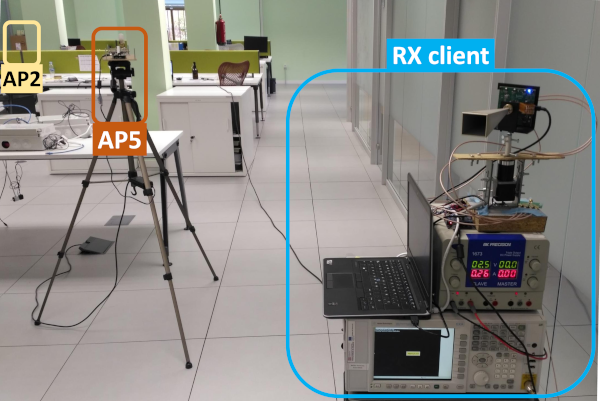
Figure 1. Photo of the open space measurement setup shown in Figure 3, with access point AP2 (client) and access point AP5.
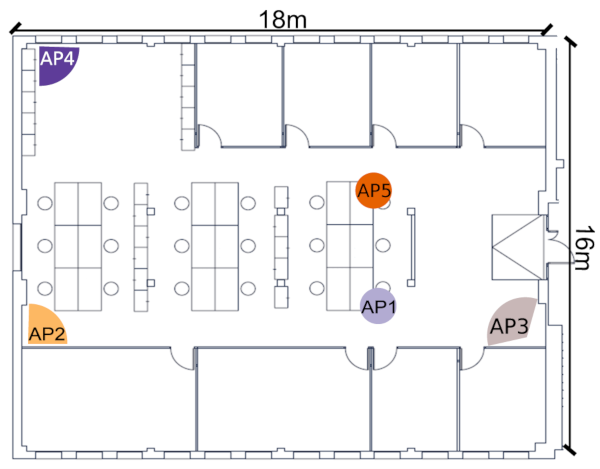
Figure 2. Measurement space configuration with multiple L-shaped access points.
Five different access points have been deployed, each with a different antenna type (omnidirectional, 120° beamwidth, and 80° beamwidth, respectively).
Both figures are part of the article “Single- and Multiple-Access Point Indoor Localization for Millimeter Wave Networks,” which describes an indoor localization system using millimeter wave bands with single and multiple access points. (See references).
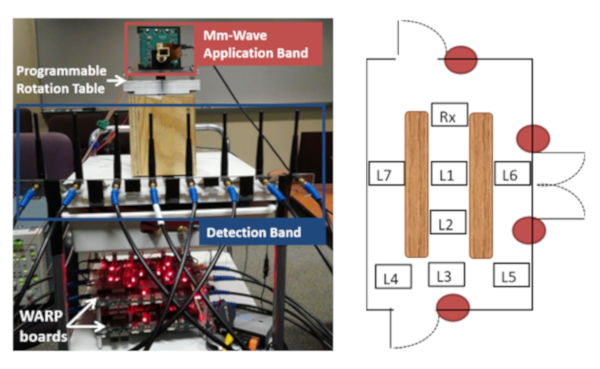
Figure 3. Experimental platform configuration for measuring “blind” beam steering (BBS). BBS is a novel architecture and algorithm that eliminates band loading for establishing a directional millimeter wave link. The illustration appears in the article “Steering with Eyes Closed: mm-Wave Beam Steering without In-Band Measurement” (see references).