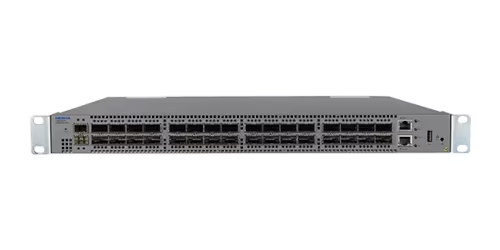
The company unveiled its new 7220 Interconnect Router (IXR) family of high-performance switches, along with an enhanced version of its Artificial Intelligence for Operations (AIOps) tools within the Event-Driven Automation (EDA) management platform. These innovations deliver the extreme performance and reliability required to support advanced AI training and inference workloads, driven by the growing demand for agentic AI applications.
The widespread adoption of agentic AI applications is transforming data center requirements and accelerating the evolution of network solutions. AI is the engine behind these advancements, representing a dual opportunity: network innovation and operational transformation. These factors are driving the latest developments in Nokia's data center switch portfolio.
Tom Burke, Chief Revenue Officer at Nscale, commented:
“Our partnership with Nokia continues to deliver significant operational advantages amid the accelerating pace of AI innovation. With Nokia’s technology, Nscale strengthens its ability to serve our customers. This announcement further extends Nokia’s leadership and confirms that, together, we are better positioned to meet the needs of those who rely on advanced AI technology.”
Alan Weckel, founder and technology analyst at 650 Group, added:
“The 1.6 TE interface speeds in Nokia’s new 7220 IXR switch family hit a sweet spot in the market as agentic AI demands changes to data center network infrastructure. The AI-powered AIOps capabilities on Nokia’s EDA platform arrive at a critical time, improving operational efficiency and reliability. Furthermore, Nokia’s commitment to UEC is noteworthy, as 650 Group’s analysis projects Ethernet will be the dominant protocol for AI in the future.”
Scalable performance and flexibility for AI data centers.
To meet the enormous demands of scalability and high performance, the Nokia 7220 IXR-H6 switches deliver exceptional throughput of up to 102.4 Tb/s, with interface speeds of 800 GE and 1.6 TE, effectively doubling throughput within the same physical footprint. They comply with Ultra Ethernet Consortium (UEC) specifications, optimizing packet flow, preventing congestion, and increasing efficiency in large-scale networks with up to one million XPUs and more.
The 7220 IXR-H6 family offers unprecedented flexibility, available in liquid-cooled or air-cooled variants, compatible with a variety of rack configurations.
Nokia is the only vendor to offer hardware compatible with either an embedded network operating system (NOS) or SONiC. The new switches can be configured with SR Linux or open-source SONiC, giving data center operators the freedom to choose the best software solution backed by Nokia's technical support.
AI-Driven Network Operations:
Faced with the need to deliver always-on services, both cloud providers and enterprises are prioritizing automation, AIOps, and modernization to reduce downtime and ensure resilient performance. To address these challenges, Nokia is incorporating advanced AI agentic capabilities into its EDA platform, combining natural language processing with autonomous reasoning to quickly and accurately identify and resolve issues.
Thanks to real-time telemetry, integrated digital twins, and EDA's instant test and rollback capabilities, operators can resolve faults with confidence, achieving a 96% reduction in data center network downtime, according to a study by Bell Labs Consulting and Futurum.
Vach Kompella, Senior Vice President and General Manager of the IP Networking business at Nokia, stated:
“The astonishing growth of AI has transformed data center operations and demands constant evolution of hardware and operational tools. We are pleased to introduce our new 7220 IXR-H6 switch family along with enhancements to the EDA platform, which now leverages agentic AI to ensure highly reliable and fast network operations. This is just one of many milestones in our data center networking portfolio.”
The Nokia 7220 IXR-H6 switches will be available in the first quarter of 2026, while the EDA AIOps features can be demonstrated starting today and will be available for deployment by the end of 2025.