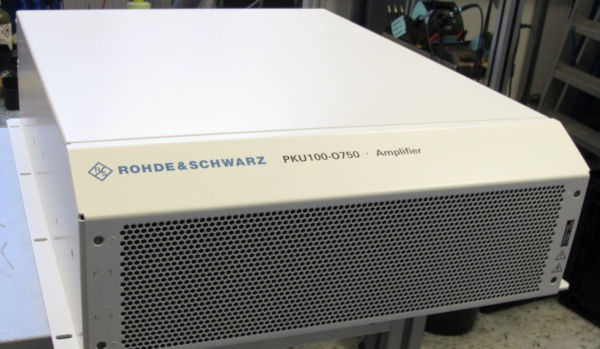
Although the R&S PKU100-O750 boasts a power output of 750W, it comes in a superior, more compact and lightweight form factor. Furthermore, through a rigorous research and development process, Rohde & Schwarz's design engineers have achieved the highest power efficiency of any amplifier in its power class.
In developing its new family of satellite amplifiers, Rohde & Schwarz aimed to replace traditional tube technology with the latest advances in solid-state transistors. Operating at high frequencies, the major challenge was developing a heat sink design to keep the transistors cool, thus increasing their lifespan and performance, and creating a compact topology for the RF components with minimal attenuation caused by insertion losses from power dividers, combiners, connectors, and cables.
It is important to note that if the transistors fail during operation, the amplifier continues to function at a reduced output power. Because it does not use high voltages within the product, it is easy to maintain and offers a longer lifespan than its tube-based competitors. Furthermore, Rohde & Schwarz amplifiers can be equipped with redundant power supplies for both AC and DC operation, ensuring that a power supply failure does not halt the amplifier's operation.
"We have developed two power classes for our uplink amplifiers: the 400W and 750W models will be available as outdoor and indoor units and for the two frequency bands 12.75 GHz to 13.25 GHz and 13.75 GHz to 14.5 GHz," explains Christian Baier.
The amplifiers come with optional adaptive linearization. Within satellite uplink amplifiers, signal linearization is critical, as it produces a significantly cleaner amplifier signal. Signal linearization has been a feature found in various tube-based amplifiers, but until now it has not been possible to integrate it into solid-state amplifiers.
Linearization has two effects: first, it improves in-band signal quality, meaning a better Modulation Error Rate (MER), or consequently a better Error Vector Magnitude (EVM) or Noise Power Ratio (NPR), making the signal easier to receive. Second, linearization produces much better out-of-band performance, that is, significantly better attenuation, which translates into lower adjacent channel power and therefore less interference with neighboring satellite channels.