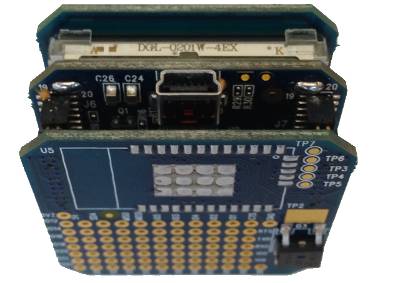
 The board was jointly developed by Arrow's European engineering team and NXP Semiconductors, a leading provider of NFC devices.
The collaboration between Arrow and NXP in the development of SmarTool NFC is the first step in a new phase in which Arrow and NXP aim to spread the use of NFC in the many areas where near-proximity identification systems can be beneficial.
The SmarTool NFC main board includes a PN532 NPX transceiver for contactless communication; an LPC11U37 NPX microcontroller fully compatible with full-speed USB 2.0; a DC-DC step-down converter; an ultra-low jitter clock; and an LCD. The microcontroller is based on a 50 MHz ARM® Cortex™-M0 core and features 128 KB of flash memory and 12 KB of RAM.
The reference design is accompanied by a ready-to-use application software suite that demonstrates the implementation of NFC technology in use cases such as access control and micropayments, among others. In the access control scenario, the system interacts with a mobile phone or NFC tag and registers the presence of an enabled device. In the micropayment scenario, the system simulates the operation of a vending machine, allowing for cash reloading and product dispensing. The software is compatible with devices that use NXP MIFARE® integrated circuit (IC) smart cards, including Classic, Ultralight®, and DESFire®.
An additional application is provided to assist with antenna calibration. This offers an alternative to manual measurement in situations where users lack access to specialized analyzers in their labs. Using this method, a frequency generator feeds the antenna with a sweep around the desired resonant frequency. Simultaneously, the microcontroller generates an analog signal proportional to the output frequency. By connecting two scope heads to the ramp generated by the microcontroller and to the antenna, and positioning the scope in XY mode, the user can observe the antenna's resonant frequency profile. This then aids in the tuning process.