This addition to the COFITEL Group catalog has been developed with the intention of eliminating the limitations of alternatives that use electrical sensors, such as transmission losses or susceptibility to electromagnetic interference (EMI).
OPTRAL's new wired and software system solves these problems by using fiber optic detection, which uses light instead of electricity, and fiber optics instead of copper.
The use of a distributed sensor (a single fiber optic cable) behaves like an array of multiple individual sensors, with remarkable accuracy, allowing the location of events in unforeseeable points and the optimization of operating costs.
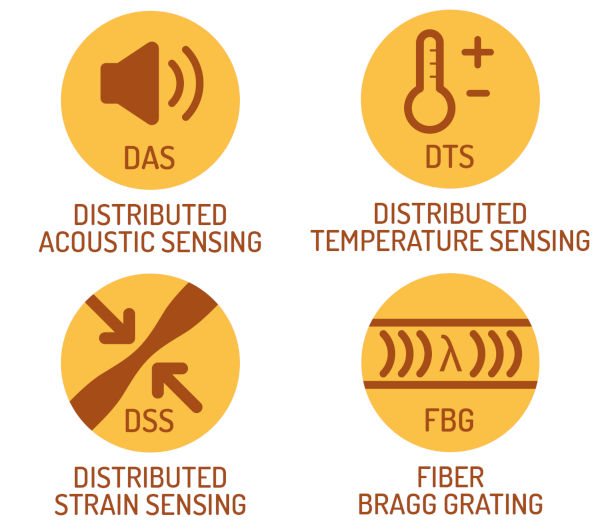
Responding to the requirements of each environment, this monitoring system can operate with the most suitable technology (DTS, DAS, DSS and FGB) and with the wide family of OPTRAL cables for distributed or point (multipoint) sensors: DTS-FOSC – Raman detection, DLS-FOSC – Raman and acoustic detection, DVS-FOSC – OFVS, FBG-FOSC and DAS-FOSC.
The necessary optical hardware components (couplers, multiplexers and switches, among others) and the solutions offered (OSensor, OGuard and OWatch) guarantee the visualization and monitoring of detected events.
Application examples:
• DTS technology with a distributed fiber optic sensor for temperature measurement: fire detection in tunnels, leak detection in pressurized gas pipelines, industrial control (fermentation in wine and beer production), monitoring the structural health of bearings on conveyor belts in mining, cold chain control in logistics centers, and temperature measurement in pharmaceutical warehouses, data centers, and high-voltage power lines (overloads).
• DTS technology with a distributed sensor for acoustic vibration measurement up to 20 kHz: intrusion detection over large perimeters (up to 5 kilometers), border protection, leak detection in water and oil pipelines, structural health analysis of railway infrastructure, and traffic density monitoring on roads.
• DSS technology with a distributed fiber optic sensor for strain measurement: detection and control of deformations in pipes, detection of geological events (landslides, mudslides, and earthquakes), structural health testing of large civil engineering projects requiring numerous sensors, such as dams and viaducts, and presence detection over very large areas.
• FBG technology with multiple sensors for measuring temperature, vibrations, and strain: temperature monitoring at specific and spatially distributed points in electrical substations, phase cables in high-voltage lines, and industrial control; structural health analysis in civil engineering projects (dams, bridges, wind turbines, and buildings in general) as well as in ship and aircraft frames; force and pressure monitoring on structures (wind turbines or sails) to optimize performance; and presence detection over very large areas (kilometers) with low spatial resolution (>100 m).