 Smart communities will enrich the lives of residents and make local governments more efficient at responding to their citizens' needs. From security and convenience to revenue generation, smart city applications will change how cities function and how we live and work. But it all starts with connectivity: smart city residents, vehicles, systems, and applications must be connected, and in most cases, that means fiber optic infrastructure.
 Long-term planning
Traditionally, companies have developed isolated applications, such as surveillance cameras, smart lighting, or traffic sensors, but by 2019 they will begin to take a broader view and think about building a basic infrastructure to support all smart city applications. This only makes sense; otherwise, the city is digging in the same streets every year to add infrastructure for each new application. For example, a city installs basic security cameras on light poles but does so without installing fiber optic connectivity that would allow adding small cells to those poles or implementing facial recognition applications for the cameras. Now, the city must upgrade its light pole connectivity network, a cumbersome and expensive process.
To avoid having to upgrade networks in the future, city planners are now educating themselves about future possibilities, consulting with IoT and network connectivity providers, and working to develop a long-term plan. For example, Stockholm, like Chattanooga, Tennessee, and Lincoln, Nebraska, has built high-speed fiber networks in its cities with enough bandwidth to support new IoT devices and applications in the future.
In general, data connectivity is becoming the fourth most important utility in cities; it's a business opportunity that shouldn't be missed, and cities recognize this. Connectivity in homes and businesses is a competitive advantage for cities, and they are rushing to implement it.
Creative Financing:
Like water, gas, and electricity, cities don't always provide the service themselves, but they enable the construction of the basic infrastructure that delivers it. We are beginning to see more projects that combine government funding with public-private partnerships. In Europe and elsewhere, many national governments are mandating and providing funding for large-scale fiber deployments. In North America, service providers, developers, and local utilities are deploying parts of the civic connectivity infrastructure, while the city facilitates permitting and planning for construction.
Electric utilities are uniquely positioned to deploy fiber-optic infrastructure because they already own rights-of-way and have overhead poles or underground conduits that can accommodate new fiber, allowing them to deploy fiber more quickly and at a lower cost. In some cases, North American cities are funding or partnering with local electric utilities to build the “middle mile” of the fiber-optic network (Figure 1)—the portion from central offices or other distribution centers to neighborhoods or business parks. Middle-mile networks are the most common municipal model due to lower risk, lower deployment costs, and the ability to lease excess conduit/fiber to private providers.
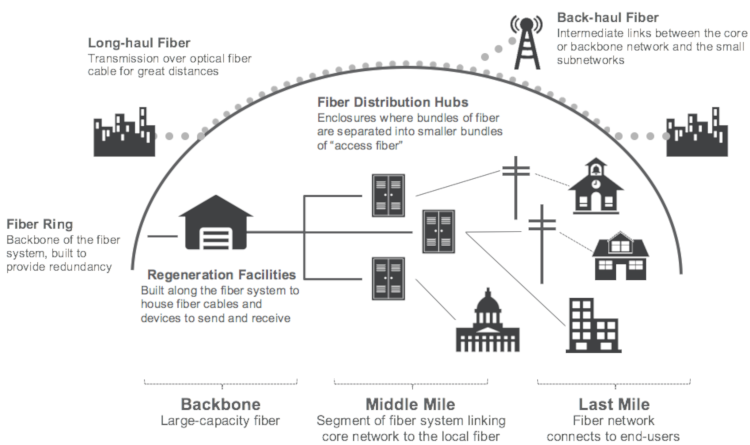 In many other cases, cities are also implementing the "last mile" component that connects customers, often in partnership with local municipal utilities. Some are deploying last-mile connectivity on their own, while others are partnering with local utilities to reach end customers. We see similar trends internationally in Stockholm (Stokab), the Netherlands (Reggefiber, Citynet Amsterdam), and Singapore (OpenNet), to name just a few. Operators are also building their own last-mile networks, and 5G access will play an increasingly important role in delivering this connectivity, whether through the densification of mobile networks or the deployment of new fixed-access solutions. Verizon already launched 5G wireless access trials in several cities in 2018.
Network Convergence:
In the past, service providers built separate wireless and wired networks. Wireless infrastructure is becoming more centralized, so it makes more sense to converge all wireless backhaul traffic onto the same fiber used by wired services. The fiber network convergence process is primarily driven by the development of supporting technologies, user demand, and service provider capabilities. Large, dominant service providers have both wired and wireless operations, so converging onto a single network and maximizing asset utilization makes excellent business sense and will be a driving force in 2019. There have been real-world examples where a network was built for fiber to the home (FTTH), and several months later, the same construction crew opened up the same street to lay fiber for a cell site, which is both unproductive and detrimental. Network convergence would mean a single infrastructure that could be used for multiple service delivery platforms, including FTTH (Figure 2).
That said, most cities will incorporate networks from different providers into their overall infrastructure. How should they bring all these networks together? The first step is to lay all this fiber from different providers in the same trench and conduit. Some networks need to be private (public safety, for example), but cities can at least ensure that all networks use the same conduit and perhaps even the same fiber bundle. After all, when the national motorway system was built, there weren't separate roads for trucks, cars, and motorcycles; instead, a shared infrastructure was constructed. It makes sense to do the same with fiber networks.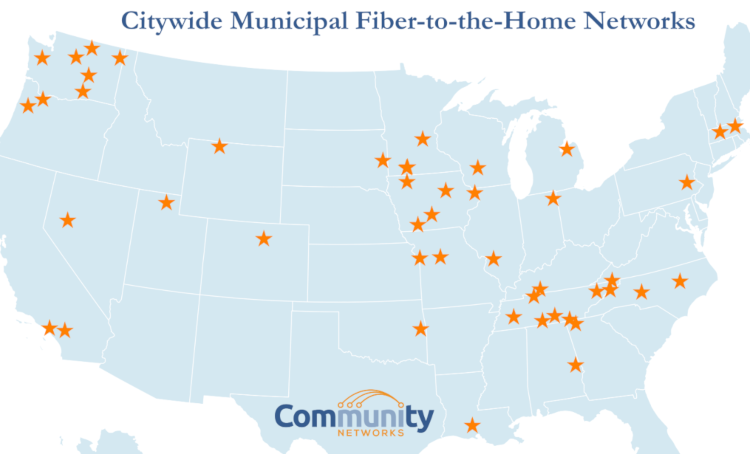
Applications are driving the need for greater bandwidth: parking, smart meters, public safety (surveillance cameras), traffic management, 5G small cell densification, waste management, and emergency services coordination are just a few examples. It's easy to see that a single converged network would be the most cost-effective way to support these applications. When a city builds a fiber network in its light poles, for example, those poles can support smart lighting, surveillance cameras, and small cells for 5G network densification.
In fact, the arrival of 5G networks in the next two years is a major driver for fiber deployments. 5G will not only bring faster speeds but also much denser small cell deployments due to distance limitations with millimeter-wave technology and ultra-low-latency edge applications. By providing the pole infrastructure and streamlining permitting, a city can accelerate the construction of fiber-to-pole networks by utilities or service providers.
By meeting these expectations, 5G will foster new applications. Large companies like Netflix and Uber were created because the wireless infrastructure of fiber and 4G mobile was there to support their services. With its increases in bandwidth ubiquity and coverage, 5G will drive similar innovations, but it will depend on fiber optics for transport to and from the rest of the city's network.
Cities are implementing smart city applications because they improve efficiency, reduce costs, generate new revenue streams, and, most importantly, improve the lives of their citizens. By planning ahead, using creative financing approaches, and converging networks around citywide fiber deployments, cities will advance on the path to becoming smarter in 2019.
Author: Morne Erasmus, Director of Smart Cities at CommScope