


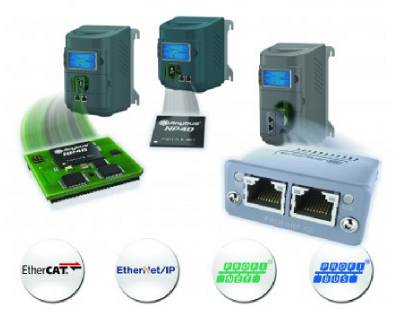
Now, by integrating support for Anybus CompactCom into a drive, device manufacturers will be able to offer extensive connectivity for fieldbus and industrial Ethernet plus integrated profile support to their customers, all in a single development project.
Multi-network connectivity with drive profiles: how it works.
Different networks have different standards for communicating with a drive (for example, to tell the drive to operate at a specific speed). These are called “drive profiles” or “motion profiles” and are supported by the Anybus concept through a Profile Driver Package, a software stack implemented in the drive during development. HMS's ready-to-use source code can be quickly integrated into the processor of any drive.
Therefore, the data for a given profile is not actually “translated” within Anybus CompactCom, but rather passes through the module's transparent channel without variation, and the conversion is performed in the drive using the HMS Profile Driver Package. The DS402-based Profile Driver can be used to handle any CAN-based profile, not just drive and motion profiles, over any network. For example: EtherNet/IP.
The fast track to network connectivity for drives:
The Anybus CompactCom 40 series enables drive manufacturers to meet the demands of major networks, including high-performance standards such as EtherCAT and PROFINET 2.31. The 40 series is designed for demanding applications requiring low latency and high data throughput. Process data latency is less than 15 µs, and 1500 bytes of process data can be transferred in each direction.
Products in the 40 series are pre-certified for network compliance by major networking organizations, significantly accelerating testing and compliance. HMS also offers implementation support as a service for drive manufacturers.
What is Anybus CompactCom?
Anybus CompactCom is a series of communication products integrated into an industrial device to provide connectivity to various industrial networks. CompactCom is supplied in chip, brick, or module format, allowing the user to choose the level of integration.






