 L2 Switching The FIB-SWITCH-1090 supports the following Layer 2 features: • Auto-negotiation of port speed • IEEE 802.3x • Spanning Tree Protocol: 802.1D (STP), 802.1w (RSTP), 802.1s (MSTP) • VLANs: 4K IEEE 802.1Q VLANs • Link Aggregation: Static Trunk, LACP, Load Balancing • IGMP Snooping Automatic Protections With the FIB-SWITCH-1090, a 1 GbE circuit can be provisioned end-to-end with guaranteed bandwidth and quality of service using OAM&P circuits and VLAN tunneling. Furthermore, Ethernet ring topologies can be established with an ITU G.8032v2 protection mechanism, very similar to the Spanning Tree Protocol (STP) but with the advantage of significantly faster link failure recovery. The device also allows for fault detection: signal loss, loss of continuity, and QoS . The Carrier Ethernet service also defines attributes such as the bandwidth profile, which includes: CIR , EIR or PIR , and CBS/EBS. The FIB-SWITCH-1090 offers service providers the ability to deliver services with bandwidth and defined priority (8 CoS). It also allows for traffic classification and priority management based on IEEE 802.1p, IP Precedence/DSCP, TCP/UDP port, IP address, MAC address, Ethernet Type, and C-VLAN. For increased scalability, the FIB-SWITCH-1090 supports MPLS-TP. MPLS -TP retains the basic network architecture of MPLS and introduces Additional functions in operation, administration, and maintenance (OAM) to improve fault detection and management. Among the OAM functionalities supported by the equipment are: • IEEE 802.3ah o Remote Failure Indication o Self Discovery o Dying Gasp o Link Fault o Critical Event o Remote Loopback o Delay/delay variation o Frame loss test o User data packets loopback o User enable/disable loopback o Performance monitoring o Errored Symbols Seconds o Errored Frames Summary • IEEE 802.1ag o Path Discovery o Link trace Message and Reply (LTM, LTR) o Fault Detection o Continuity Check Message (CCM) o Fault variation and isolation o Loopback Message and Reply (LBM, LBR) o Fault notification and recovery o Performance Monitoring o Ethernet Frame Loss Ratio (FLR) o Ethernet Frame Delay (FD) o Ethernet Frame Delay Variation (FDV) Fibernet's Carrier Ethernet solutions have been designed to meet the growing need for high bandwidth in the transport of Mobile, voice, video, and data services, ensuring compliance with IEEE, ITU, and MEF standards, compared to traditional Enterprise Ethernet solutions. Fibernet's Carrier Ethernet solutions reduce service deployment and investment costs compared to SDH/SONET-based transport and allow the network (except for nodes providing IP services) to be built with Layer 2 aggregation and access equipment, minimizing the number of Layer 3 devices deployed. Carrier Ethernet technology offers the following benefits: • Standardization: Ensures interoperability between different technologies and vendors. • Carrier-class functionality in operation, administration, and maintenance (OAM). • Quality of Service (QoS): Enables granular and customized service control at the VLAN level, allowing the delivery of services with demanding SLAs tailored to customer needs. • Scalability • Reduced operating costs: Faster and simpler implementation, requiring no specialized operations personnel.

- Details
- Category: Switches
-
By Carlos Martinez
Fibernet Carrier Ethernet Switch FIB-SWITCH-1090
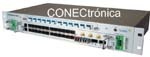
Fibernet presents the next-generation FIB-SWITCH-1090 equipment, whose port density (24 x 1000 Base FX, 4 x 10 GbE), support for synchronization protocols, quality of service and protection scheme makes it suitable for the demands of service providers, reducing their operating costs and differentiating the services they can offer their customers.

-
-
FL Switch 2000 family switches for automation in harsh environmental conditions
With the new 2200 and 2300 variants of the FL Switch 2000 family, Phoenix Contact expands its offering of managed switches for automation networks. They are suitable for the flexible design of robust and fault-tolerant networks in the construction of installations, both in the...
-
Allied Telesis updates its x600 series switches
Allied Telesis introduces the x610 family of Layer 3+ switches, offering 100% backward compatibility with the x600 family, as well as a number of additional features to improve adaptability and scalability.
-
ATEN enhances its 32-port multi-console KVM Matrix switches to meet the needs of today's data centers
ATEN International has announced enhancements to its KVM Matrix product line for businesses. The KM0932 and KM0532 32-port multi-console KVM Matrix switches are designed for today's complex enterprise data center environments, which require reliable and highly secure access... -
Belden presents RSP-Smart, a switch for harsh environments
Belden Inc., a provider of signal transmission solutions for critical applications, has added RSP-Smart, a cost-effective variant of the proven RSP switch family, to its Hirschmann product line for the Europe, Middle East and Africa region.
-
RapidIOTM Gen2 Serial Switching: a combination of high-speed digital switching fabrics with analog serializers/deserializers
The Serial RapidIO Gen2 specification contains significant improvements to the physical, logical, and transaction layers. The physical layer specification has doubled the throughput to 6.25 Gbaud; doubled the target transmission distance to 100 cm from FR4; and...

Newsletter
Latest News
Nabiax will invest 800 million in its new ADC3 data center in Alcalá de Henares
Nabiax has laid the foundation stone for Alcalá Data Center 3 (ADC3), its new data center in...
Salicru receives the Adaptability Award from amec positive industry
The awards were presented by amec positive industry, an association that brings together and represents...
Teldat joins SAFENet to boost European digital sovereignty
Teldat, a Spanish company specializing in cybersecurity and connectivity solutions, has...
PSC 2026 analyzes the role of photonics in AI and data centers
The growth of artificial intelligence is increasing the capacity needs of...
Agriculture and livestock farming lead the IoT in Spain with 44.8% of devices
The agricultural and livestock sector is consolidating its position as a leader in the implementation of the Internet of Things in...
Social networks
 |
 |
 |
 |
 |

Technical Courses and Seminars
Mouser and Telit Cinterion are organizing a webinar on cellular IoT with CMB100
The development of cellular IoT may require independent hardware platforms in the stages...

Mouser drives IoT development with its LoRaWAN resource center and new wireless connectivity solutions
Mouser Electronics, Inc. highlights its comprehensive LoRa® resource center as the market accelerates...

DataCom: Technical guide for networks, fiber optics and structured cabling
Digital transformation has turned data networks into a critical infrastructure for...
Taoglas launches The Antenna Podcast, a new technical space about antenna design and innovation
Antennas remain one of the most critical and, at the same time, most misunderstood elements in...
ISE 2026 Barcelona: Summits, Megatrends and the most ambitious content program in the AV sector
Returning to Barcelona in February 2026, Integrated Systems Europe (ISE) presents its program of...
Optical Networks
Vesta 200 6.4T CPX: 6.4 Tb/s optical engine for CPO and NPO
The new Vesta 200 6.4T CPX optical engine is designed to meet the growing needs for wide-angle...
Nokia launches Mobile Core Early Access to accelerate 5G innovation
Nokia has announced "Mobile Core Early Access," a live hosted environment that offers a preview...
Nokia unveils the first commercial AI-RAN platform for mobile networks
Nokia today announced the industry's first commercial AI-RAN platform, marking one of...
Televés renews Overlight with more efficient optical transmitters and a Quattro receiver that is 60% more compact
Televés expands its Overlight solution for distributing television signals over fiber optics with a...
VIAVI launches AI Experts: artificial intelligence to accelerate network validation and diagnosis
VIAVI Solutions Inc. has announced the launch of AI Experts, the first addition to its...
The glass box imperative: governance of intent-based automation in AI-native networks
Connectivity is a fundamental infrastructure, and reliability standards continue to rise...
Multidimensional reconfigurable add/delete optical multiplexer for WDM-MDM systems
In the rapidly evolving field of optical networks, the demands for greater flexibility and...