 The previous article presented OSNR monitoring techniques based on optical signal polarization and the use of RF subcarriers. To conclude this series of articles, we will now examine the technique based on homodyne signal cancellation and present the basic principles of OSNR monitoring in optical packet networks.
Homodyne Signal Cancellation Technique
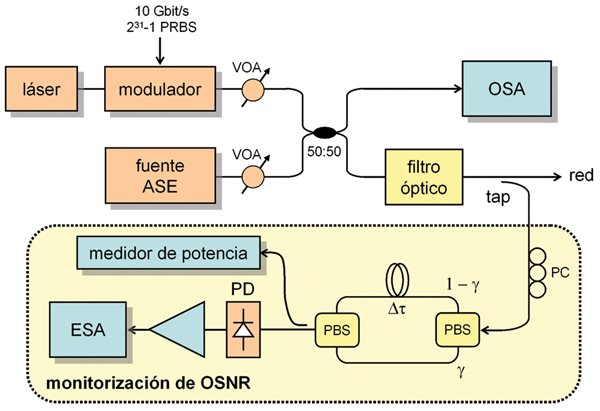
As already discussed, estimating the noise present within the modulation bandwidth is difficult because the signal components mask it. This is why measurements are sometimes taken at frequencies as low as 40-50 kHz. However, this is only valid for short data patterns; otherwise, the level of the signal components remains high. To avoid this, an experimental setup like the one shown in Figure 1 has been proposed. In this case, the signal to be monitored consists of a 10 Gbit/sa pseudorandom data sequence to which a variable noise level is added, achieved using an ASE source and a variable attenuator. A polarization controller is placed at the input of the monitoring block, and the signal is subsequently separated into its two orthogonal polarization components using a polarization beam splitter (PBS). One of these components is delayed with respect to the other, Dt, and they subsequently recombine before the photodetector, obtaining an electrical power level in the ESA given by:
 where g represents the power coupling factor in one of the interferometer branches (adjustable by means of the input bias controller), S(f) and R(f) are the power spectral components of the signal and noise, respectively, and f is the measurement frequency in the ESA.
From the above equation, it follows that the signal components can be eliminated when the following conditions are met:
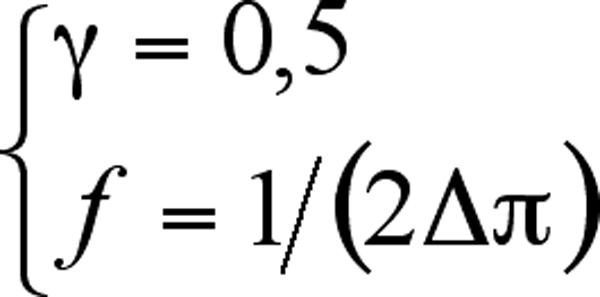 Therefore, this technique makes it possible to measure only the noise power within the modulation bandwidth, even for long data patterns such as the one used in the experiment: PRBS 231 – 1. Furthermore, the performance of the proposed technique is unaffected by the laser linewidth or bit rate, as it relies on the correlation between the optical signal and its delayed version, rather than on interference between them.
Figure 2 shows practical results of this monitoring technique (CJ Youn, et al., PTL, vol. 14, no. 10). Specifically, it shows the noise levels measured in the ESA as a function of the OSNR value for different signal powers. The 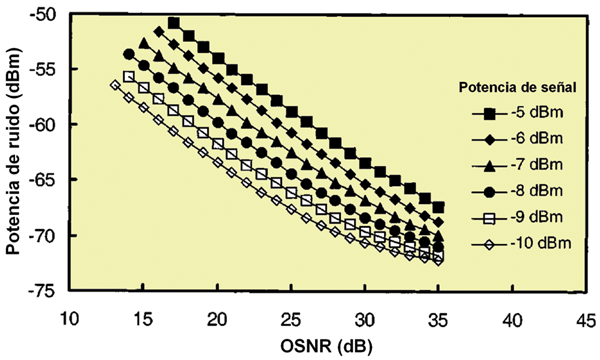 measurements were performed at a frequency of 8 GHz (Δt = 62.5 ps) and with RBW = 1 MHz. The measured noise power consists of two types of noise: ASE beats and thermal/shot noise. Beat noise is inversely proportional to OSNR, while thermal/shot noise has virtually no correlation with OSNR. Based on the results in Figure 2, it can be deduced that the dominant noise is ASE beat noise, and that OSNR can be estimated from the received noise measurement.
'
As an example, Figure 3 shows the OSNR results estimated with this technique for a 640 km WDM (8-channel) optical communications link consisting of 8 fiber segments of 80 km interleaved between 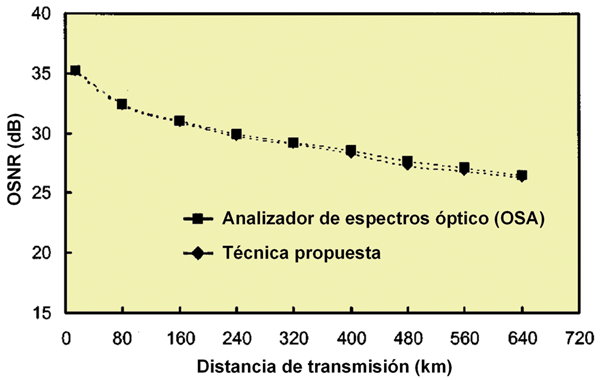 EDFA amplifiers.
The OSNR was monitored at the output of each fiber segment, observing the degradation it undergoes with link distance. Although the fiber's PMD (Premium Modulated Deflection) can affect the accurate estimation of the OSNR, it has been observed that the accuracy is better than 0.5 dB regardless of the link distance.
Monitoring in Optical Packet Networks:
The application of signal quality monitoring techniques, and specifically OSNR measurement, is beginning to be studied within the framework of optical packet networks. In this type of network, each packet must be considered an individual piece of information, which, as such, can travel different paths through the network and therefore suffer different levels of degradation. This is why monitoring mechanisms must be applied to each individual packet. However, the short duration of packets greatly complicates signal monitoring mechanisms.
To date, various techniques have been proposed, but the most interesting are those that use a monitoring field embedded within the packet itself. In our case, we will focus on OSNR monitoring techniques, which are our primary concern. These techniques consist of embedding a data segment of a specific length, which is then extracted at a remote node to monitor the OSNR. There is clearly a trade-off with the bit length of this field in terms of network efficiency and the accuracy of 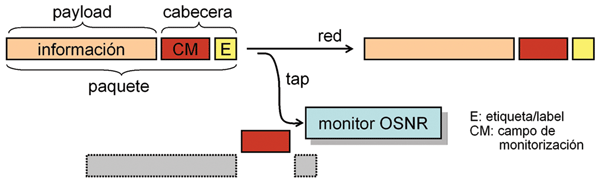 OSNR estimation. Figure 4 schematically represents the monitoring process in this type of technique. The operating principle of the monitoring block can be based on some of the techniques already presented, such as OSNR estimation by measuring RF noise. First, this block must extract the monitoring field, for which a Mach-Zehnder modulator can be used, fed with a square wave signal of the field's duration. At its output, the signal is photodetected, amplified, and applied
 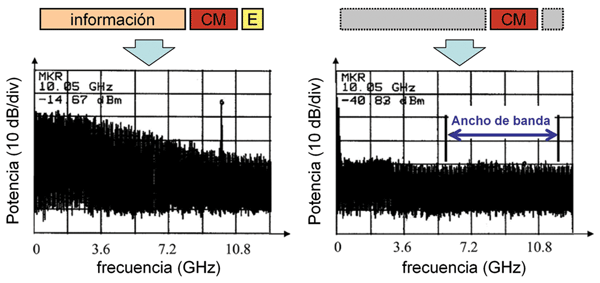 to an ESA to analyze the RF spectrum. The RF spectra of the monitoring field and the complete packet are shown in Figure 5. In this case, the monitoring field consists of 100 bits at level "1" (duration of 10 ns at 10 Gbit/s). From this spectrum, the OSNR can be estimated by calculating the RF noise power within a given bandwidth, since this noise power is directly related to both the OSNR and the received optical power.
Among the main advantages of this monitoring technique are:
- its immunity to interference caused by the header and the information carried by the packet, since the monitoring field is transmitted serially,
- its high sensitivity, given that there is a large bandwidth available where the noise can be integrated,
- and its ability to measure ASE noise in the same channel band, thus avoiding errors caused by extrapolation in the OSNR monitoring technique based on OSA.
Using this technique, errors of less than 0.6 dB have been observed in OSNR measurements of 16 to 27 dB in consecutive packets. Furthermore, its response time (around 10 ns) makes it a promising technique for quality monitoring in optical packet networks.
Francisco Ramos Pascual. Doctor of Telecommunications Engineering.
Full Professor at the Polytechnic University of Valencia.
E-mail: