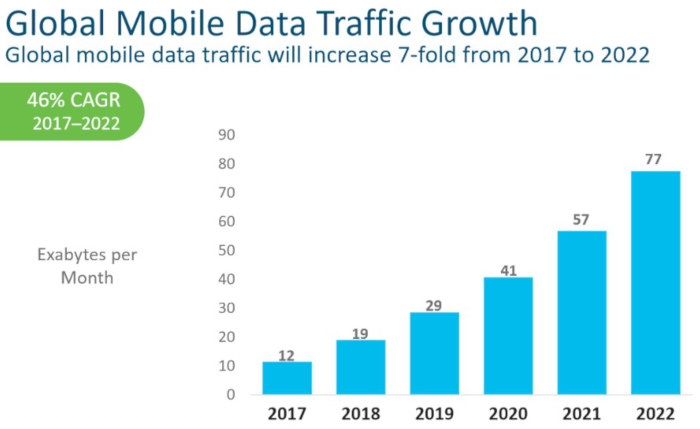
In Spain, mobile data traffic will increase sixfold between 2017 and 2022 (a 43% year-on-year growth rate), reaching 6.3 exabytes annually in 2022 (1 exabyte in 2017) and accounting for 12% of all IP traffic in the country (fixed and mobile).
Mobile technologies continue to connect more people and things than ever before. In 2017, there were 5 billion mobile users worldwide, but in the next five years this figure will increase by 700 million to reach 5.7 billion users, representing approximately 71% of the world's population. In Spain, there will be 41 million mobile users (88% of the population) in 2022, up from 40 million in 2017.
By 2022, there will be more than 12 billion mobile IoT devices and connections (compared to 9 billion in 2017). In 2022, mobile networks will support more than 8 billion personal mobile devices and 4 billion IoT connections.
In Spain, there will be 103 million mobile IoT devices and connections in 2022 (2.2 per capita), up from 63.7 million in 2017 (a 10% year-on-year increase). Mobile IoT connections will account for more than half (50.3%) of the total (51.8 million), up from 13.6 million in 2017 (21.3%).
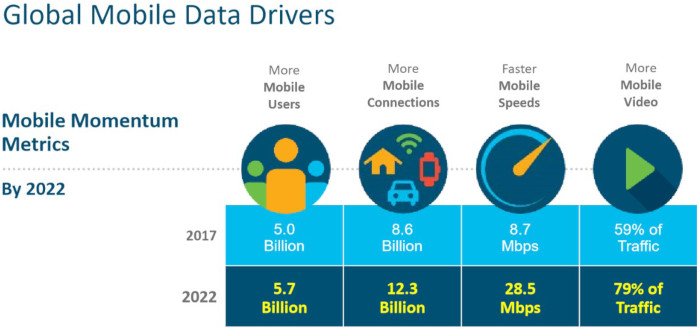
The updated report also highlights the ongoing efforts of mobile operators worldwide to improve mobile network performance. The average global mobile network speed will more than triple, from 8.7 Mbps in 2017 to 28.5 Mbps in 2022. Mobile speed varies significantly by geographic area, as 5G adoption begins to accelerate in some regions. In Spain, the average mobile network speed will more than quadruple, increasing from 15 Mbps in 2017 to 66.7 Mbps in 2022 (a 34.8% year-on-year increase).
Key predictions
: Share of 2G, 3G, 4G, 5G and LPWA connections.
In 2017, Low Power Wide Area (LPWA) networks supported 1.5% of all mobile devices/M2M connections (9.3% in Spain); 2G was responsible for 34% of global mobile devices/M2M connections (9% in Spain); 3G networks supported 30% of global mobile devices/M2M connections (35.7% in Spain); and 4G, 35% (46% in Spain).
By 2022, LPWA networks will support 14% of mobile devices/M2M connections (28.7% in Spain); 2G will be responsible for 8% of global mobile devices/M2M connections (2% in Spain); 3G will support 20% of global mobile devices/M2M connections (5.7% in Spain); 4G, 54% (58.7% in Spain); and 5G, 3% (4.9% in Spain), approximately 422 million 5G connections worldwide (5 million in Spain).
5G
connections will account for more than 3% of all mobile connections (over 422 million 5G devices and M2M connections globally) and almost 12% of total global mobile data traffic. In Spain, 5G connections will represent 4.9% of all mobile connections (5 million 5G devices and M2M connections) and 19.2% of total mobile data traffic in 2022.
By 2022, the average 5G connection (22 GB/month) will generate approximately three times more traffic than the average 4G connection (8 GB/month). In Spain, the average 5G connection (20 GB/month) will generate three times more traffic than the average 4G connection (6.7 GB/month) in 2022. In Spain, the average 5G speed (190 Mbps) will be more than 2.5 times faster than the average 4G speed (86.6 Mbps) in 2022.
WiFi: Offloading traffic from mobile (cellular) networks to fixed (WiFi) networks.
In 2017, the monthly offloaded traffic (13 Exabytes) exceeded the monthly mobile/cellular traffic (12 Exabytes).
In 2017, 54% of total mobile data traffic was offloaded (62% in Spain); by 2022, 59% of total mobile data traffic will be offloaded (71% in Spain).
In 2017, total global IP traffic (fixed and mobile) was divided as follows: 48% wired, 43% Wi-Fi, and 9% mobile. In 2017, total IP traffic (fixed and mobile) in Spain was divided as follows: 38% wired, 56% Wi-Fi, and 6% mobile.
By 2022, total global IP traffic (fixed and mobile) will be divided as follows: 29% wired, 51% Wi-Fi, and 20% mobile. By 2022, total IP traffic (fixed and mobile) in Spain will be divided as follows: 24% wired, 64% Wi-Fi, and 12% mobile.
Globally, the total number of Wi-Fi access points (including home Wi-Fi access points) will quadruple between 2017 (124 million) and 2022 (549 million). In Spain, the total number of WiFi access points (including those in homes) will quadruple between 2017 (4 million) and 2022 (16 million).
Mobile data traffic will increase sixfold between 2017 and 2022 in Spain
According to this year's (2017-2022) Cisco VNI Mobile forecast update, mobile traffic is poised to reach one zettabyte annually by the end of the forecast period. By 2022, mobile traffic will account for nearly 20% of global IP traffic, reaching 930 exabytes annually. This is almost 113 times the total global mobile traffic generated just ten years earlier, in 2012.
Unlabeled
-
Apollo and Alcatel-Lucent have announced an industry milestone: a successful demonstration of data transmission at approximately 3 terabits per second (Tbit/s), based on 40 Gbit/s channels, per fiber pair in a submarine network. Apollo is a...

-
Cloud-TM, the EU's cloud computing project, presents an initial prototype
After three years of hard work, the Cloud-TM (Transactional Memory) Platform prototype has been launched. This announcement marks the final stage of one of the largest cloud computing research projects in the European Union.
-
The M2M boom is driving massive growth in the value-added services market
The tremendous expansion of machine-to-machine (M2M) connections in the coming years will cause the market for services associated with value-added services (VAS) to expand by a factor of seven and reach $10 billion in 2017. -
WLAN monetization and 802.11ac, the most important Wi-Fi trends in 2015
Location-based services, social networks as user registration credentials between companies that provide guest access, or Hotspot 2.0 roaming consortia have been some of the most talked-about Wi-Fi trends during 2014.
-
Mateo Valero, awarded an ERC Advanced Grant, which is the most prestigious aid for a scientific project
The European Research Council (ERC) has awarded Mateo Valero, director of the Barcelona Supercomputing Center – National Supercomputing Center (BSC-CNS), an Advanced Grant in the physical sciences and engineering category for his project 'Riding on... -
How does coherent optics increase data speed? - Modulation and polarization multiply the data capacity in optical networks.
In the early days of optical networks, all optical signals relied on a simple mechanism known as on-off keying (OOK). Simply put, this mechanism works by turning a light on and off to transmit data. OOK is a broader term used to describe...
Newsletter
Latest News
Demonstration of free-space optical communication with PCSEL: a breakthrough from Vector Photonics
Vector Photonics, the Scottish start-up that is leading the way in the use of surface emission lasers with crystal...
AI for Good Global Summit 2026: Innovation and Leadership in Artificial Intelligence in Geneva
As governments accelerate their strategies on artificial intelligence, sovereign AI, and...
Iceland's Parliament modernizes its security with Genetec Security Center and IoT sensors
The Parliament of Iceland, Alpingi, one of the oldest democratic institutions in the world,...
Commvault strengthens data and AI security in Commvault Cloud with new governance and classification capabilities
Commvault has announced an expansion of its data security and AI capabilities within...
Vertiv powers AI factories with converged infrastructure alongside NVIDIA Rubin DSX
Vertiv has announced its key role in advancing physical infrastructure designs...
Subscribe to CONECtrónica magazine
You can subscribe to the Conectrónica magazine in 2 formats.
Digital Format: 5 downloadable PDF editions at an annual cost of 60 Euros (VAT included)
Paper Format: 5 editions to be received by mail at an annual cost of 180 Euros (VAT included).
Contact our subscriptions department at subscriptions@conectronica.com
Payment via Bizum or bank transfer
Technical Courses and Seminars
Cybersecurity and AI: risks, opportunities and keys to the new digital balance
Artificial intelligence multiplies both the sophistication of threats and the capacity to...
D-Link launches the 29th season of free webinars on networks, 5G and cloud
D-Link has announced that the 29th season of its D-Link Webinars begins tomorrow. These sessions...
Taoglas launches The Antenna Podcast, a new technical space about antenna design and innovation
Antennas remain one of the most critical and, at the same time, most misunderstood elements in...
ISE 2026 Barcelona: Summits, Megatrends and the most ambitious content program in the AV sector
Returning to Barcelona in February 2026, Integrated Systems Europe (ISE) presents its program of...
E-book: the future of satellite communications
Mouser Electronics, Inc., in collaboration with Qorvo and other technology innovators...
Optical Networks
Evolution of optical networks: ROADM, OpenROADM and OpenZR+ in the 400G and 800G era
The rapid increase in data traffic is driving the construction of new infrastructure worldwide...
Legrand launches Chroma Link, the fiber optic solution for high-density AI networks
Legrand has announced the launch of Chroma Link™, a fiber optic cabling solution with...
Hollow Core Fiber (HCF) Deployment and Testing
Hollow Core Fibers (HCF) represent a significant evolution...
Network infrastructure in the age of AI: why fiber optics is key beyond bandwidth
New requirements for network infrastructures: why, in the age of AI, fiber optics...
Nokia drives optical networks for the AI era with new coherent solutions and multi-fiber amplifiers
Nokia has announced a suite of new optical network innovations designed to address...
Fiber optic network testing in hyperscale data centers: keys to ensuring performance and reliability
Hyperscale data centers represent the backbone of the digital infrastructure...
High-Speed Network Demands: Architectures, Challenges and Technological Evolution in the Era of Exponential Traffic
The rapid growth of IP traffic, driven by applications such as 4K/8K video, computing...