In traditional seismology, researchers studying how the ground moves in the moments before, during, and after an earthquake rely on sensors that cost tens of thousands of dollars to install underground. Because of the expense and labor involved, only a few seismic sensors have been installed in remote areas of California, making it difficult to understand the impacts of future earthquakes, as well as small earthquakes that occur on unassigned faults.
Now, researchers at the U.S. Department of Energy’s Lawrence Berkeley National Laboratory (Berkeley Lab) have discovered a way to overcome these obstacles by converting portions of a nearly 13,000-mile-long “dark fiber” testbed, owned by the DOE’s Energy Sciences Network (ESnet), into a highly sensitive seismic activity sensor that could potentially boost the performance of earthquake early warning systems currently being developed in the western United States. The study detailing the work, the first to employ a large regional network as an earthquake sensor, was published this week in Nature Scientific Reports.
Shaking up seismology with dark fiber.
According to Jonathan Ajo-Franklin, a staff scientist in Berkeley Lab’s Earth and Environmental Sciences Area who led the study, there are roughly 10 million kilometers of fiber-optic cable worldwide, and about 10 percent of it is dark fiber—relics from the dot-com boom when telecom companies rushed to install vast underground cable networks to meet the demands of a burgeoning new industry. As data transmission technology improved, however, fewer cables were needed, leaving behind a legacy of dark fiber without light, waiting to be used.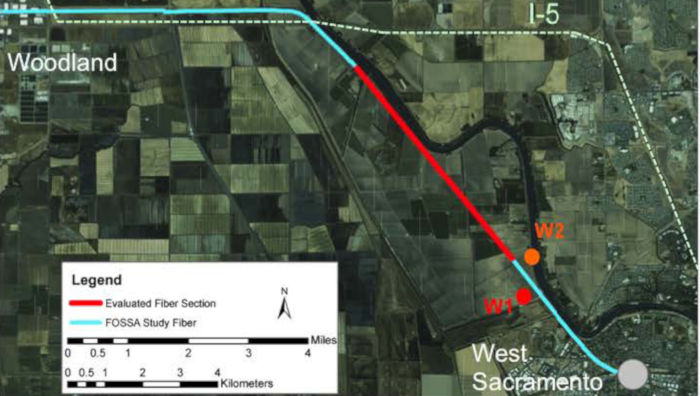 The Ajo-Franklin group has been working on this type of experiment for several years. In a 2017 study, they laid a fiber-optic cable in a shallow trench in Richmond, California, and demonstrated that a new sensing technology called distributed acoustic sensing (DAS) could be used to image the shallow subsurface. DAS is a technology that measures seismic wave fields by firing short laser pulses along the fiber. In a follow-up study, they and a group of collaborators demonstrated for the first time that fiber optic cables could be used as sensors to detect earthquakes.
A research team led by Jonathan Ajo-Franklin of Berkeley Lab conducted its experiments on a 20-mile segment of the 13,000-mile-long ESnet Dark Fiber ESB that stretches from West Sacramento to Woodland, California. (Credit: Ajo-Franklin/Berkeley Lab)
The current study uses the same DAS technique, but instead of deploying its own fiber optic cable, the researchers conducted their experiments on a 32-kilometer segment of a nearly 21,000-kilometer-long ESnet dark fiber testbed that stretches from West Sacramento to Woodland, California. "To further verify our results from the 2017 study, we knew we would have to conduct the DAS tests on an actual dark fiber network," says Ajo-Franklin, who also heads the Department of Geophysics at Berkeley Lab.
"When Jonathan told me about using our dark fiber testbed, I didn't even know it was possible to use a network as a sensor," says Inder Monga, Executive Director of ESnet and Director of the Science Networking Division at Berkeley Lab. "No one had done this work before. But the possibilities were tremendous, so I said, 'Sure, let's do it!'"
Chris Tracy of ESnet worked closely with the researchers to work out the logistics of the deployment. Telecommunications company CenturyLink provided fiber installation information.
Because the ESnet Testbed has regional coverage, the researchers were able to monitor seismic activity and ambient noise in greater detail than in previous studies.
“The coverage of the ESnet Dark Fiber Testbed gave us images of the subsurface at a higher resolution and on a larger scale than would have been possible with a traditional sensor network,” says co-author Veronica Rodriguez Tribaldos, a postdoctoral researcher in Ajo-Franklin’s lab. “Conventional seismic networks often employ only a few dozen sensors spaced several kilometers apart to cover such a large area, but with the ESnet Testbed and DAS, we have 10,000 sensors in a line with a two-meter spacing. This means that with a single fiber optic cable, you can collect very detailed information about the soil structure for several months.”
Deep Digging for Underground Data: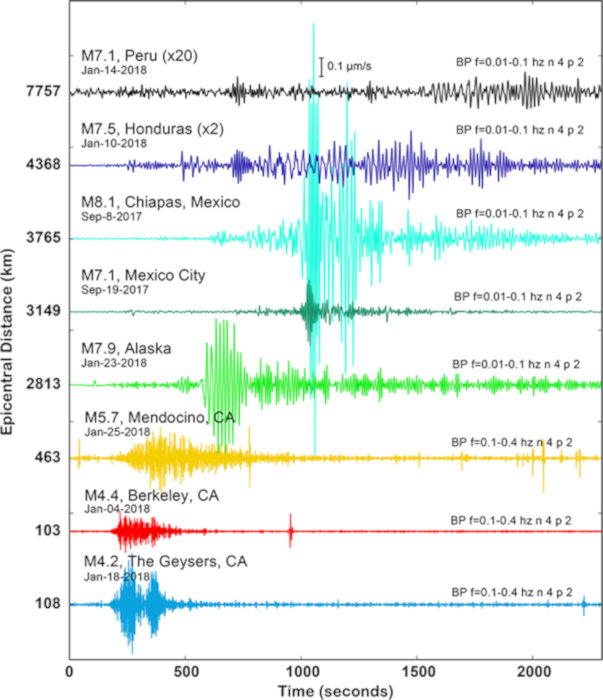
By combining DAS technology with dark fiber, researchers at the Berkeley lab were able to detect local and distant earthquakes, from Berkeley to Gilroy, California, to Chiapas, Mexico.
After seven months of using DAS to record data through the ESnet Dark Fiber Testbed, the researchers demonstrated the numerous benefits of using commercially available fiber. “By listening for just 40 minutes, this technology has the potential to do approximately 10 different things at once. We were able to capture very low-frequency waves from distant earthquakes, as well as the higher frequencies generated by nearby vehicles,” Ajo-Franklin said. The technology allowed researchers to differentiate between a moving car or train and an earthquake, and to detect both local and distant earthquakes, from Berkeley to Gilroy and Chiapas, Mexico. The technology can also be used to characterize soil quality, provide information about aquifers, and be integrated into geotechnical studies, she added.
With such a detailed picture of the subsurface, the technology has potential for use in time-lapse studies of soil properties, Rodríguez Tribaldos said. For example, in environmental monitoring, this tool could be used to detect long-term changes in groundwater, permafrost melting, or the hydrological changes involved in landslide hazards.
The findings of the current study also suggest that researchers may no longer have to choose between data quality and affordability. "Cell phone sensors are inexpensive and tell us when a large earthquake is happening nearby, but they won't be able to record the subtle vibrations of the planet," said co-author Nate Lindsey, a UC Berkeley graduate student who led the fieldwork and earthquake analysis for the 2017 study. "In this study, we show that inexpensive optical fibers pick up those tiny ground movements with surprising quality.".
With 300 terabytes of raw data collected for the study, researchers have been challenged to find ways to effectively manage and process the "fire hose" of seismic information. Ajo-Franklin expressed hope to one day build a seismological data portal that combines ESnet as a sensor and data transfer mechanism, with long-term data analysis and storage managed by Berkeley Lab's supercomputing facility, NERSC (National Center for Scientific Computing for Energy Research).
Monga added that even though the dark fiber testbed will soon be lit up for the next generation of ESnet, dubbed "ESnet 6," there may be sections that could be used for seismology. "While it was completely unexpected that ESnet, a transatlantic network dedicated to research, could be used as a seismic sensor, it fits perfectly with our mission," he said. "At ESnet, we want to enable scientific discovery without geographical constraints."
The research was funded by the Laboratory-Led Research and Development Fund with prior research supported by the Strategic Environmental Defense Research Program (SERDP), U.S. Department of Defense.
ESnet, a DOE Office of Science user facility, is a high-performance, unclassified network created to support scientific research. It is operated by the Berkeley laboratory.